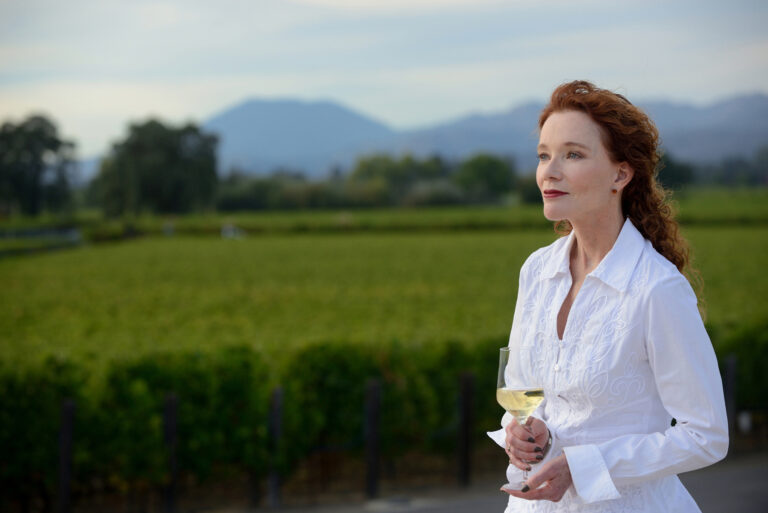
June 9, 2023 – To fully digest and even quote chapter and verse from Karen MacNeil’s nearly 900-page tome, The Wine Bible, now in its Third Edition with almost one million copies sold internationally, would take years. But that was not the aim of her book. She spent 10 years researching and writing her book in the 1990s to fill a publishing void she identified. “Most wine books at the time were ‘intellectually daunting.’ If you didn’t already know a lot about wine, you’d read one page and were exhausted. There would be 10 concepts and 20 terms you didn’t know,” Karen said to Chaîne during a May 9 telephone interview. Instead, Karen decided she would embed interesting stories to expand readers’ knowledge of wine by learning fascinating nuggets of associated history and culture.
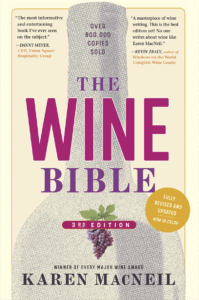
“I think wine should not be divorced from culture, gastronomy, art, history and religion,” she said.
The late Peter Workman, founder of Workman Publishing, asked Karen to write a food book in 1990 after reading an article (on lobster rolls and summer sandwiches!), which she had written for The New York Times. She agreed, but with one change. She wanted to write a book about wine. It was the chance of a lifetime, but also an overwhelming challenge. The Workman offer included a small advance which sustained her for a few months. What followed were many years of self-funded research, tasting, and traveling to wine regions around the world. But it was also a process of “falling in love with wine” over and over again, she explained.
Born in Boston, Karen spent her teenage years in Nevada after her family moved there. In high school, she didn’t take typing because she was afraid she’d be sidelined into a career as a secretary. Her passion was for a career in wine and food.
“Maybe it’s unusual but I honestly never considered anything else. Even as a young child, I loved food. I loved the way that food revealed culture. And the way that food brought people together in the most communal and beautifully natural way,” she said. Wine was the logical extension of that passion.
Taking Peter up on his offer, without any formal writing or typing classes, she sat down at her electric typewriter in her apartment in New York City to begin a literary journey that has now lasted more than three decades. It was a labor of love. “Wine is not a thing, like a stereo you put up on your shelf. It is a living entity,” she said. “You can participate with Nature every single day by drinking wine. You don’t have to be wealthy. You don’t have to do anything. Wine is simply an incredible gift to mankind.”
“When you’re a writer, you can ask someone almost anything and really get to know someone or something very well. For me, writing became a way of being lucky enough to be a constant student. To write well, you had to research. I love learning. I’ve always also loved words,” she said.
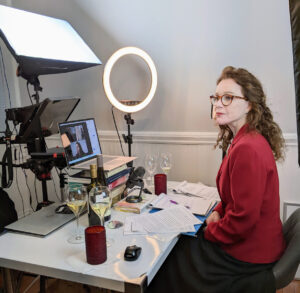
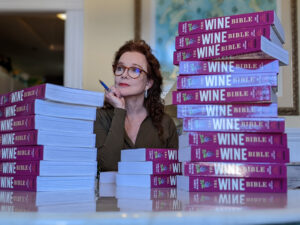
Key to her success, Karen embraces big projects that have not been done before. At the time, no American author had tackled a big wine book and certainly not from the holistic perspective Karen had formulated. Similar to an archaeologist, she began digging into the wines and history from well known, and some not so well known, Old World and New World wine regions.
Perched in front of her typewriter for years, her manuscript steadily grew to 4,000 pages as the new Millennium approached. A key innovation she devised early on has been a key to the book’s ongoing popularity. Her comprehensive approach to content inspired her to create text boxes within her narrative text so that her readers could easily and quickly learn fun facts about the wines and wine regions being discussed.
Today it’s a common literary device and essentially the idea under the Windows operating system with different windows for different functions. Karen also adopted a conversational style of wine writing. “For a book in the 1990s, it was unusual,” Karen said. “For 25 years, people have told me that what they love most about the book is the feeling that they are in a room with me and I’m telling them the story of wine.”
And what a story she has told! Karen is the only American to have won every major wine award given in the English language, including the James Beard award for Wine and Spirits Professional of the Year; the Louis Roederer award for Best Consumer Wine Writing; and the International Wine and Spirits award as the Global Wine Communicator of the Year.
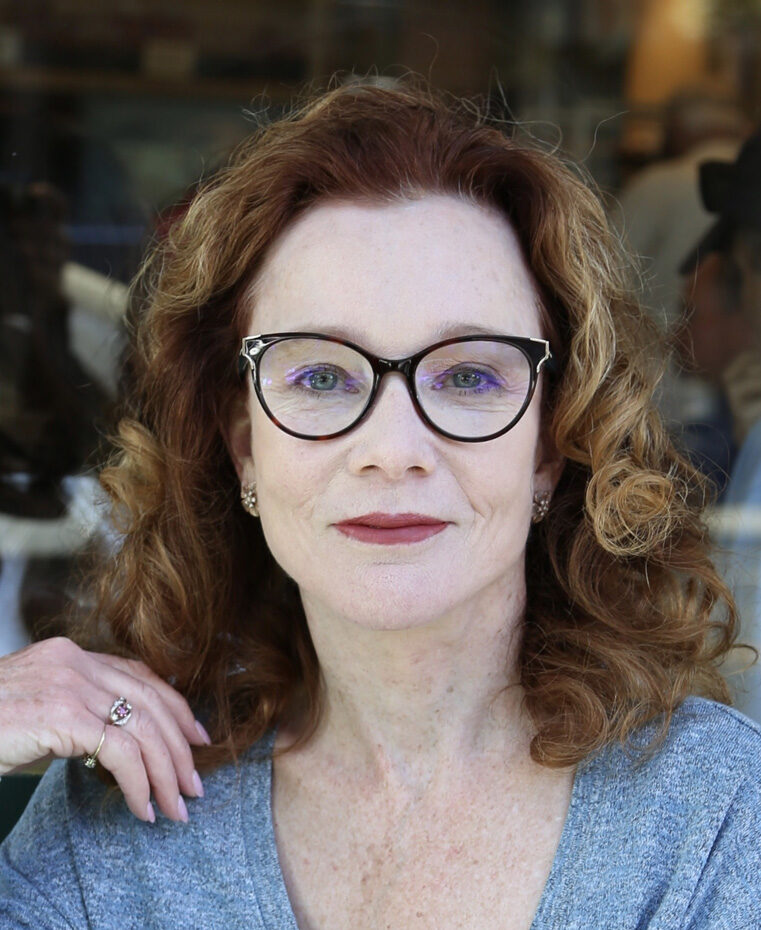
Because her book is organized geographically by countries, readers can quickly find their pertinent section with a plethora of information and insights into the wine and culture of the area. That includes the United States where a nascent wine industry and culture, rooted primarily in California in the 1970s and 1980s, blossomed over the next 50 years with wineries now in every state.
“I think organizations like the Chaîne have a wonderful opportunity to encourage young people to develop a lifelong love and connoisseurship of wine. We all know how ‘rich’ life is when great wine is a part of it. The Chaîne and other organizations can “pay this forward,” helping to ensure a thriving culture of wine and food in America,” Karen said.
A quick perusal of Karen’s book is a case in point. Just browsing the pages of the 2001 First Edition for a few minutes, one learns that:
|
Especially for wine neophytes, all of the above are examples of what is known in the television industry as an IDNOT – or “I didn’t know that.” Karen said she has appeared on television and learned that expression, which influenced her goal to have people learn from her book with IDNOT facts to add context and fun to the more intellectual, “dry” information about wine and wine regions.
For Karen, wine and food are one and the same.
“Most wine regions are very good food regions because generally speaking, people who love flavor love flavor—it doesn’t matter if that flavor is solid (food) or liquid (wine),” she said.
In regard to wine and food pairings, Karen acknowledges certain classic pairings but dismisses the notion that certain foods require a certain wine. “We don’t need food-and-wine police,” she remarked. “By and large, it’s more important to pair wine with mood than with food. I know that’s heresy but the truth is, both food and wine are based on providing pleasure, and pleasure should not be dictated. Pleasure should be very individual.”
That said, one of her most memorable food and wine pairing experiences was one she vividly recalls. “The flavor experience I will never forget happened at The French Laundry more than 20 years ago. Chef Thomas Keller cooked the meal. I had a White Burgundy Premier Cru with his dish of agnolotti and summer corn in a cream sauce. It was just heaven,” she said.
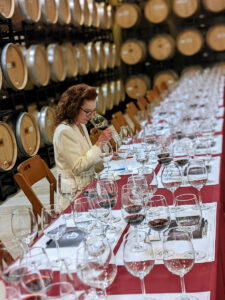
A refined palate is at the foundation of such an experience. The good news is Karen believes food and wine aficionados can acquire it. “I don’t think wine is like music. I don’t think there is an equivalent to someone who has perfect pitch. Most of us either teach ourselves or are taught to have a good palate. It takes diligence, time, and repetitive tasting, but almost anyone can develop their palate.”
Karen said the 10,000 rule applies in this case. To be an expert at anything, with few exceptions, one needs to practice 10,000 times whether it’s wine tastings or making widgets. On the faculty of both the CIA and Stanford University, Karen has definitely achieved expert status in wine.
To support wine education, Karen and her company offer a free weekly digital newsletter called WineSpeed that has 40,000 subscribers. It’s packed with tidbits of fascinating information about wine, wine recommendations, fun wine quizzes, exceptional wine events, wine advice and more—in fact, just about everything a wine lover could want except a bottle of wine itself.
Karen’s outlook on life is one of being a lifelong learner – and writer.
“Good writing is not easy to do. And so, a little bit like wine, you never get there. You’re just always in the process of becoming more knowledgeable about wine and a better and better writer as time goes on,” she said.
The Wine Bible is certainly a testament to that wisdom.
LINKS