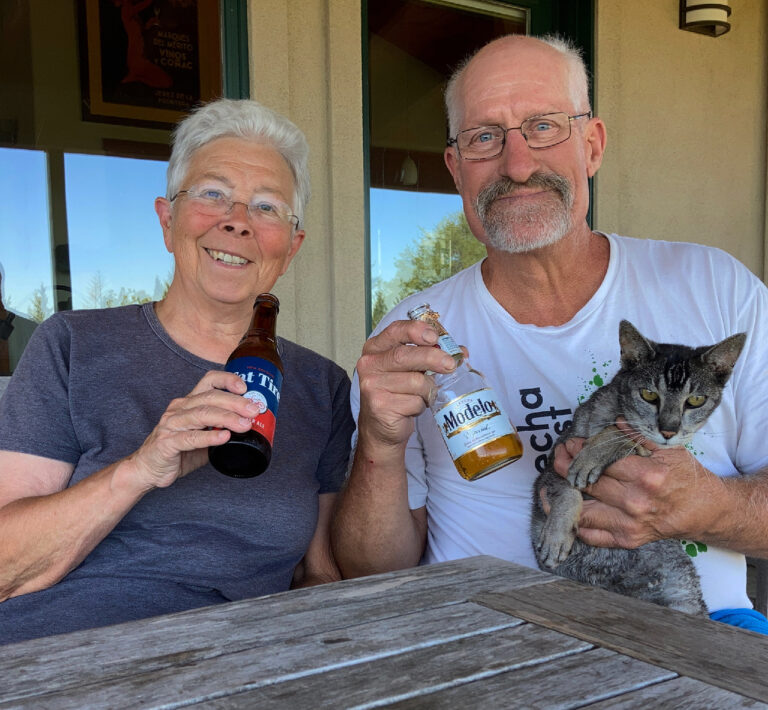
Sept. 3, 2021 — Do you know the parents of the Chardonnay grape? Did you even know the Chardonnay grape, and all grape varieties for that matter, have parents? Carole Meredith, professor emerita at the University of California at Davis, co-founder and co-owner of Lagier Meredith Vineyard in northern California and 2009 inductee into the Vintners Hall of Fame, does. In 1997, she and her genetics research team at the university discovered, with a little sip of serendipity, that Chardonnay’s mom is Gouais blanc and Chardonnay’s dad is Pinot noir. “That was a wonderful discovery,” Carole said during a March 2, 2021 telephone interview with Chaîne.

Carole’s esoteric work as a grape geneticist and sequence sleuth from the 1990s through 2003 rivals that of Sherlock Holmes, Nancy Drew and James Bond all rolled into one. At least those famous sleuths had other cases from which to draw inspiration. Carole and a few other scientists around the world had to make their case that advances in the 1990s in DNA technology used to solve crimes could also be instrumental in determining identities of wine varieties. The idea represented a bold and daring leap, one that proved prescient and practical as winemakers were able to confirm their varieties.
Finding grape DNA markers naturally leads to delving into history too. Carole explained the Gouais blanc variety, Chardonnay’s mom, originated in central Europe and was most likely brought to France during the Roman era.
After Carole’s years as a genetics sleuth, she retired from academia in 2003 to devote full time to the vineyard she and her husband, Steve Lagier, planted on Mount Veeder in the Napa Valley after purchasing the land in 1986.

Few vineyard owners can walk their vineyard as Carole can with such deep understanding of their fruit.
Human and Grape DNA
With 23 chromosomes made up of 3.2 billion base pairs of A-T (adenine and thymine) and C-G (cytosine and guanine) nucleotides, humans are vastly similar but also different to the point that relationships can be deduced simply by matching DNA segments, or markers.
Carole pondered that application to confirming the identity of grape varieties being grown in New World countries from Old World cultivars that may have been present in Europe for thousands of years. She explained that names of grape varieties were often lost when vines were transported to other parts of the world. The only way to prove a grape being grown in a New World country, such as Australia, the United States, New Zealand and Argentina, is an authentic Old World cultivar is proving its genetic identity.
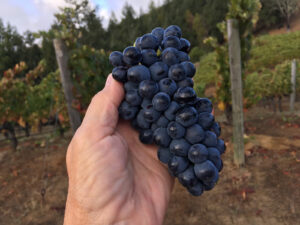
In the 1990s, her research lab at UC Davis began the laborious work of identifying DNA markers in grapes, sequences of the same base pairs present in human DNA. It’s an area of research historically not well funded but one she felt would provide valuable scientific knowledge and practical application to vintners and the wine industry in general.
“Our initial thought was that if we could develop genetic markers for grapes similar to the kind of genetic markers that were being used in humans, that we could use those markers to try to match a New World grapevine to a proposed Old World counterpart,” Carole said.
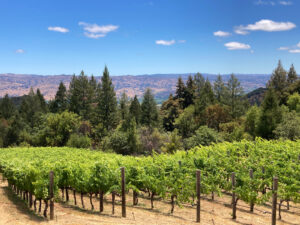
She and her research team began sequencing grapevine DNA to identify regions on the grape genome that would be useful to deduce relationships. They approached it methodically by following a step-by-step process that became increasingly more sophisticated.
After referencing authentic Old World samples, they first discovered a California grape being grown as Pinot blanc was actually Melon de Bourgogne. While UC Davis had a reference collection of European grapevines, it did not include Melon so they obtained one from French colleagues to match the markers between the two samples.
After identifying this grape variety, they expanded their efforts to look at relationships. Carole is quick to point out that research labs in Australia and Vienna were also developing grape genome markers at the same time. The labs agreed to share results to advance the science more quickly.
Having developed a small number of genetic markers, Carole’s lab made an exciting discovery about the parents of the Cabernet sauvignon grape. Its mom was Sauvignon blanc and its dad was Cabernet franc. To prove the relationship, her team tested their findings with robust statistical tools to determine not only that was it possible but also it was probable that the grapes were a family. Similar to a court of law, Carole said they proved the relationship “beyond a reasonable doubt.”
With these successes and most likely a few toasts of Cabernet sauvignon and Chardonnay for their efforts, they kept advancing the science. In the late 1990s at a meeting of the International Plant and Animal Genome Conference, held annually in San Diego, Carole proposed a consortium of international researchers to share their results. After legal documents were signed, 20 entities participated in expanding the grape genome marker database. Through their collaboration, the consortium identified more than 400 markers for grapes.
John Bowers, one of Carole’s graduate students, wrote his doctoral dissertation in 1998 after working in France with Jean-Michel Boursiquot, an internationally known expert in cultivated grape varieties, to identify genetic relationships among grape varieties associated with northeastern France. John found the parents of 26 varieties, including the Chardonnay grape.
Carole and her team made a few landmark discoveries early on in the partnership. Eventually the consortium, called the Vitis Microsatellite Consortium, identified enough genetic markers to develop a genome map of a grape. The map is not an entirely sequenced genome but a linear arrangement of hundreds of genetic markers along the 19 chromosomes grapes have. It’s useful in identifying and isolating genes and is still relevant today. “Having a genome map is a necessary prerequisite to isolating genes,” Carole said.
Lagier Meredith Vineyard
During this time, Carole had the perfect location when she needed a break from her laborious yet exciting lab work. In 1986, she and Steve purchased 84 acres of mountainous property in the Napa Valley. Steve has been a winemaker for 40 years, leaving Robert Mondavi in 1999 as their own business developed.
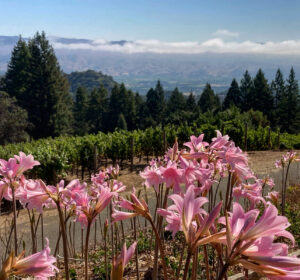
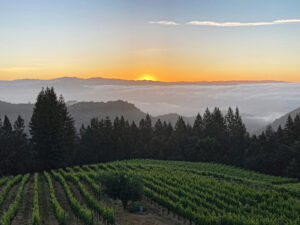
The legal definition of the Napa Valley American Viticultural Area (AVA) includes surrounding mountains. At 1300 feet above sea level, their property is not high enough for elevation to be a major factor in growing grapes but its shallow mountain soil is a key factor, Carole said. Shallow soil can only hold a minimal amount of water and nutrients so the vines are not excessively vigorous, she explained. Because the vines are not vigorous, the grapes are smaller but not shaded so they develop deep color with complex flavors. It took Carole and Steve eight years to prepare about four acres of land for their vineyard.
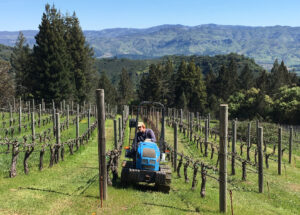
Their location near San Francisco Bay allows marine air to bask the vineyard in cooler air, which allows the grapes to ripen more slowly than vineyards in warmer locations. Their knowledge of grapes and wine led them to believe their vineyard would produce great wine but they did not set out to open a commercial winery. They wanted to produce wine to enjoy. After planting their first vines in 1994, they added other grape varieties. Their 1998 vintage, released in 2000, was their first commercial vintage following rave reviews of their wine through word of mouth. Today they produce a total of 800-900 cases with four varieties with marketing efforts focused on social media.
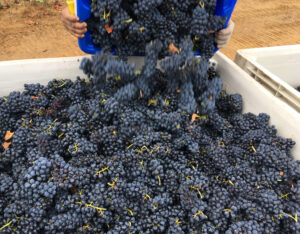
Carole commuted back and forth between UC Davis and Napa but as the business blossomed, she was stretched too thin and decided to retire from academia in 2003 but certainly not from work. She is the first to admit growing grapes and making wine involves a lot of work but it’s a life she and Steve embrace wholeheartedly. They have not taken a vacation in 20 years. Standing in their vineyard overlooking the Napa Valley is a vista they love each and every day.
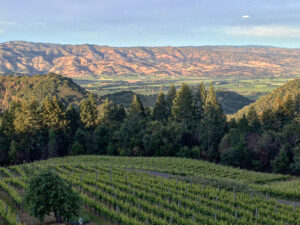
Their daily life is their vacation. She enjoys being her own boss but most of all, Carole said making a living off the land, a tradition vintners have done for hundreds and even thousands of years, is very rewarding.
Informed decisions, along with serendipity that has followed Carole since her genetic sleuthing days, have helped them recently through wildfires and the pandemic. When they built their house on the property, they used fire resistant materials and have kept the brush low and cleared away from the house. A devastating set of wildfires in 2017, called the Wine Country fires, encircled their house but stopped when the fire ran out of fuel – brush. The 2020 wildfires did not affect them but they are looking ahead.
“Now we’re just preparing for the next one and there will be a next one,” Carole said.
Although they sell a small amount of wine to restaurants, most of their business has been and remains direct-to-consumer, a definite advantage during the pandemic. It was another sip of serendipity when they decided to produce their first commercial vintage in 1998 just as the internet was redefining retailing. They became early adopters and now have a full eCommerce platform. The pandemic had no effect on their business. “We’ve been very, very fortunate in that regard,” Carole said.
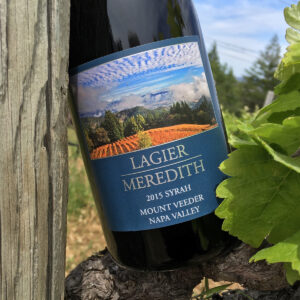
There is no need for a sleuth to unravel the mystery of why Lagier Meredith wines have had a loyal following for many years. With their hands-on, heads-up and hearts-in approach and their deep understanding of the fruit, the soil, the climate, the winemaking process and the business, Carole and Steve have the unique combination to unlock the potential of those grape genetic markers Carole identified in her lab years ago.
“It’s very, very satisfying to have bought this property and to have initially started with the idea to just make a little wine for ourselves and then finding that people liked it,” Carole said.
Links
University of California at Davis Department of Viticulture and Enology