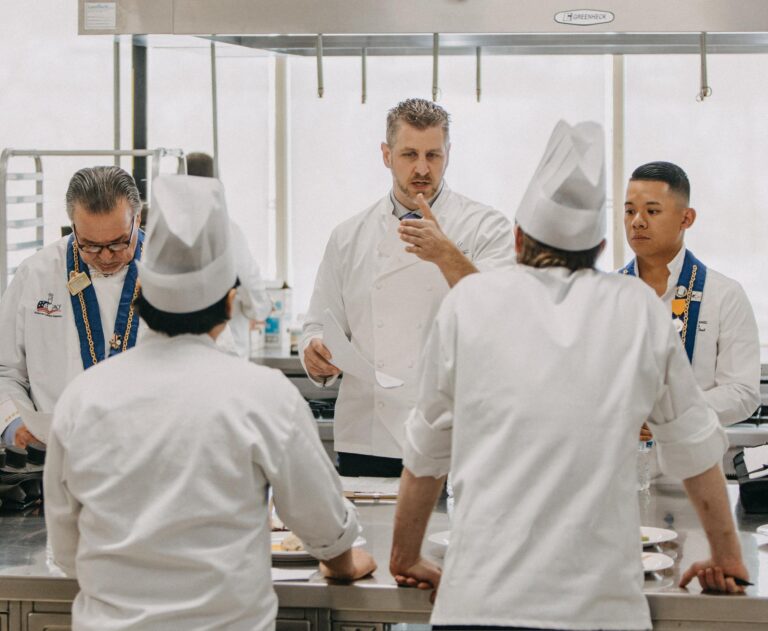
Aug. 19, 2023 – The road to reaching the pinnacle of the culinary profession, passing the arduous exam to become a Certified Master Chef (CMC), is not only a long and winding one but also one dotted with detours, construction zones, rest stops to reenergize, and a myriad of exits to explore before arriving at the destination. Even with a virtual navigator guiding the journey, AI will never be the exclusive route to an elite CMC certificate. Master Chefs get their hands dirty, pour their hearts and souls into their profession, and naturally bond with each other. A computer will never be able to replicate a chef’s dogged determination to succeed and their esprit de corps. “I decided I was going to work however long it took, however hard it took, to become a Master Chef,” Chef Gerald Ford, CMC and Chaîne Professional member, said to Chaîne during an Aug. 14, 2023 telephone interview.
Similar to many accomplished chefs, Gerald credits his love of cooking to his family who lived in Dearborn, Michigan. “I was blessed with being born into a German-Polish family. I really came to love food at an early age. That was how our family interacted,” he said.
Describing himself as curious and mischievous, he said he would pester his grandma to let him help her make Perogies and pies. He quickly deduced that since he liked to eat, it would be beneficial for him to learn how to make food that tasted so good.

With a nurturing family, one of his uncles who was an engineer with a passion for food took him under his wing. They started going to food markets together and not just to browse. His uncle tasked Gerald with the job of searching through cookbooks for recipes they could prepare together for family dinners. They would spend the night before prepping what could be made ahead of time, such as filling for stuffed wantons. “I liked to get my hands dirty and always liked to be involved in as much as humanly possible,” he said. “I started there.” Just 12 years old, his uncle – and mom and grandma – poured the strong foundation for Gerald’s future career.
Henry Ford College
As he grew from a curious, mischievous youth to a curious, mischievous teenager, his wise mother enrolled him in weekend cooking classes at Henry Ford College in Dearborn. While the class was primarily for older couples to learn how to cook a variety of foods, Gerald immensely enjoyed the experience because of his instructor. Master Chef Ed Janos who demonstrated how to roast a chicken, make mashed potatoes and the elusive perfect gravy. “It was awesome,” Gerald said. “I love my mom but she knows how to dry out a chicken. I love my grandma but she knows how to make really lumpy, sticky gravy. None of those things happened at the class.” And it was not just the perfect food.
Chef Janos had the “it” factor, which to a 14-year-old teenager was beyond cool. “I remember his swagger. He had that chefly swagger where he was talking about the juices on the cutting board being the tears of the customers who didn’t get to eat them,” Gerald vividly recalls. “That’s where I needed to go. I got the bug.”
As a freshman at Edsel Ford High School, his mother nudged him to enroll in home economics classes even though he thought the path was just for girls. But his mother again wisely guided her son. Even though he did not understand it at the time, it was the correct choice. And he learned to sew in addition to making cookies that he had been making for years at home!
Recognizing his potential, his teachers and counselors placed him in a program that had students split their time between core curriculum classes at Edsel Ford and culinary classes at Fordson High School, the district’s vocational school. Some course credits at the vocational school transferred to credits at Henry Ford Community College so Gerald was well on his way.
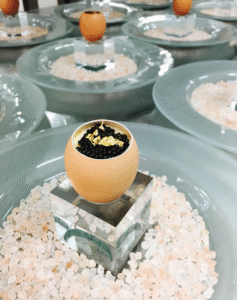
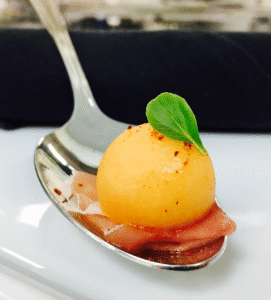
Tall for his age, Gerald said he was able to “weasel” his way into doing things he may have otherwise not been able to do. At 16 years old, he began volunteering to work at college events. At one event, the chef from the Ritz Carlton Hotel offered him a job on the spot so his choice for college was an easy one. He enrolled in Henry Ford Community College to earn his associate’s degree and continued working at the Ritz Carlton. Automotive executives from around the world attended events held at the Ritz Carlton so Gerald combined his college courses with real world experience at one of the top hotels in the region. “I was learning at a very accelerated rate and applied that knowledge rapidly,” Gerald said.
Culinary Institute of America (CIA)
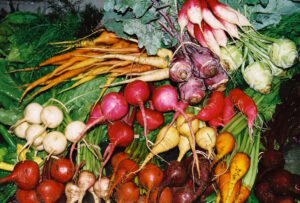
Taking stock of his career options in the Detroit area and the path other Michigan Master Chefs had followed, he determined his next move had to be to New York to attend the Culinary Institute of America (CIA). “Early on I realized I needed to get out of Dearborn to expand my culinary career to be successful,” he said. So he mischievously told his mother he was going to New York to visit some friends but in reality, he went for a CIA interview and was accepted.
Humble to his core because of his family and his Midwest roots, Gerald approached his CIA years with a yearning to learn and not a pinch of arrogance about how he already knew his way around a commercial kitchen. Admittedly a tad bit cocky as most 20-year-old young men are, being cocky and humble simultaneously was a perfect combination for him to succeed at the CIA. “It felt like home. It’s the most comfortable I’ve ever been,” he reflected.

While at the CIA, Gerald embraced additional challenges to the rigors of the curriculum by competing in a Chaîne’s Jeunes Chefs Rôtisseurs competition. He won the Northeast Province title and then competed at the national level, learning the concept of “Mise En Place” in real time. The phrase literally translates to “everything in its place” but Gerald explains that it changes as chefs mature. “Mise En Place just graduates as you grow. Competition, for me, helped me look at all of that in snapshots before it was actually time for it to be my full responsibility.” Mise En Place “everything” included how to pack food that could travel and how to write a menu he could produce anywhere. That type of thinking as a young chef has benefits down that long, winding road to master chef certification. “That’s the cool part. It exponentially grows your skills,” he said.
Always up for the next challenge, Gerald also competed in and won the 2001 Les Amis d’Escoffier competition in New York City. Because of this achievement, Gerald was able to spend seven weeks in France working at the three-Michelin-starred Moulin de Mougins in Mougins. He approached his time in France with humility and an open mind as he did entering the CIA. Asking “Qu’est-ce que c’est” (“What is that?”) took him on fun adventures while there. “I’m a big guy. I look like an American. As long as I had the curiosity and willingness to speak French, I was met with nothing but kindness and pleasantness,” he said. He knew he had to go back to France to learn more at some point in his career.
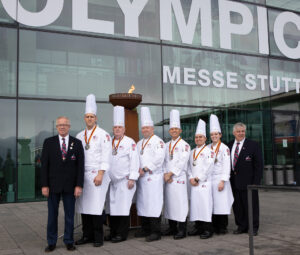
France
That opportunity came after he returned to the CIA where he earned a Bachelor of Science in Hospitality Management. Now armed with a degree from Henry Ford College, two CIA degrees and years of culinary cooking experience in commercial kitchens, he moved to France where he worked for about two years. When asked what he brought back from France after that experience, he said it was a twofold appreciation of first, the French culture that lives for food and second, the highest quality product with a deep respect for it.

“That was the first time I was faced with a duck that needed to be plucked. And getting to eat it was unbelievable,” he said. He learned to handle it in the most respectful manner, a practice he has seen all over the world except in the United States. “If I had to gripe about anything at this point in my career is the fact that most people don’t understand to respect the food that they cook.”
As the Chef at Château Robert in the village of Montgaillard in southwest France, Gerald made many friends. Duck farms proliferate in that region. He recalls a friend’s mom preparing foie gras from a freshly slaughtered duck. He watched as she made a fresh foie gras pie with perfect pastry, an experience he cannot put into words even to this day except to say it was a “life changing” experience. Other meals he shared with friends and their families were “just out of this world.”
“It was food and community and family like I hadn’t experienced since I was a little kid at home but at a whole other level,” he said.
Master Chef Certification

After his two years in France, he returned to the United States where he had to navigate a few detours both personally and professionally. He likes to think of these times as “failing my way forward” in that he was willing to take chances on new adventures and was fine with outcomes he did not expect.
To find his way, he decided to tour the United States to visit “second cities” where culinary culture was in its infancy. His travels took him to Northern California and Seattle in the west where he contemplated opening a restaurant in Napa Valley. It turned out to be a worthwhile exit to explore but did not come to fruition.
Traversing the country back to the east coast, he accepted a job as Chef de Cuisine at the Westchester Country Club in Westchester, New York. It was a logical move as he kept his goal of one day becoming a Master Chef just like Chef Ed Janos back in Dearborn. “The Universe was pushing me towards Westchester. That’s where Master Chefs had been built and where the U.S. Culinary Olympic team had practiced for eight years,” he thought.
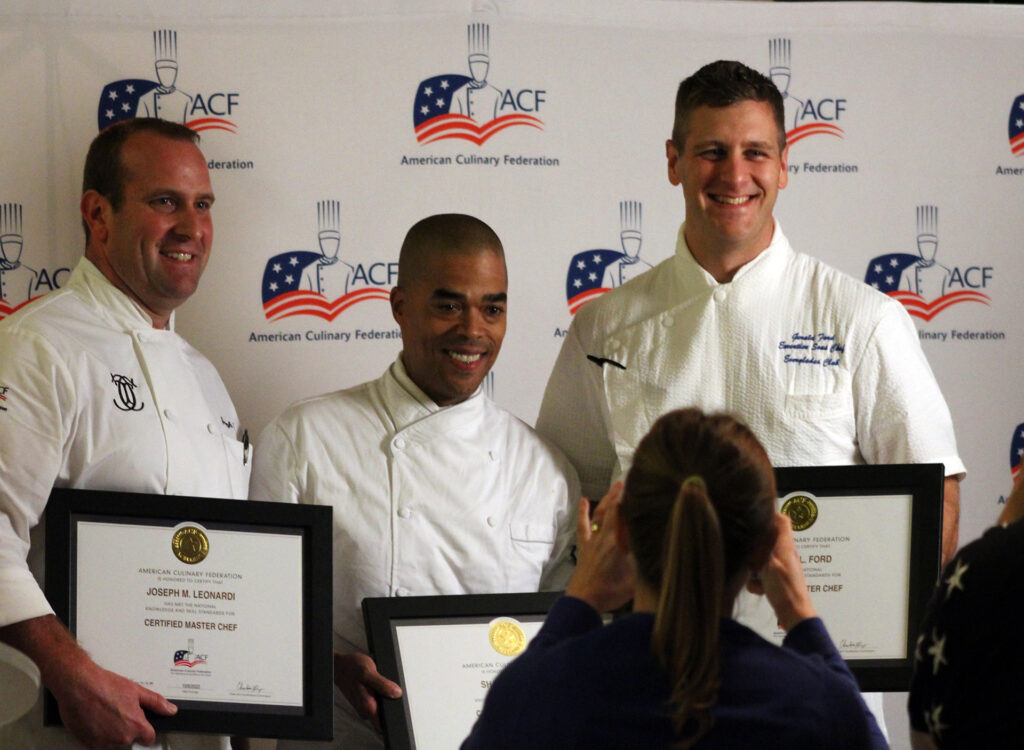
Within five years, he was promoted to Assistant Executive Chef but with the Executive Chef firmly in place of an excellent operation, Gerald moved to Florida in 2015 to work under a Master Chef at The Everglades Club to prepare in earnest for the Master Chef exam. He also met Chef Reimund Pitz and tried out for the U.S. Culinary Olympic team, still embracing competition as an excellent way to learn.
By 2017, he was at the exit for the Master Chef exam and didn’t look back. Out of 11 chefs who took the exam with him, four of them, including Gerald, passed. He is currently one of just 84 Master Chefs in the United States.
“It was the single hardest, most complex crucible I ever could have considered in my life and the most enjoyable test I ever could have put myself through. We had an amazing group of chefs there,” he said. It’s not an understatement to say it was a career changing milestone. New avenues with limitless possibilities opened up for Master Chef Ford.
In 2020, he left the day-to-day life of a chef in a commercial kitchen to start his own business. Legit Concepts coaches executive chefs, who seek him out directly, to success by offering them the tools and systems Gerald has developed based on his models of approaching operations, competitions and his quest to conquer the Master Chef exam.

In addition, he finds fulfillment working with high school and college students to nurture the next generation of professional chefs, a philanthropic focus for him now. The industry is definitely in what some may call a seismic transition as new norms replace norms that have been in place for decades. “One of the early skills I had to learn was how to duck sauté pans. It made me quick,” he said but added that it’s no longer an accepted norm. “I consider myself well positioned between generations.”
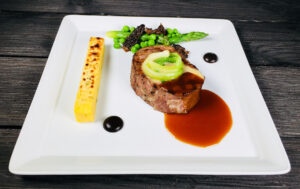

He nurtures young culinarians by emphasizing the importance of skills that previous generations of chefs learned through the School of Hard Knocks but now need to be taught in new ways. Adjusting to consequences of the pandemic is also important to recognize and address. Gerald has identified the need to help students realize the importance of deadlines, a basic skill that was assumed in prior years but is new to young chefs. Young chefs also have higher expectation for their quality of life.
“The profession is in transition and it’s up to us to make it great. I don’t think there is anything wrong with people taking an occasional Saturday night off,” he said.
When all is said and done, the power of a superb culinary experience is the same today as it was 100 years ago.
“It’s amazing to be able to share the world with people who make hospitality their life and I just wish the world would understand the value of great hospitality because I think we need it more than ever. It’s the ability to sit down at a table and break bread and be able to enjoy company for the sake of enjoying company. Few things can bring people together like a great meal – and a well-made beverage,” he said.
With humility and humor, Master Chef Gerald Ford has paved that culinary road for all to explore. Thank goodness for curiosity and mischief!
LINKS