July 25, 2025 – “Don’t hit any of the vines or posts,” Michael Anderson, vintner and founder of MTGA Wines, recalls his father and grandfather telling him as he completed one of his chores driving a tractor at Anderson’s Conn Valley Vineyards, the family’s 40-acre property located three miles east of St. Helena, California. Michael was tall for his age and could reach the tractor pedals by the time he was 10 years old. Without realizing it, doing chores as a young boy to earn his allowance so he could buy ice cream on his way home from school helped paved the path for his future career as an independent craft vintner. After graduating from college, the pull to return to his roots in Napa Valley for his life’s work was grounded in the unique culture of community among Napa Valley vintners. “This is arguably the most important thing that kept me in the Valley after moving back,” Michael said to Chaîne during a July 15 telephone interview.

Gustaf “Gus” Anderson
The Anderson family’s adventure into growing grapes and making wine began with Michael’s Grandpa Gustaf “Gus” Anderson (1930-2016). Living in Michigan’s Upper Peninsula (UP) on the shores of Lake Superior, Gus, an orthodontist, would often fly his private plane to visit wine distributors in New York City or the nation’s capital to purchase wine. He was a big fan of Burgundian wines. But the UP, with wicked winters that forges residents, proudly known as Yoopers (UPers), into rugged individuals, was not exactly a thriving market for fine French wines.
With his love of wine, in the 1970s Gus decided it was time to leave the UP. He and his wife, Phyllis, and their four children, including Todd, Michael’s father, moved to Napa Valley where Gus continued his career as an orthodontist. Todd became a geologist and in the early 1980s, Gus found a 40-acre plot of land east of St. Helena in the Conn Valley, the perfect spot to bring his dream of growing grapes and making wine alive.

Michael said there have a been a few iterations of the story of how the family acquired the land. “Both my dad and grandfather, they never let truth get in the way of a good story,” Michael said. One thing is certain though. Gus, Phyllis, Todd, and Dana, Michael’s mother, pooled their resources to go all in on the property. They planted their first grapes in 1983 and in 1987, released their first vintage of cabernet sauvignon under their new Anderson’s Conn Valley Vineyards label.

Gus became the company’s first winemaker. Todd managed the vineyards. Dana, an accountant, ran the back office. Phyllis had the most important role of all, that of peacekeeper to make sure no one was trying to kill each other, Michael said in jest. He and his two siblings filled the traditional role that children have had for eons on family vineyards by helping whenever and wherever needed, whether in the vineyard or in the winery. “It took us all a long time to realize what we were doing and the impact it had on the wines made from the fruit,” Michael said.

Gus was able to retire from his dental practice and focus on winemaking full time in the 1990s as the family’s label grew in popularity.
In the early 2000s, individual family members expressed themselves through launching their own labels while maintaining the family label. “Everyone had their own little sandbox to play in while still having Anderson’s Conn Valley Vineyards, the family brand,” Michael explained. His grandfather started Eagles Trace wine, his father launched his Ghost Horse label, and his mother and stepfather founded Trespass Vineyards.
Gonzaga University
“At this time I was the feisty teenager going into high school. The only thing I knew was the wine industry,” Michael said. He wanted to get away from it a little bit so he moved to the Pacific Northwest to attend Gonzaga University in Spokane, Washington. He admits he was never enthused about school and had an uncanny ability to fall asleep in any classroom. He said he is a ‘learn by doing’ student but his saving grace was the fact that he was on Gonzaga’s crew team so he had to keep his grades up to maintain eligibility.

After bouncing around a couple of different majors, he began taking political science and sociology classes, including a sociology class that studied serial killers for the entire semester. “Oh, this is fascinating. It had me on the edge of my seat the whole time,” Michael said. “It caught my attention.”
With help from his academic advisor, Michael completed the required courses and graduated with an undergraduate degree in criminal justice and sociology.
MTGA Wines
In summer 2009 after graduation, he moved back to St. Helena and, as he had done in previous summers, decided to work at Raymond Vineyards. He thought he would work there until he figured out what he wanted to do with his degree, possibly pursuing a career in law enforcement. In college, his summer job served the sole purpose of padding his college beer fund. But the 2009 summer job took on a new seriousness. He found the work really interesting as Raymond Vineyards was in a transition period having recently been purchased by the Boisset Collection.

One day that summer while working at the winery, he had a moment of clarity, not quite an epiphany but one that had a similar effect. “I had been around all parts of the business but I’ve never actually made a wine from start to finish, much less unsupervised. There was always someone looking over your shoulder to make sure you weren’t doing anything wrong,” he thought.
So he set a goal for himself to make a wine from start to finish in 2010. “Okay, let’s find some fruit, hopefully something relatively affordable and see what we can do with it. I stumbled upon a little merlot vineyard outside of downtown St. Helena. At that time, merlot was less than popular,” he said. His winemaking career was off and running or stroking as he did thousands of times in college rowing for four years.
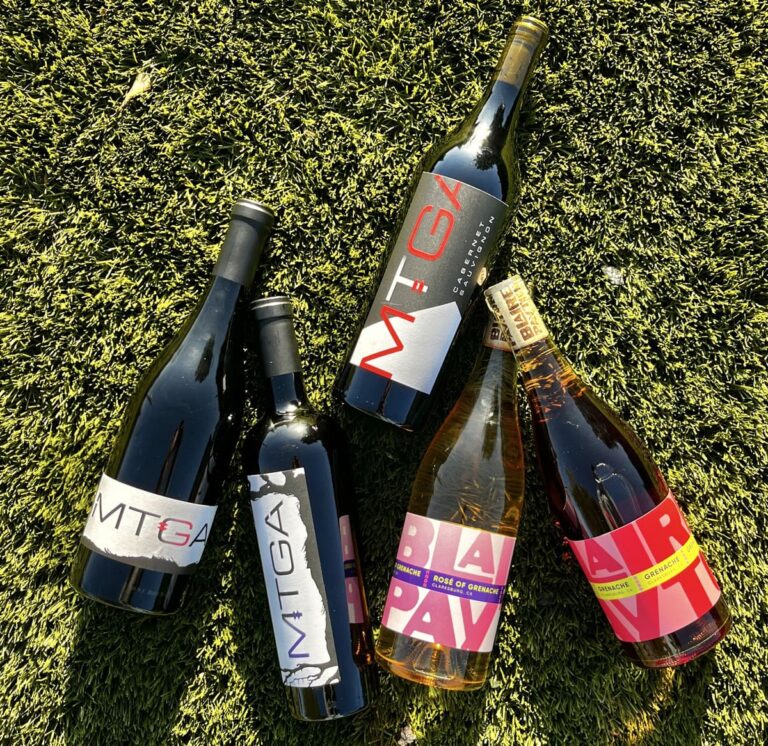
In 2011 and 2012 just before bottling his merlot, he received positive feedback from tastings. “If this little hobby can pay for itself, that would be great,” he remembers thinking. Released in 2013, he sold his total production of 50 cases in two months under his new MTGA label, a tribute to three generations of Andersons making wine – M (Michael); T (Todd, his father); G (Gus, his grandfather); and A (Anderson). MTGA wine labels highlight one letter over the others when that varietal is a special tribute to a family member.


With his success in 2013, Michael brought in more fruit. “From there, it snowballed quite a bit.”
In 2011, he met Brittany during harvest. They started dating and she became his assistant winemaker, a role she has, along with many others at MTGA Wines, to this day. Michael and Brittany married in 2018.

With early success, Michael didn’t think a lot about the bottom line during the first few years. He kept his day job working first at Raymond Vineyards and then with Cliff Family Wines so that income continued to subsidize MTGA losses. “I was having a lot of fun. The wine tasted great. I was getting a good response for what it was,” he said. To maintain sales, he discounted his wine with distribution primarily through wholesale channels.
In 2014 and 2015 with a growing customer base, MTGA production increased from 50 cases per year to a few hundred. But then reality set in. “I’m still in the red on this thing. The math just isn’t working,” he said. It was a wake up call that he took seriously.
Slowly but surely, by 2018 he was meticulously keeping track of dollars and cents on both sides of the ledger. For years, he hadn’t calculated his cost of goods, what his time was worth, what Brittany’s time was worth, and a long list of other expenses.
MTGA is a custom crush client of Anderson’s Conn Valley Vineyards. His family carved out space for him to make his wine there. But MTGA does not use any grapes from the family’s vineyard. Michael made the decision to source his own grapes elsewhere to clearly distinguish his wine from his family’s production – and so that his grandmother’s peacekeeping skills would not be needed!
By 2018 with production between 400 and 500 cases, he knew he needed to get to a production of 800 to 1,000 cases so he could devote full time to winemaking. “That’s what we were able to do,” he said. “But it took us eight to nine years to get to that point.”
Now 15 years of MTGA vintages, production is 1,200 cases per year with about 15 to 20 percent merlot depending on the year; 15 to 20 percent cabernet sauvignon; and 40 percent grenache/chenin blanc with the remaining cases a mix of cabernet franc and pinot gris. One thing has not changed though. He and Brittany do it all. They are both the production and marketing team.

He has taken to heart the financial lessons he learned along the way. “This is my favorites thing to talk about because it’s something that a lot of folks don’t talk about,” he said. The romance of making wine and caring for a vineyard is certainly a key factor in motivating people to get into the wine business but unless the math makes sense, the enterprise will not succeed. Michael said he was fortunate because he had a good paying job to subsidize his losses for many years. Michael now knows every detail of the dollars and cents coming in and going out. “The nuts and bolts are super fascinating,” he added.
Transparency

On the MTGA website, visitors can look at Michael’s production notes for every vintage and varietal since he began in 2010. He strongly believes in transparency so that consumers know what they are buying and drinking. All wineries have this data because of industry regulations so the information is available. It’s simply a matter of publishing it for the public to see. Wine is not regulated by the Food and Drug Administration (FDA) so wineries are not required to disclose ingredients. Rather, the wine industry is regulated by a tax agency that requires a few basic pieces of information on the label, such as alcohol percentage, varietal and a warning about alcohol consumption.
Recently, the issue came to the forefront when a wine shop publicly discussed the high sugar content in a well known brand versus another label they recommended that contained less sugar. The wine shop was challenged but replied they had a lab report to back up their facts about the high sugar content. Michael said it’s showing transparency is becoming more acceptable, a trend also being driven by younger generations who are demanding more information about products they purchase.
In regards to transparency, Michael said, “That’s the right thing to do. Let people know what is actually going into our wines, what the sugar content is and what’s actually going on in our cellars.”
As the industry as a whole seeks to appeal to younger generations who favor beer, spirits and seltzers over wine, Michael recommends meeting each generation where they are. For Baby Boomers, Napa Cab is still king. For Millennials, GenXers, and GenZers, price point and transparency are king. “There’s a lot of potential for wine to continue to grow in this country but we need to try and make it more accessible,” he said. Creating second labels at a price point younger generations can afford is one way to attract new wine drinkers. And offering an experience with wine is very important to people in their 20s and 30s, he added. At MTGA, wine tastings are by appointment only so that either Michael or Brittany can be there to educate customers about their wines and the wine industry in general.
Napa Valley Community Spirit
When it comes to Napa Valley vintners helping each other, it’s not words, but actions that define their spirit. Michael experienced it first hand last winter. He was attending a round table discussion with fellow vintners when the esoteric topic of waterways, water rights and wells came up. Michael asked if anyone had experience with bridge construction as a bridge to their winery had recently collapsed causing a bottling run cancellation. And he was looking ahead to a potentially major problem with harvest in the fall. “We’re literally up this creek without a paddle,” he told his colleagues. Within two days, two people at the meeting and two others reached out to him to offer him space at their wineries after harvest. “That’s the kind of bond this industry has. That’s what keeps us going for sure. There’s an amazing community and mentality that a rising tide raises all boats here that is unique to this industry,” he said.
 With production increasing and 15 years of experience, MTGA recently donated wine to Chaîne’s Grand Chapitre, held in Hawaii last May. “It was great to be able to get to that point,” Michael said. Michael first learned of the Chaîne 15 years ago when he was working for Raymond Vineyards and the Boisset Collection. Brittany was recently on a sales trip to New Orleans where she met with a number of Chaîne members who then visited the MTGA tasting room in St. Helena. “This community continues to build upon itself, which is amazing,” Michael said.
With MTGA blazing a trail with transparency and keeping it simple with few ingredients in their wines, MTGA is poised to flourish even in an industry that Michael describes as tumultuous.
“As beautiful and amazing as the wine industry is, it’s nothing without community that bond us all together. We’re all just crazy enough to be in this industry together because of how much hard work it is and the rules and regulations that we have to work with. It’s a bear to make wine and be successful in this industry,” Michael said.
It’s obvious Michael has inherited his Grandpa Gus’ Yooper toughness, a common trait also shared with generations of California grape growers and vintners!
Featured image above: MTGA varietals inspired by individual family members are highlighted on the label with one letter distinguished from the others. (Photo: Courtesy of MTGA Wines)