
May 17, 2024 – To his students at the Seattle Culinary Academy, he is “Chef V.” The V stands for Varin, his first name. But the letter V could just as easily stand for Victory, a victory he engineered himself when his dream of becoming a professional snowboarder hit a snowbank after sustaining an injury on the slopes. Instead of flying down a mountain for a living, he decided to become a chef, methodically climbing the culinary mountain replete with long hours of attending class, studying, practicing, and working to remain in school. In 2009, one of his chef instructors suggested he enter Chaîne’s Jeunes Chefs Rôtisseurs Competition (JCR). “Let me just try it and see. So I did it and somehow I won the local version then the regional version and nationals was in Scottsdale. And I think I was pretty much the underdog,” Maître Rôtisseur Chef Varin Keokitvon, chef instructor at the Seattle Culinary Academy at Seattle Central College, said to Chaîne during an April 30, 2024 telephone interview.
One of his competitors at the 2009 JCR had recently returned from participating in the Culinary Olympics in Germany so Varin had reason to be considered an underdog. But he approached the competition with confidence in his preparation and experience. Coached by Chef John Fischer, CEC, CCE, AAC, HGT, WCMC, who at the time was a chef instructor at Renton Technical College, Chef Varin and Chef John created their formula for success.
Already well known for his expertise in pastry, which is one-third of the cooking competition, Varin worked on not losing any points in the kitchen score in which points are deducted for being messy, not being organized, and/or violating Department of Health guidelines for food safety.

Chef Fisher coached him to hold his own against the other competitors in cooking the first and second courses but then outright win the dessert course because of his pastry ability. Most young chefs struggle with pastry because they are not trained extensively in that area, Varin explained. Chef Fisher also helped Varin understand what the judges would be looking for as they evaluated him. His underdog status did not last long as the competition commenced. Reflecting on his success, Varin said, “I think it was partly from my work ethic and partly from coaching.”
No doubt his work ethic came from his upbringing in a loving family who instilled that value in him at a young age.
Family
Born in 1984 in Vientiane, Laos, Varin and his family – his parents, grandparents and older brother – emigrated to the United States in 1986 from Thailand. They had fled to Thailand from Laos shortly after his father escaped from a Laotian POW camp in 1984 where he has been a prisoner of war for eight years.

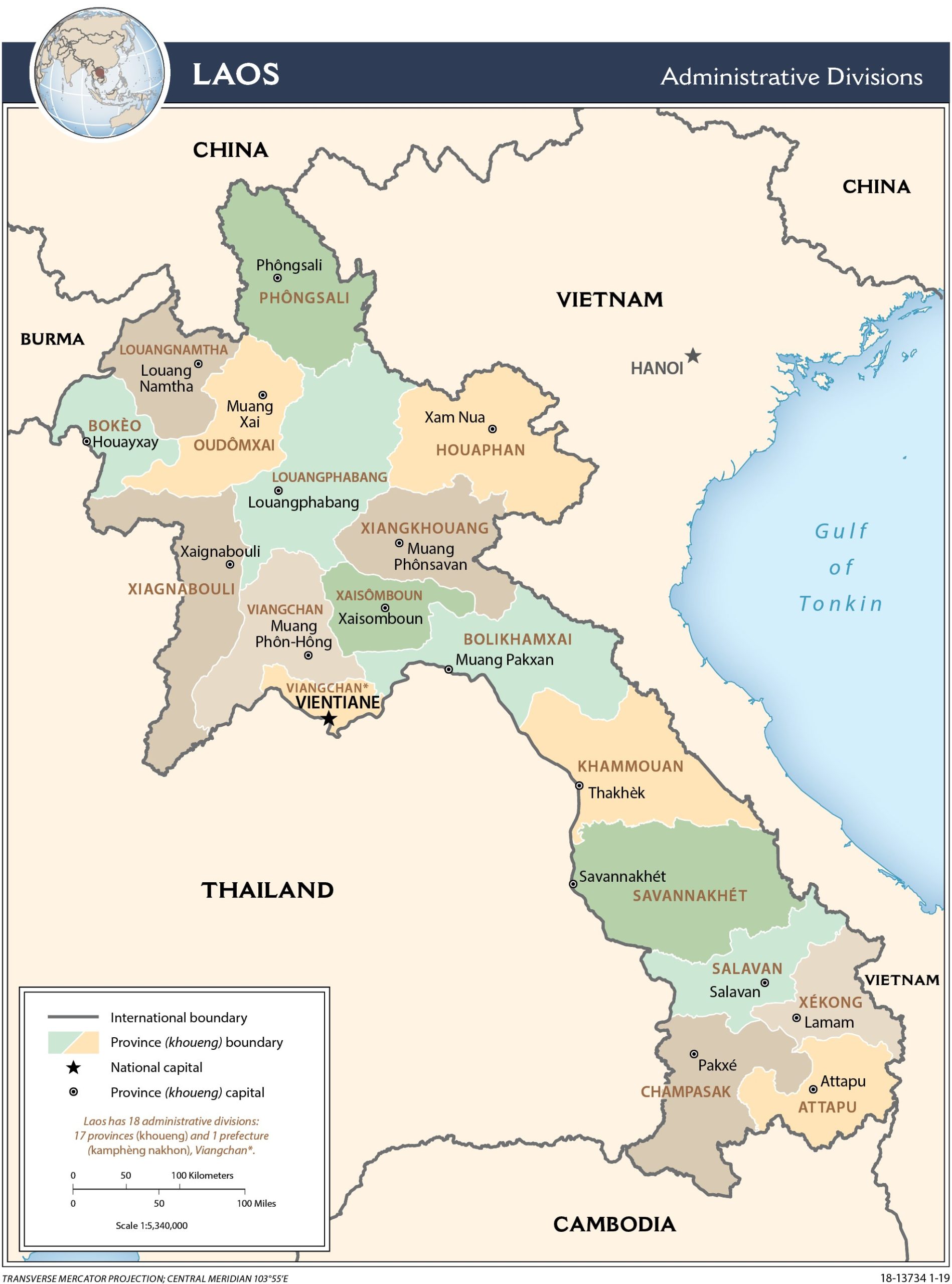
Varin’s father was a bomber pilot for the Royal Lao Air Force during the Vietnam War, fighting as an ally of the United States. In 1976 as the war was coming to an end, he was captured and sent to a “re-education” camp. Fluent in five languages, eventually he earned privileges that gave him the opportunity to escape. Once free, he found his family in Laos and because he was certain the government would be looking for him, he moved his family to Thailand where he applied to emigrate to the United States to live in Seattle.
While many chefs report being inspired as a young child by cooking with their parents or grandparents, Varin said he wasn’t really interested in cooking as a young boy. Rather, “it was something I had to do to help out.” His mom and dad were always working so his grandmother raised him. He recalls entire weekend days being set aside to prepare egg rolls or make Vietnamese crepes (Banh Xeo). “I did not like it because all of my friends would be playing outside.”
But upon reflection, especially after entering the culinary profession, Varin is glad for the time he spent in the kitchen with his grandmother. “Now looking back, I think about that rich experience and how it helped me understand food a little more. And how wonderful it was to have those times to connect and to have those memories.”
He has vivid memories of being introduced to new foods, foods that he thought were very strange. Blue cheese leads that category for him as dairy is not a part of Laotian and Southeast Asian cuisine. “To find out blue cheese is milk from a cow that we decided to add this mold to, leave it out for three months, and now we’re going to eat it, was very odd to me,” he said. It’s a story he tells his students to this day as he asks them to tell him about the strangest food they have ever eaten.
Growing up in what he describes as a tough neighborhood, Varin said his father made certain that he and his brother attended good schools through a public school program that bused students to more affluent neighborhoods with better schools. Although the schools were better, Varin said there are always some bad influences regardless of the school. “Experiences in high school – some are bad, some are good but you always learn from them.”
In his senior year, he took a Home Economics class at Roosevelt High, which he failed. With his mind set on becoming a professional snowboarder, he would skip classes and admits to probably not putting in his best effort in the class. Ironically, he just hosted the 2023/2024 Roosevelt High Home Economics class at the Seattle Culinary Academy, immediately connecting with the students by telling them his story. What an inspiring and motivational role model Varin is for teenagers deciding on career paths today!
Snowboarding
After graduating, Varin announced to his father that he was moving to Stevens Pass (elevation: 4,061 feet) in the Cascade Mountains near the border of King County and Chelan County in Washington state to become a professional snowboarder. “I’m going to work there, live there, and get really good at this,” he told his father. Varin said he attributes his competitive nature to his father who still competes in badminton tournaments. “He’s pretty good,” Varin added.

To support himself to practice his sport at Stevens Pass, he smartly deduced the best place to work would be at a restaurant where he would be fed. So he snowboarded all day and worked at restaurants in the evening.

The first snowboarding season went smoothly. But then he hit a figurative snowbank his second year. “I got injured in the second season. Oh man, if I can’t ride and have to take off two weeks to heal, maybe I need a backup plan just in case,” he thought. Emphasis on pastry in the culinary arts was just starting to gain attention as a new area of expertise. “I had always remembered loving food and loved pastry. Maybe I’d like to do that one day.”
Culinary Career
Fortunately, one of his friends was studying culinary arts at North Seattle College. He told Varin, “You should come down here and do this because it’s pretty amazing.” So he did, leaving his snowboard dreams on a mountain pass.

Back in Seattle, Varin’s instinct to try culinary school was spot on. “I ended up liking it and being really good at it.” After graduating from the two-year program he worked for a couple of years but his drive to push himself as far as he could go led him back to school to earn a degree in culinary arts and to specialize in pastry at Seattle Culinary Academy, part of Seattle Central College. Refining his skills working at restaurants while going to school made him the perfect candidate to enter the 2009 JCR competition.
On the heels of winning the 2009 JCR, Varin was awarded the 2010 Vilcek Prize for Creative Promise in Culinary Arts. Each year the Vilcek Foundation awards monetary prizes in two fields – the arts and biomedical engineering. In 2010, culinary arts was the focus for the arts category.
With two prestigious awards, Varin said a lot of doors opened, including the Spanish Embassy. The Ambassador of Spain to the United States invited Varin to participate in a trade commission program in Spain as one of 24 chefs from around the world learning Spanish culture, language, food products and cuisine. So it was off to Spain instead of France where he had planned to hone his skills in pastry. International success followed. “I was selected for El Celler de Can Roca, third best in the world that year,” Varin said.
Living in Spain for about 10 months, when he returned to the United States, he took a job as Executive Chef at FareStart, a nonprofit founded in 1992 to feed homeless and disadvantaged adults. He worked there until 2014 when the E3 Restaurant Group recruited him to be the Executive Chef at Heartwood Provisions, a new restaurant concept.
There he developed his management skills setting high standards for his staff but being flexible, to a point, with schedules to give them a healthy work-life balance. He told his staff: “I’ll give you any day off you want but when the time comes – if it’s New Year’s Eve, I need everyone, all hands on deck. I don’t care what’s going on. No one gets that day off.” His style paid off. “Provide a lot of respect and support for people. You gain their respect and they pay it right back.”
Chef Instructor
In 2019, he left E3 to join the faculty at the Seattle Culinary Academy, returning to his alma mater to teach and mentor young culinarians. He could never have known it when he made this career decision but just a few months later, the pandemic hit and Heartwood Provisions was forced to close, never to reopen.

During the pandemic, the Academy only closed for the 2020 spring semester, returning to campus fully opened for summer 2020, albeit with many safety precautions in place. But that environment was still preferable to having students take lab classes virtually, Varin said.
Their culinary program is a lockstep one so that students progress along a defined trajectory first taking an introductory course in food service basics. Students who pass that course then take Varin’s course – Introduction to Cooking, a course that requires students to prepare eight to 12 plates daily that are served to staff and students for lunch. Varin does not believe that course could ever work virtually.
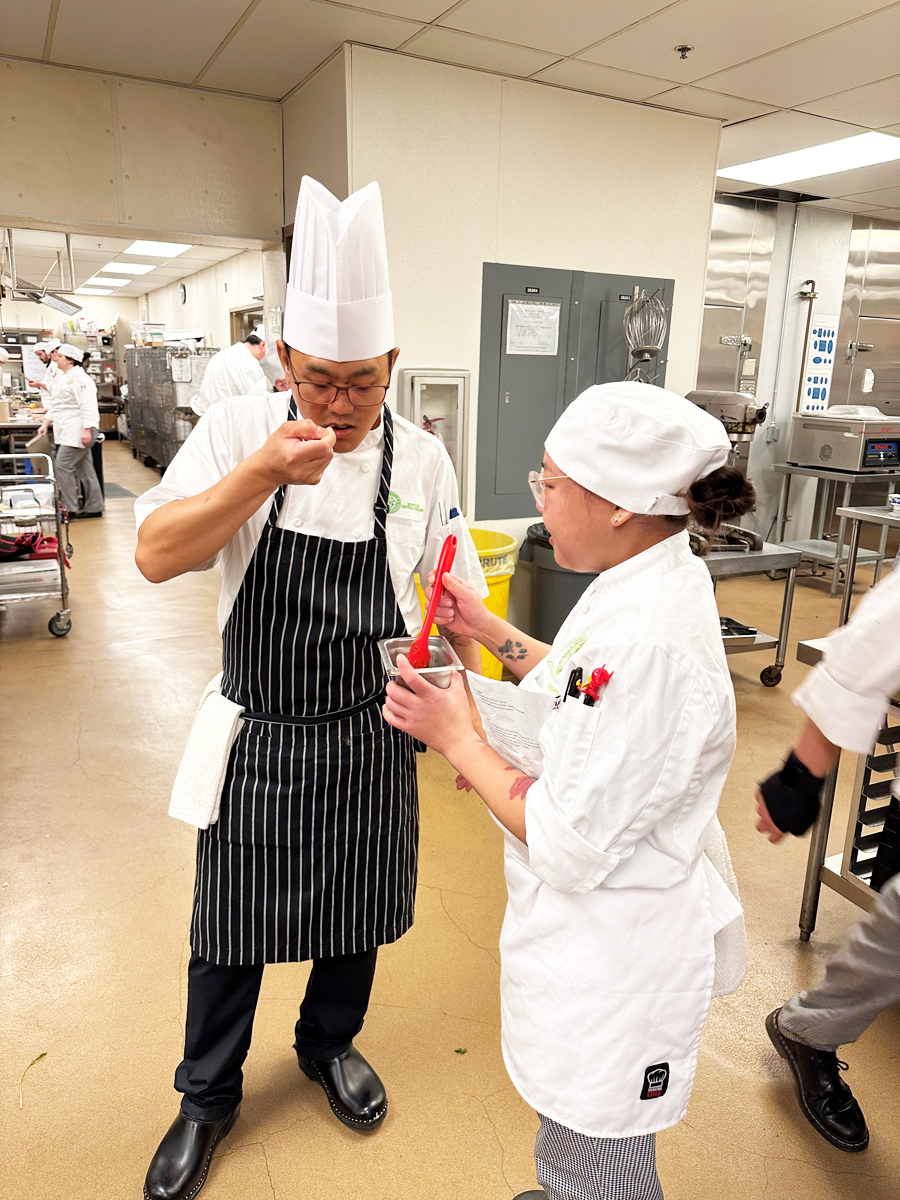
“I already have students nodding off in class because it starts at 7:30 a.m.. I can’t imagine them being on Zoom and doing that,” he said.
Seattle is no different than hundreds of other cities where restaurants are constantly looking to hire staff. Varin fields many requests from chefs but his focus is on preparing his students for long term success in the industry by career planning with them. He has noticed their student body is younger now with about 15 percent coming directly from high school. “That’s what I did too, besides the two-year hiatus trying to live on a mountain,” Varin said with a chuckle.
While snowboarding and culinary careers may seem light years apart, both provide immediate feedback and most important, joy. “The thing I love about our industry is it’s so rewarding and immediate. The moment you put the plate in front of someone, they can either hate it or love it but it’s immediate, nourishing, and something that is a connection,” he said.
Does Varin still snowboard in his spare time? “I put down the board and picked up a rod, mostly recreational fishing for salmon, trout and steelhead,” he said. Recently he was fishing on the Yakima River. He loves living in the beautiful Pacific Northwest. He and his wife are parents of a three-month-old daughter whom he is excited to take places to show her the beauty of the area.
Varin is now paying it forward by mentoring young chefs entering JCR competitions. He is thankful for the many opportunities that came his way because of it and believes competing not only develops great culinarians but also leaders for the world. For three years in a row, he has coached the student who won the Pacific Northwest Provincial JCR competition. At the upcoming 2024 JCR competition in Seattle, Varin’s student will again compete for the national title. The Seattle Culinary Academy will host the Welcome Reception and the Turkish Taste One Pot Competition on Friday, June 7 and on Saturday, June 8, Renton Technical College will host the JCR Competition and Gala Dinner.

Laser focused on the real world, Varin views technology as both a blessing and a curse. On the positive side, his students can pull up videos on demand to watch master chefs flawlessly perform culinary techniques. But he said technology can also be a curse when it impedes students from experiencing the real world. Noting a personal story, he said his wife’s eight-year-old nephew would rather watch someone online playing a video game than playing the online game himself. “This is insane,” Varin said. “I just care about life skills – how to feed yourself, how to be on time. Those are giant in my book,” he said.
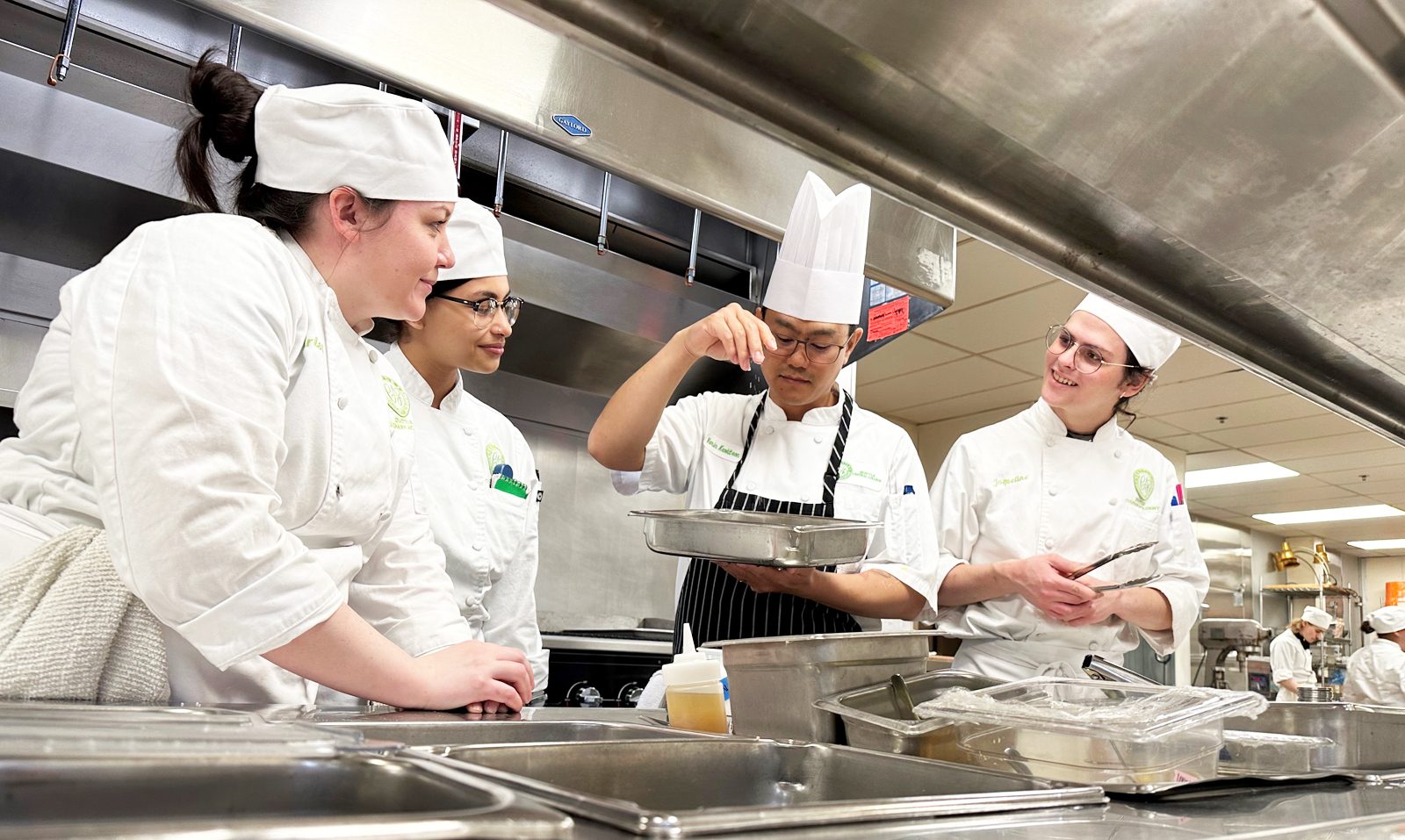
And for his students, he can easily tell if they have been practicing in the real world as opposed to merely watching videos. “If you don’t put the time in, you don’t get good at it. It’s one of the cool things about cooking. It’s immediate. We can tell if you’re not good,” he said.
Given the pervasive force of technology in all aspects of life today, nurturing young students to live – and work – in the real world is another mountain to climb but having climbed and conquered that mountain himself, Varin is uniquely qualified to guide the next generation. What a ride he is offering them!
Links
Seattle Culinary Academy
Vilcek Foundation