Home Blog Page 6

Ferrelli Family: Generations of Passion for Wine and Food

Feb. 18, 2022 – For centuries, vineyards that dot gently rolling hills overlooking some of the world’s most beautiful vistas have gifted generations of families with not only a livelihood but also life itself. Embracing known and unknown risks, toiling towards perfection, and facing adversity head on are deeply-rooted, viticultural traditions. Eléni (Helen) and Big Papa (Daniel) Ferrelli, co-founders of EFESTE, an award-winning winery in Washington State, and their family are no exception.
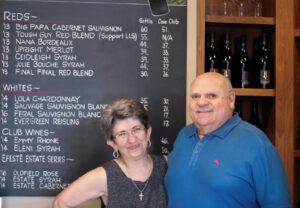
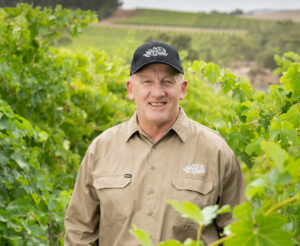
Eléni and Big Papa Ferrelli (Photo: Courtesy of EFESTE)

Daniel’s father, the original Big Papa, learned how to make wine from his ancestors who lived in Italy’s Calabria region, located in the toe of the boot. His family immigrated to Chicago during the Great Depression and Prohibition. Passing down the family’s Italian and American heritage, as a young boy, Daniel helped his grandfather make wine in their basement using his old wine press. Burnished in Daniel’s memory were also the Ferrelli family Sunday dinners, really Sunday feasts to which neighbors were invited with just one request to bring a fork.

The family moved west to the Seattle area in 1959, bringing their passion for food and wine with them. When Daniel married Helen Stylianoplous, their future as vintners was sealed as Eléni and Big Papa although the leap into full-time winemaking waited a few years while they raised a family of three children.

However, Daniel never stopped making wine at home, an annual family tradition. With assistance from his father, brother, uncles and cousins, Daniel produced and bottled wine for family and friends from his garage. When his daughter Angela was in high school, Kevin Taylor, her boyfriend, offered to help. The garage proved to be just as good as a marriage made in heaven. The high school sweethearts graduated from Washington State University, married and began nurturing the next generation.

In 2005, Angela and Eléni traveled together to Italy to celebrate Eléni’s retirement and Angela’s decision to put her marketing/advertising career on hold to stay home with their two young boys. Big Papa and Kevin watched the boys while they were gone. What a surprise when Angela and Eléni returned home to learn their garage winery was now going commercial!

“Dad and Kevin told us they met a guy, got some grapes, and decided to make real wine,” Angela said to Chaîne during a Feb. 9, 2022 telephone interview. “They said it was just going to be a couple of barrels but it was A LOT more.”

In 2005, the Ferrelli family and the Taylor family founded EFESTE (Ferrelli, Stylianoplous and Taylor) with an oenological philosophy to let nature take the lead. Purchasing grapes grown in Eastern Washington, they hired a full-time winemaker with expertise in native fermentation.
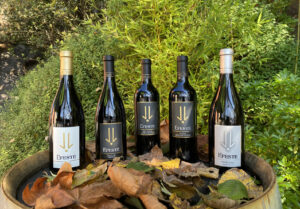
EFESTE’s core wines are named after people. (Photo: Courtesy of EFESTE)

The first two years were relatively calm as they waited for the 2005 vintage to age. The two families leveraged each other’s unique skill sets to plan their first release in 2007. Kevin has a background in land development and finance; Big Papa is a natural salesman; and Eléni is an amazing cook, Angela said. With her marketing/advertising expertise, the nascent company was already laying a solid foundation for growth. That growth came quickly after they crushed it with their 2007 release. But along with instant success came adversity.

Joe, Angela and Kevin’s five-year-old son, was diagnosed with Acute Lymphoblastic Leukemia (ALL). On the day of their first release in 2007, Joe started his low-dose chemotherapy treatments that would last for the next three and one-half years, the standard pediatric protocol to defeat the blood cancer. Once his treatments ended, Joe internalized his doctor’s advice to make healthy choices as he grew. Today Joe is enthusiastically learning the wine business through real world experience and, as a student, is working on his acceptance into the Viticulture and Enology Program at Washington State University. He is also a member of the Cougar’s football team. “My son is absolutely amazing. He’s very much appreciative of his cure and acts that way,” Angela said.

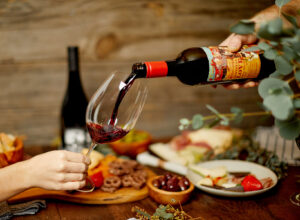
EFESTE’s Tough Guy, a high end Red Blend, is named after Joe. A portion of the proceeds from every bottle sold is donated to the Leukemia and Lymphoma Society (LLS) Pacific Northwest. EFESTE’s annual Rockin’ Sips is a charitable fundraiser for the LLS and Joe is the spokesperson to the media and at the event. Usually held each February, this year the fundraiser will take place in June or July because of the pandemic.

Joe Taylor at the 2018 Rockin’ Sips charity event (Photo: Courtesy of EFESTE)
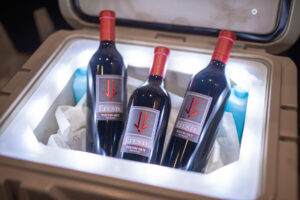
EFESTE Tough Guy wine at a Rockin’ Sips event (Photo: Courtesy of EFESTE)

Washington State Vineyards and EFESTE

Tough Guy is made from grapes grown in Eastern Washington in the Red Mountain American Viticultural Area (AVA). It’s one of 19 AVAs in the state, according to the Washington State Wine Commission (WSWC).
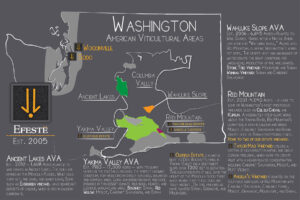
Washington State AVAs and EFESTE vineyards (Photo: Courtesy of EFESTE)

As of 2020, there were 1,050 wineries in the state producing more than 17 million cases, according to WSWC data. More than 99 percent of Washington wines are made from grapes grown on about 59,000 acres in the Columbia Valley AVA, nested within the Columbia River Valley. Geographically, the state is traversed by the 46th parallel and 47th parallel, which also defines France’s famous Bordeaux and Burgundy winemaking regions.

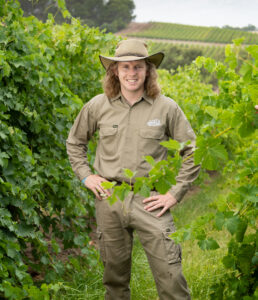
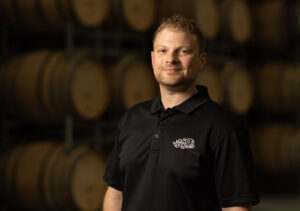
Mark Fiore, EFESTE’s principal winemaker, joined the company almost five years ago. “I met Kevin, drank two beers, met the rest of the family, had dinner and it was done,” Mark said during the Feb. 9 telephone interview. Angela said they knew immediately Mark was the perfect fit.
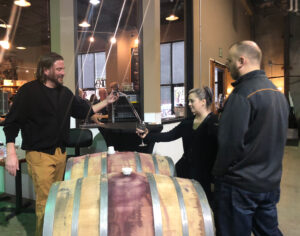
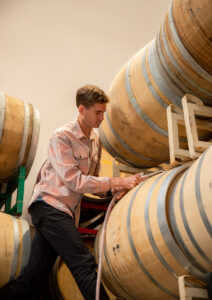
Mark, left, at a barrel tasting (Photo: Courtesy of EFESTE)

In 2008, EFESTE planted their first vines in Eastern Washington within the Red Mountain AVA, which encompasses about 2,300 acres.

Just as Mark came on board in 2017, the vines reached maturity. His first recommendation to the family was to harvest the grapes for their estate Cabernet Sauvignon. Because their vineyard has a rare north-facing slope, Mark said the grapes have unique characteristics. Designated as an AVA in 2001, Red Mountain’s terroir is defined by warm temperatures, persistent winds and an average rainfall of five inches. EFESTE’s Tough Guy is also made from grapes grown in the Red Mountain AVA.

In tribute to the family’s heritage, EFESTE’s Big Papa wine is made from grapes grown on old vines planted 35 years ago in the newly formed White Bluffs AVA, Mark said.
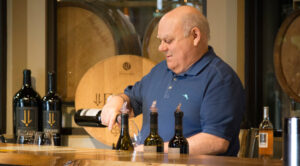
Big Papa Ferrelli (Photo: Courtesy of EFESTE)

Sourced from a single grower, the Bacchus, Sagemoor and Dionysus vineyards all sit on the banks of the Columbia River. Mark added that the Bacchus and Dionysus vineyards sit on sloping land close to one another with elevations from 550 to 900 feet. The climate is ideal with warm temperatures, which are never too hot or too cool. The Sagemoor vineyard is farther south and also has a beautiful view of the Columbia River and the Rattlesnake Mountains. The soil is comprised of a very sandy loam, an ideal composition of clay, silt and organic material for grapevines.
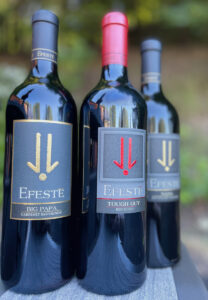
EFESTE Big Papa and Tough Guy wine (Photo: Courtesy of EFESTE)

In 2021, EFESTE expanded into sparkling wine, a dream for many years. EFESTE crushed it again when Mark produced Angie, a delicious Champagne made from grapes grown in the Clos Chevalle vineyard located within the Lake Chelan AVA. The vineyard is EFESTE’s most northern vineyard with a higher elevation of 1,250 to 1,600 feet and sits along the south shore of Lake Chelan, Mark explained. The grapes ripen late so it’s a perfect site for their sparkling wine.
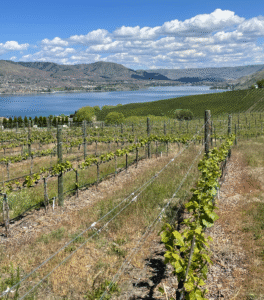
Lake Chelan AVA vineyard (Photo: Courtesy of EFESTE)

Mark will begin traveling to the vineyards in March to first check to see how everyone handled the winter weather. Because the climate varies dramatically from Western to Eastern Washington, Mark keeps a close eye on the weather. “It’s different every year,” Mark said. Two years ago, wildfires tainted some of their grapes so they decided not to make their Paulie varietal. “Every harvest has its own challenges. That’s why I love what I do.”

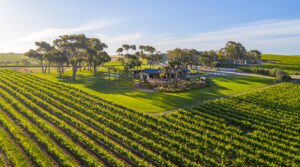
EFESTE’s Angela’s 18.9 acre vineyard is located in the northeastern tip of the Red Mountain AVA. Grapes from this vineyard are used to make EFESTE’s Syrah, Grenache, Cabernet Sauvignon and Cabernet Franc. (Photo: Courtesy of EFESTE)

As harvest approaches, Mark will make weekly visits to the vineyards. But deciding when to pick the grapes is only the beginning of a tense yet exciting fall season for Mark and the winery.

As a Seattle-based winery using grapes grown in Eastern Washington, there is a major logistics component to EFESTE’s operation. Grapes are transported by truck but Mother Nature determines optimal time for picking and transport.

“Bad things can happen if the grapes are picked in the morning and sit in the sun all day,” Mark explained. “Trucking grapes has become more difficult,” Angela added. With a total production of 13,000 cases, Angela said if they expand to producing 20,000 or more cases per year, they will consider installing a crush pad in Eastern Washington.

For their red wine production, after harvest, Mark lets the grapes start the fermentation process on their own. There can be a seven to eight day lag period as that bubbly process begins. “We just have to protect the grapes from oxygen. We use a lot of carbon dioxide and dry ice to protect the wine,” Mark said.

“It’s a glorious process,” Angela commented.

Mark then tastes the wine daily to determine when to press. They have the luxury of being able to wait 30-40 days if necessary. He is tasting for flaws so his palate can easily handle a tray of 16 samples.

A few years ago EFESTE purchased state-of-the-art concrete tanks sourced in France’s Bordeaux region. “They’re gorgeous. They look like five UFO spaceships,” Angela said. Mark added that people still fondly remember the day the tanks came. “It was a fun day when they arrived,” he said.
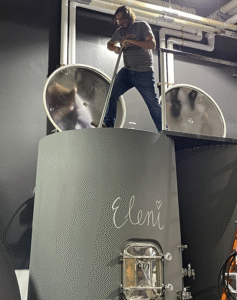
Mark is performing a “punchdown” in one of the five concrete tanks. (Photo: Courtesy of EFESTE)

Their commitment to excellence has earned EFESTE many awards. Most recently, the 2021 Seattle Wine Awards for Washington State Wines honored four EFESTE wines: 2019 EFESTE ‘James Vineyard’ Malbec (92 pts); 2019 EFESTE ‘Taylor Mag’ Cabernet Sauvignon (92 pts); 2019 EFESTE ‘Estate Grenache’ (93 pts); and the 2020 EFESTE ‘Penelope’ Rousanne (92 pts).

Pandemic
The family’s entrepreneurial expertise proved invaluable during the pandemic. The shock of closing their two tasting rooms, one in Woodinville and one in Seattle, was a seismic one. “We couldn’t cry. Everyone was in the same boat,” Angela said. It was another adversity the family met head on.

To her staff, Angela said: “Listen, here’s the deal. We’re not selling Armani suits. We’re selling wine and everyone is still going to want a glass of wine so let’s get creative.”

Eléni and Big Papa had always made food for EFESTE’s big events with rave reviews from attendees. “My mom could still cater an event for 500 people if she wanted to,” Angela said.

As they pondered how to operate in the midst of a pandemic, they added food to become a one-stop shop for customers.

“We just stayed true to our roots. We stayed entrepreneurial and tried to figure out ways to sell and be there for people,” Angela said. They opened a tent selling food, wine, T-shirts and gift items. People came out in droves. Now they offer pizza each day, which has been very popular.
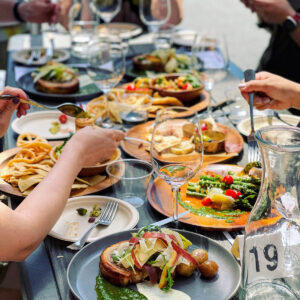
Happy Hour at EFESTE! (Photo: Courtesy of EFESTE)

Angela said 2021 was one of their best years ever. She was deeply touched during the pandemic as their customers worried about them. “It was really a beautiful thing,” Angela said.

The family feels a bit of pressure to duplicate the stellar year they had in 2021 but they are standing on the shoulders of generations of winemakers who have passed down their skills and commitment to excellence. And as heir apparent to EFESTE, Joe Taylor is there to eagerly receive the torch in time. “It’s just a perfect fit for our family so we’re pretty excited,” Angela said.

LINKS

EFESTE

EFESTE WINE CLUB

WASHINGTON STATE WINE COMMISSION

WASHINGTON STATE UNIVERSITY VITICULTURE AND ENOLOGY PROGRAM
LEUKEMIA AND LYMPHOMA SOCIETY (Pacific Northwest)

Bailli Jill Kummer Leads Pittsburgh with Steely Commitment to Youth

Feb. 4, 2022 – In her role as Bailli of Pittsburgh, Jill Kummer draws upon a lifetime of experience in the hospitality industry, the entrepreneurial world, and as a Chaîne des Rôtisseurs member and leader since 1988. “I still think the best job in the Chaîne is being a Bailli. It’s been awesome,” Jill said to Chaîne during an Aug. 13, 2021 telephone interview.

Ashley Bowman inducted her as a Chaîne professional in Charlotte, North Carolina in 1988. Jill vividly recalls arriving at the induction ceremony with apprehension yet an enthusiastic mindset for the gastronomic organization’s recognition of hospitality professionals. She took to the Chaîne like duck confit to wine. “It was cool,” Jill said.

Life brought her many moves around the country after her induction. One of her first tasks in a new city was finding a local Bailliage. Without the advantage of smartphone search, she quickly connected in person. From Tampa to Houston to St. Louis, Jill immediately forged bonds with people who shared her interest in food and wine.

Photo: Courtesy of Jill Kummer

Shortly after she arrived in St. Louis in 1996, the St. Louis Bailli suddenly quit. Jill filled the position with youthful energy and a tad – well, more than a tad – of trepidation. “It was trial by fire. I had no idea what I was doing, absolutely no idea,” Jill said.

Anchored by professional success and confidence, Jill embraced the responsibility to both innovate and carry on traditions there. She became very involved in nurturing young chefs, a passion she continues to this day.

Pittsburgh

In 2003, she moved to Pittsburgh where she became a member of the local Bailliage and began her journey as an entrepreneur. In 2004, she started her own event planning company, featuring software for event planning and non-profit management that was one of the first to offer online event ticketing to nonprofit organizations.

In 2014 when the local Bailli passed away, Jill took on that responsibility, embracing her leadership role once again as well as serving two terms as Bailli Provincial. By 2016, the pace of her event planning business that had her at events six nights per week took its toll. She decided she was done with that phase of her career. Since then, she has written two books to help others plan events. When asked what mistake many event planners make as she attends events as a guest, Jill said: “Not walking their event – properly.” It seems so obvious, but planners must look at the event through the eyes of their guests to be successful, she added. Tasks can be tedious but there are no shortcuts.

“You have to put the time, the energy and the effort into planning it out and making sure everything is running like clockwork,” Jill said.

A little rest and two years recharged her entrepreneurial batteries. In 2018, she founded Eventsburgh, an online event resource business for nonprofit organizations. The pandemic idled her for 12 months. Typical of so many small businesses navigating the unknown during the pandemic, she is just beginning to get back to some sort of normal.

In a recent update, Jill said, “There is a tremendous desire to return to exciting events. We used the last year to research and build more features into the business. It is easy to become mired in the same event pattern every year. We are encouraging our clients to break out of that pattern.”

Teaching

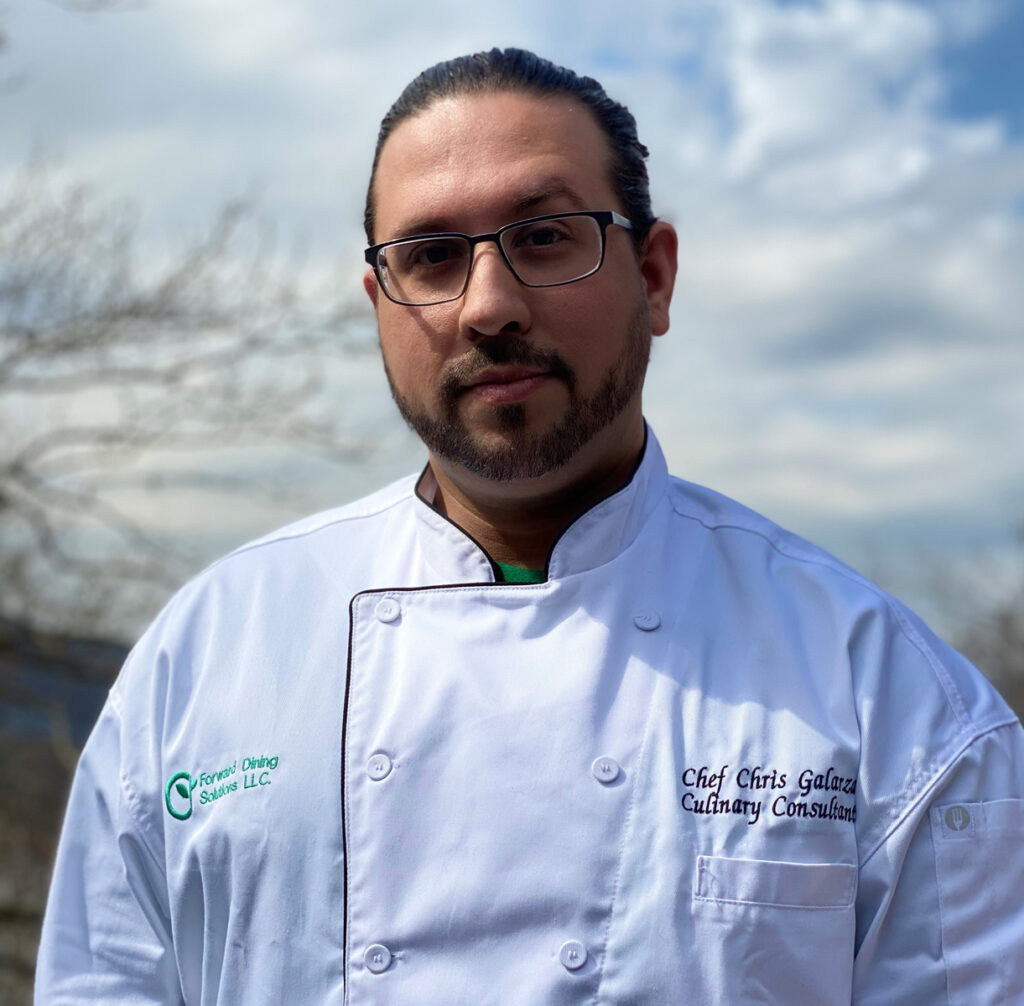
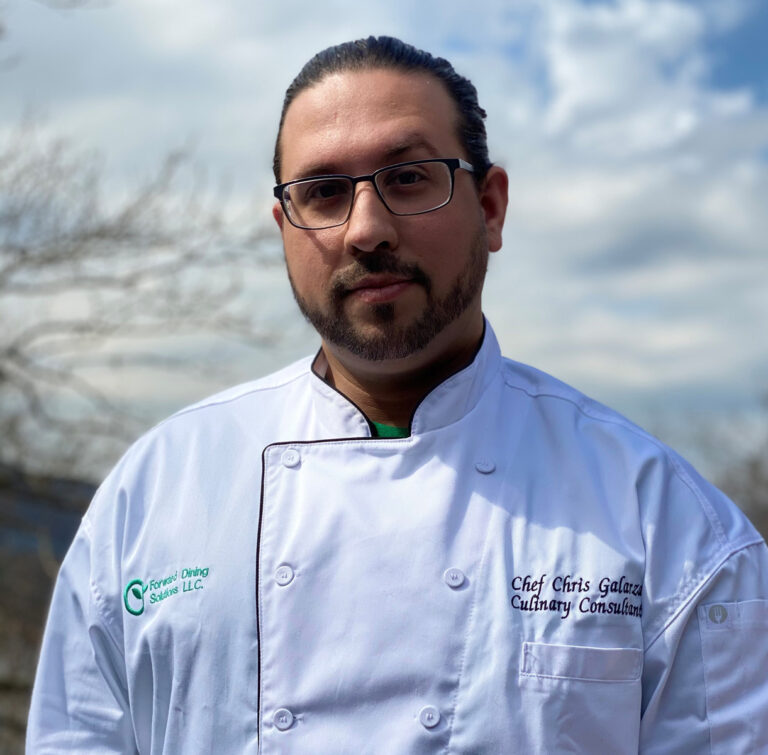
Chef Chris Galarza (Photo: Courtesy of Chef Galarza)

Nurturing young culinary students remains a passion. Jill is now an adjunct instructor at Westmoreland County Community College and the American Academy of Culinary Arts at Pittsburgh Technical College. She teaches courses covering both the front of the house (management) and the back of the house (purchasing and cost control).

Jill guides students across a continuum from those who want to open a food truck to those who want to ascend to executive chef positions at large entities and even to those who are on the cutting edge of industry innovation, such as Chef Christopher Galarza, a 2021 Cuvée Spotlight. “Jill is amazing and is worth all the praise! She’s one of the best humans alive,” Chef Galarza said to Chaîne.

“My job is to figure out where they want to go and then be able to direct them and put them in touch with people who can actually help them get there. That’s a big thing,” Jill said. “In my experience, no one gets anywhere in this business without mentors.”

Left to Right Front Row: Maitre Rotisseur/Executive Chef Shawn WCMC, MBA; Chef Yono Purnomo CEC, CFBE; Maitre Rotisseur/Executive Chef Mark Wright CEC, AAC; Left to Right Back Row: Conseiller Culinaire Provincial Midwest Honoraire/Chef Norman Hart CEC, CCE, AAC; Conseiller Culinaire Provincial Far West/Chef Robert Phillips CEC; Vice Conseiller Culinaire Pittsburgh/Chef Rikk Panzera CEC, CCE, AAC; Maitre Rotisseur/Chef Tom Macrina CEC, AAC, HOF; Bailli Provincial Midwest Honoraire/Pittsburgh Bailli Jill Kummer; Conseiller Culinaire Provincial Mid-Atlantic Chef Thomas A. Hannum CEC; Maitre Rotisseur/Chef Byron Bardy CMC, AAC; Conseiller Culinaire des Etas-Unis/Master Chef Reimund Pitz, CEC, CCE, AAC, HOF, WCMC; Conseiller Culinaire Far West Honoraire/Chef Michael Ty CEC, AAC, HOF (Photo: Courtesy of Jill Kummer)

But in all positions, students must master the fundamentals and the business side, or they will not survive as culinarians and hospitality professionals. “If you don’t know the fundamentals and you don’t know your numbers, you don’t know your business,” Jill said emphatically. “It’s absolutely critical they understand this.”

Fortunately, most students today recognize the importance of costing out recipes and learning the fundamentals. During the pandemic, Jill conducted classes virtually, which she said was challenging since hospitality is a relationship business. She began every virtual class by asking how her students were doing, giving them an outlet to share their successes and challenges. Thank goodness humor can be shared virtually. During one class, she noticed long lines of funny characters in the chat box when a student quickly apologized for his cat walking across the keyboard! Jill turned that humorous moment into an opportunity to learn more about her students. She invited everyone to turn on their cameras to introduce their pets to the class. “We’re human before everything else,” she said.

Pittsburgh Bailliage

Now well into the 21st century with its dizzying pace of technology and take-out, Jill has held on tightly to 20th century hospitality and Chaîne traditions. Even though casual events are becoming more common, Pittsburgh still plans to host two annual black-tie dinners and one white-tie dinner when able to do so.

At the Aug. 8, 2021 “Not Your Ordinary Picnic” event, held at a private home in Ligonier in the Laurel Highlands area, 85 members and guests had a blast! (Photo: Courtesy of Jill Kummer)

She is not worried about younger generations taking the traditional reins into the future. The Pittsburgh Bailliage has made a concerted effort to recruit new members who are 35 years and younger. When young prospective members come to one of their black-tie events, it’s the first time many have ever been to a formal dinner. From the moment the door opens to a beautifully decorated room with scenes that could easily be featured in gourmet magazines, young men and women are impressed.

On Dec. 5, 2021, the Pittsburgh Bailliage celebrated its 60 plus One anniversary at The Pittsburgh Golf Club after the event had to be rescheduled five times in 2020 and 2021 due to the pandemic. (Photo: Courtesy of Jill Kummer)

They are impressed with a new reality, not virtual reality or a reality show but a personal experience where they share their passion for food and wine with strangers who quickly become their friends. It’s old-fashioned but what is old often becomes new again. Jill said it hasn’t come full circle yet but it’s getting there.

A dinner that lasts three hours is a new dining experience for many young people. For table assignments, Jill will purposely seat young members and prospective young members with older members so that vibrant conversations can flow about travel, food and wine. “I think there is a huge amount of interest in learning about wine and how things go together,” Jill said.

Bone Marrow Candle – “An Ode to Foie” Dinner Fall 2017 (Photo: Courtesy of Jill Kummer)

To keep a lively vibe, Jill requests members tuck their phones away unless they are taking pictures of food. “It’s all about the food, the wine, the camaraderie wherever we are. We’re looking for that great experience. For three hours, put your phone someplace else and enjoy the environment and the chance to be treated really special by an operation. That’s what it’s all about,” Jill said.

Jeunes Chefs Rotisseurs (JCR) Competition

In 2017, the Pittsburgh Bailliage hosted the Midwest Provincial JCR Competition. In 2019, they hosted the National JCR Competition, both held at the American Academy of Culinary Arts at Pittsburgh Technical College.

Winning a JCR Competition is wonderful but the experience of competing makes everyone who participates an automatic winner, Jill said. She explained that the culinary profession is unique in that securing a job as a top chef frequently requires the candidate to perform a “cook test.” This is similar to young chefs being given a mystery basket of ingredients to turn into an appetizer, an entrée and a dessert in three-and-a-half hours. “Winning is cool but at the 50,000-foot level, you’re looking at helping them build their career.”

She’s ecstatic women are rising to the top in JCR Competitions and will be representing the United States at international competitions in 2022. “I think for women in this business, the sky is the limit,” she said. She is also quick to point out that women chefs excelling at that level are paving the way for both male and female chefs. “It’s really exciting,” she added.

There is no getting around current challenges with large numbers of restaurants closing and labor shortages, yet Jill remains optimistic. She encourages Chaîne members to keep supporting their local restaurants, hotels, clubs, catering companies and chefs.

“Don’t ever lose faith in this industry. I think it’s going to come roaring back. We are going to be better than ever but understand right now, it’s under a lot of pressure. Please be patient,” Jill said.

LINKS

Pittsburgh Bailliage

“Not Your Ordinary Picnic” event

Westmoreland County Community College

Pittsburgh Technical College Culinary Arts Program

Chef Schurr’s Secret to Success: Consistency Everywhere

Jan. 21, 2022 – During an Aug. 21, 2021 telephone interview with Chaîne, Chef Daniel Schurr, Chaîne member and Executive Chef at the Second Empire Restaurant and Tavern in Raleigh, North Carolina, said he had the $!#% scared out of him as a young adult when his father requested a meeting with him.

The father-son tête-á-tête immediately changed his life when Daniel learned he would be losing his credit card and all funding. Daniel recalls his father telling him, “You better find something you like to do and be damn good at it because you have expensive tastes.” For the past 25 years, Chef Schurr has been offering his guests a superior fine dining experience in a beautiful 19th century Victorian home that Ted Reynolds and his family restored over a two-year period before opening it as a restaurant in 1997. Kim Reynolds, Ted’s daughter, is the current owner/manager who has been carrying on her father’s legacy since he passed away three years ago.

The Second Empire Restaurant and Tavern in Raleigh, North Carolina (Photo: Courtesy of Second Empire)

Second Empire History

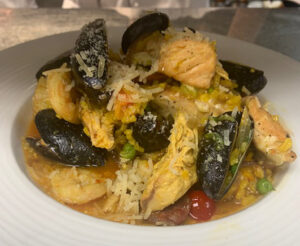
The Hinsdale family owned the home from 1890 to 1971, which perfectly fit their formal lifestyle that included eating every meal in the dining room with their good silver and china. Built originally for Mayor William H. Dodd in 1879, local Raleigh residents in the 20th century came to know it as the Dodd-Hinsdale home. 21st century Raleigh residents and visitors know it as Second Empire, a destination restaurant and tavern where memories of a lifetime are seared as strongly as the seafood paella on the menu, an entrée since day one, Daniel said. “I can’t take it off the menu.”

Empire Seafood Paella: steamed mussels, clams, scallops, seasonal fish, shrimp, saffron rice, chicken, chorizo sausage, stagionato cheese, herb fumét (Photo: Courtesy of Second Empire)

In 1971 when the last Hinsdale family member died at the age of 92, many individuals and groups attempted to acquire and restore the house to its original grandeur but to no avail. This exquisite southern example of Second Empire Victorian architecture, a style developed in France under Napoleon III (1808-1873), fell victim to more than two decades of vandalism and deterioration as the 20th century was drawing to a close.

In 1993, Ted Reynolds, his wife Peggy, along with their daughter and son, Kim and David, obtained an Option to Purchase the property. After two years of planning to convert the house to a restaurant, they completed the purchase and began a two-year renovation with a commitment to retaining the building’s original 14-foot ceilings, deep bay windows and ornate elements to honor its architectural and American history.

The renovation maintained the home’s original exterior, heart pine flooring, masonry walls, and doors and windows. New leaded glass panels were installed in the four original front doors. The original kitchen has been converted into a corporate dining room and a grand new entrance has been constructed in the area formerly used as a rear entrance. An elevator was installed adjacent to a 3,000 square foot, two-story kitchen, bakery and food storage area.

A tavern, additional private dining rooms, and a glassed Atrium that seats 42 people have also been added. Today the restaurant seats 240 guests offering Contemporary American Cuisine.

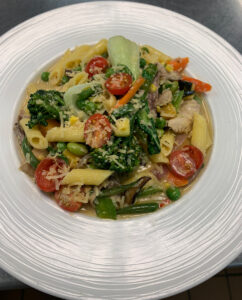
Mustard Braised Rabbit Leg Meat & Penne Pasta: bok choy, zucchini, french beans, snow peas, edamame, shitake mushrooms, butternut squash, peppadew peppers, braised jus (Photo: Courtesy of Second Empire)

Chef Schurr’s Path to Second Empire

Following his tough but loving jolt into adulthood, Daniel found a job in a hotel as a barback. He had to walk through the kitchen to get to the bar so he regularly crossed paths with Michael Mack, the chef. “He was a really great guy and asked me one day if I wanted to learn how to cook,” Daniel said.

For the next 12 months, Chef Mack mentored Daniel. It did not take long for Daniel to realize he had talent and best of all, he enjoyed the entire culinary atmosphere. Not yet “damn good” as his father had advised, Chef Mack took Daniel as far as he could go so he sent him to work under a chef in Birmingham, Alabama. After one year, his new mentor convinced Daniel to cement his culinary career with a degree. Daniel enrolled in the Culinary Institute of America (CIA) in Hyde Park, New York.

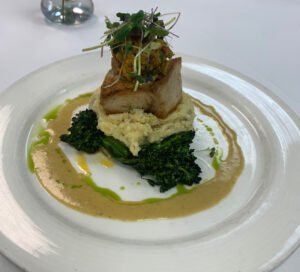
Pan-Roasted Swordfish: creamy ricotta & green olive polenta, harissa roasted broccolini, kabocha squash compote, grain mustard & poblano cream (Photo: Courtesy of Second Empire)

After graduation, he secured a job at the Four Seasons in Philadelphia and in 1996, moved back to North Carolina. Now a “damn good” chef, the Reynolds family hired him to launch their new restaurant where he has been Executive Chef ever since.

What has been and continues to be the secret to his and Second Empire’s success?

“It’s consistency in every aspect of the business. You can’t have a restaurant without the front of the house. Having great managers like Ashley [Dyson] and great staff are the liaison between you, the food and the customer,” Daniel said.

Chef Schurr offers customers a variety of dishes from his Chef’s Table. (Photo: Courtesy of Second Empire)

With 240 seats, he has a total of 50 employees. Daniel is acutely aware of customer experience, the linchpin to repeat business. While he pushes himself to be creative, he also strives to keeps things simple. Daniel said he learned that lesson from one of his favorite chefs many years ago who told him if the menu says roasted quail, it must taste like roasted quail. It’s as simple as that. Daniel said if he cannot get something that will compromise the quality of the dish, he will take it off the menu.

Given the trend away from fine dining, Second Empire remains an oasis for guests seeking that experience. A few months ago while walking through the restaurant, Daniel noticed they were serving many younger guests that evening so he sees a bright future for fine dining.

Daniel keeps his staff laser focused on ensuring customers understand the menu and the wine list. Before customers even open the door, they can be intimidated by the formal Victorian architecture so his staff is trained to warmly welcome guests, answer questions and never be pretentious. “My staff are the educators for people coming to dine at the restaurant,” he said.

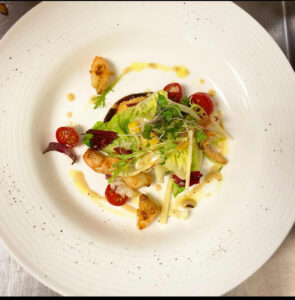
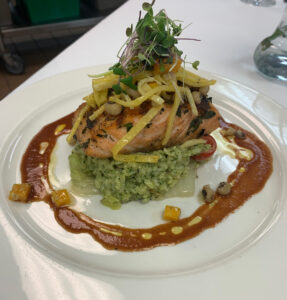
Marinated Grilled Kvarøy Arctic Salmon: basil pesto & grilled oyster mushroom risotto, napa cabbage, celery root, black eyed peas, plum tomato & port wine sauce (Photo: Courtesy of Second Empire)

Second Empire offers guests the choice between a quiet, subdued formal experience on the second floor or a louder, more casual experience at the tavern on the first floor. For a time, Daniel offered different menus but decided to transition to one menu throughout the restaurant, a decision he said simplified operations and has been popular with guests.

There have been many challenges with the pandemic but the layout of the restaurant with multiple rooms helped them easily implement social distancing guidelines when the restaurant reopened in summer 2020 after being closed for about three months. Most of the staff returned although Daniel mentioned he struggles as many restaurants currently do to recruit and hire new employees.

However, there would be no compromise on service because of the pandemic, he told his staff. “Even with a mask on, you’re going to smile with your eyes.”

Omicron is the pandemic’s most recent Covid curveball but Second Empire remains open. While people are canceling reservations due to illness, they are making new reservations so the latest viral variant has not affected them too terribly, Ashley said to Chaîne in a Jan. 11, 2022 email.

Second Empire hosted a Chaîne event in June 2021, which was the first time many members had been out to eat in a very long time. “There were lots of smiles that day,” Daniel said.

Carrying on formal traditions of the Hinsdale family and Ted Reynolds who had the vision to convert the Victorian home to a fine dining restaurant, Raleigh residents and visitors are the beneficiaries of both legacies. Walking into Second Empire is a step back in time and by all signs, a firm one into the future as Daniel has mentored his staff and made his mark.

“I’m still here after 26 years so I must be doing something right.” he said.

Tough love, talent and tenacity are “damn good” ingredients!

LINK
Second Empire Restaurant and Tavern (Raleigh, North Carolina)

Vintners Finish Year With Notes of Optimism and Gratitude

Dec. 17, 2021 – Anticipation is sky-high around the globe and could reach stratospheric levels as New Year’s Eve revelers plan parties to say good riddance, wish a fond farewell or combine the two to cap off the year. Whether the party will be a large raucous gathering with all of the bells, whistles and noisemakers or a more intimate, more subdued get together, millions of people will be clinking glasses in person at the stroke of midnight this year instead of clicking a computer to celebrate. Pure joy! Hope springs eternal that people will be clinking glasses in person throughout the year at venues far and wide. With its trio of deuces, 2022 might just be a lucky one in that regard!

Photo: David Ramsey Photography.

Hand in hand with looking forward as the calendar flips to a new year is also taking a brief pause to look back. The Cuvée Team appreciates the many wine and culinary professionals who allowed us to learn of their fascinating, fast-paced world through an interview for a 2021 Cuvée Spotlight.

We thought readers would enjoy an update about the vintners and wineries featured in 2021 since grapes have been harvested in the United States. The magic has begun for the 2021 vintage. But first, let’s look at a few fast facts about wine production in the United States and in Australia to wrap our arms around the scope and scale of the industry so many people closely follow and love.

Photo: David Ramsey Photography.

DID YOU KNOW?
According to Wine America (The National Association of American Wineries):
• As of January 2019, there were 10,043 wineries in the United States.
• More than 900 million gallons of wine were produced in the U.S. in 2017.
• Wineries in California account for 85% of American wine production.

According to Wine Australia:
• There are more than 2,000 wine businesses in Australia.
• For the 2020 vintage, 1.52 million tons of grapes were crushed producing 1.2 billion litres of wine.
• About two-thirds of annual production is exported with 26% shipped to the United States.

Cuvée Spotlight Updates (Wineries)

The wineries and vintners featured in 2021 are listed in alphabetical order with a brief update and link to their Cuvée Spotlight.

Boisset Collection
Boisset Collection announced on Dec. 8, 2021 that the Elizabeth Spencer Winery in Rutherford in Napa Valley is now in its family of wineries. Boisset’s purchase includes the Elizabeth Spencer wine portfolio of small-production wines from Napa, Sonoma, and Mendocino, and its location on the Rutherford Cross Road, where the historic 1872 Post Office building welcomes guests into a boutique tasting room, outdoor gardens, and studio.

Photo: Courtesy of Boisset Collection

“For more than twenty years, Elizabeth and Spencer have pursued their passion to create a community of loyal wine lovers with Elizabeth’s exquisite hospitality and generosity of spirit and Spencer’s viticultural curiosity. The destination they have created in the heart of Rutherford speaks to their vision, steeped in history with a welcoming environment at the crossroads of history. We are honored to be entrusted to carry forward with their vision and look forward to contributing our inspiration to the phenomenal journey they began,” Jean-Charles Boisset, Proprietor of Boisset Collection, said in a press release. “We are enthralled with the dynamic site they created, imbued with history at the vital crossroads of Napa Valley and their strong family culture, from growers to customers.”

   Cuvée Spotlight: Raise a Glass of JCB No 39 to Toast the World

Brooks Winery – from Janie Brooks Heuck, managing director

“Vintage 2021 was stellar in the Willamette Valley. While we experienced some rain during fruit set in June that led to lower yields, the berries we did get were concentrated and full of tension and acidity. Harvest brought mild weather that allowed us to pick when the fruit was at the perfect point of flavor and sugar development. The wines are beautiful and resting in the cellar. 2022 will bring lots of new bottling including our 2019 Dry Sparkling Muscat and 2017 Dry Sparkling Riesling, both made in the traditional method.”

From left, Pascal Brooks, Janie Brooks Heuck and Chris Williams, winemaker at Brooks Winery (Photo: Courtesy of Brooks Winery)

To innovate during the pandemic, Janie and her team started “Beyond Brooks,” a monthly, educational webinar. Thinking beyond wine, each session pairs Brooks wine with a company producing a complementary product, such as cheese and chocolate, or a company with a similar mission of sustainability and environmental stewardship. Participants receive the monthly bundle before the webinar to ensure an engaging experience.

Now in Season Two, the first three sessions in 2022 are:
1. January: Brooks and Camas Country Mill (sustainably farmed grains and mill products from the heart of Willamette Valley)
2. February: Brooks and Woodblock Chocolate from Portland
3. March: Brooks and Kiss the Ground, a nonprofit devoted to regenerative agriculture

   Cuvée Spotlight: Janie Brooks Heuck Approaches Life with a Wine Glass Half Full 

Lagier Meredith Vineyard – from Carole Meredith, Ph.D., co-owner, geneticist, oenologist
“2021 has been a lovely year for us here at Lagier Meredith. The growing season went smoothly and we picked our grapes at a typical time for us. Not too early, not too late, right on time. The 2021 wines are now all in neutral oak barrels and will rest there peacefully until we bottle them in 2023. And, although it is still 2021, our vines are already working on their 2022 crop. The dormant buds already contain the tiny clusters that will become next year’s grapes. The hugely beneficial rain that we’ve already had here (more than 21 inches since late October!) will serve the vines well when they start their growing season next spring.”

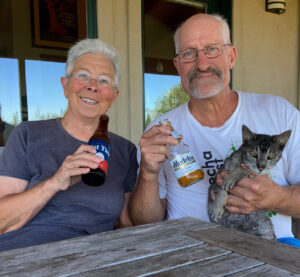
Carole Meredith., left, and Steve Lagier enjoy a beer after bottling (Photo: Courtesy of Carole Meredith)

   Cuvée Spotlight: Carole Meredith, Ph.D., a Wine Expert from Code to Cork

Mollydooker Wines – from Luke Marquis, global sales manager
“G’day, Down in McLaren Vale, South Australia, the home of Mollydooker Wines, it has been a phenomenal lead up to our growing season with winter bringing great rain each month before budburst. A perfect temperature rise throughout spring with vigorous growth and fruit set on all varieties. December 1st being the first day of Summer and warmer weather really kicking in. Growth of the vines have taken off again with the warmer weather and so has flowering, leading into Christmas we are now seeing the fruit developing into well established bunches and the crop looking healthy again after a large 2021 harvest in April this year. With all this, we are excited to see version in January and the developments of intense color and flavors for another beautiful McLaren Vale harvest in Mar/April 2022.”

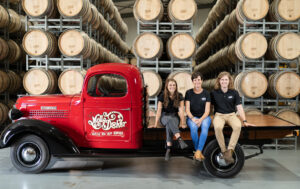
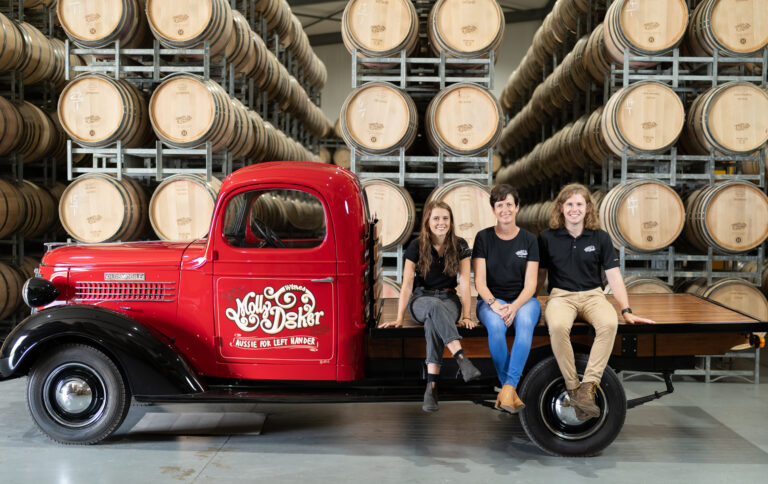
From left, Holly, Sarah, Mollydooker founder, and Luke Marquis are at the Mollydooker Winery in McLaren Vale, South Australia. (Photo: Courtesy of Mollydooker)

   Cuvée Spotlight: Mollydooker Wines: Down Under, Never Out, Now on Top

Ramey Wines – from Claire Ramey
“Harvest 2021 was extremely satisfying, but not without challenge. We were tight on labor, as travel restrictions kept the harvest intern we were expecting in France, though lower overall yields alleviated some of the strain. A combination of drought, unusual heat and unusual cold early in the growing season resulted in highly variable bloom and set, which made accurate sampling essential before scheduling picks. Yields were also highly variable, ranging from 80% below to 140% above average. Weather leading into harvest was fairly even, leading to unhurried pick dates. We did have to push back one pick due to some isolated rain toward the coast. Wine quality appears to be exceptional this year with accentuated varietal character, and particularly deep color in the reds. Twenty-twenty-one is looking like a team favorite.”

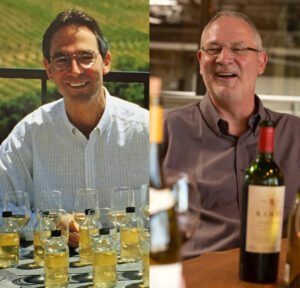
David Ramey, then and now (Photo: Courtesy of Ramey Wines)

Cuvée Spotlight: David Ramey Offers Words of Wisdom on Wine and Life

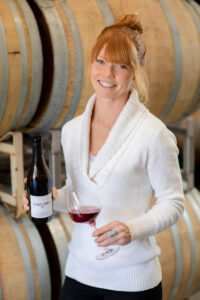
SAMsARA – from Matt Brady, winemaker (owners, Dave and Joan Szkutak)
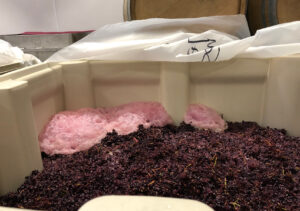
“2021 has been an exceptional vintage! It has all the potential to be a standout vintage of the decade. I’ve lived in Santa Barbara for 20 years now, and 2021 was the coolest year I can remember. Late bud-break, a cool spring, a very moderate summer, and a total absence of the (now normal) Labor Day heat waves. As a result, we had a very long growing season, with lots of hangtime, and pick dates that were 2-3 weeks later than ‘normal’ (particularly with Chardonnay and Pinot Noir). This extra hangtime gave us really big flavors, without the excessive sugar (ie alcohol). We also saw higher than average acidity across the board with all varietals and vineyards. Yields were balanced yet slightly below average at most sites (the lower yields are a good thing in a cold year as a higher crop level would require more heat to fully ripen).”

Matt Brady (Photo: Courtesy of SAMsARA)
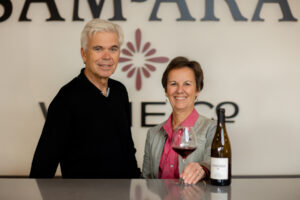
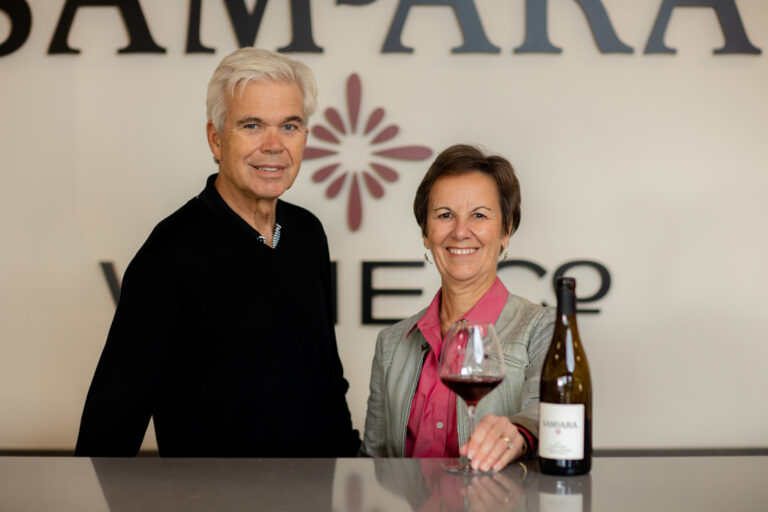
Dave and Joan Szkutak (Photo: Courtesy of SAMsARA)

Dave Szkutak wrote a beautiful end of the year reflection. Below are the first three paragraphs of that reflection:
“It’s early on Sunday morning and the winery is quiet. For the first time in a great while, I am able to reflect on life over the last 2 years; my overwhelming feeling is one of gratitude. I am grateful that the entire SAMsARA Wine Co. team has been able to remain healthy and intact despite the COVID-19 pandemic.
“Our team’s hard work and dedication has been extraordinary, and our business today is as healthy as it can be given all we’ve endured. Like most of you and the businesses you work in, we faced huge challenges and difficult questions brought on by the pandemic and we are thankful to still be here, making stellar wines for you to enjoy. Frankly, without your support we might not even still be heremaking wine this Fall!
“Joan and I are especially grateful to you, our customers! Despite the pandemic, you continued your incredible support of SAMsARA wines. Because of your patronage, we were able to keep ALL of our incredible staff and to shift our attention to finding new ways to stay “digitally connected” to our loyal customers. Many of you took advantage of our Zoom tastings, our e-mail offers, and have found the ease with which you can order wines from our website and have them delivered to your door.”

   Cuvée Spotlight: SAMsARA puts Pinot Noir and Cool Climate Chardonnay on the Map and in a Glass

It’s a Wrap!
Whether it’s raucous or reserved, the Cuvée Team wishes everyone a fantastic New Year’s Eve filled with fine wine, food, family and friends. And then 2022 is on! We look forward to another year of highlighting amazing wine and culinary professionals.

Photo: Yulia Grigoryeva, Shutterstock.

Chef Tony Parker Carves Career with Fortitude and Fun – and Ice

Oct. 29, 2021 – Six years ago when Chef Tony Parker joined the faculty at Renton Technical College (RTC) in Renton, Washington as a Chef Instructor in the Culinary Arts Program, he thought he would be trading years of 16-hour days for a more relaxing eight-hour day. But academia proved just as challenging as a bustling kitchen. For the first two to three years at Renton, he questioned his decision but there is no doubt now that he made the right move at the right time. “I really enjoy it and I love watching people succeed,” Chef Parker, member of the Chaîne Seattle Bailliage, said to Chaîne during a May 3, 2021 telephone interview.

Bailli Délégué des Etats-Unis Bertrand de Boutray with his wife, Brooke de Boutray (Dame de la Chaîne) with Chef Parker’s ice carving on Oct. 5, 2018 at the 2018 US Grand Chapitre for Bailli Appreciation Night at the Museum of Flight in Seattle. (Photo: David Ramsey Photography)

Tony’s path to a successful career as a professional chef began in high school at age 15 when he took a part time job as a bus boy at a large Inn. The Inn was a microcosm of the culinary industry with everything from fine dining, a coffee shop, a lounge with live music to a 500-seat banquet hall. He quickly learned the ropes and before long was running the front desk. At school, he took mechanical drawing courses to prepare for an engineering career.

He continued along those parallel tracks after graduation, working at the Inn and studying engineering as a college freshman.

At the Inn, he found himself back in the kitchen as a breakfast cook under the tutelage of a woman who came to the Inn from a stint running a kitchen at a camp in the Alaskan oil fields. “She was a task master,” Tony said. She drilled into him the importance of being organized and keeping everything clean. Being set and ready for the day set him up for success in the kitchen, an early lesson he internalized that ultimately set him up for success as a professional chef.

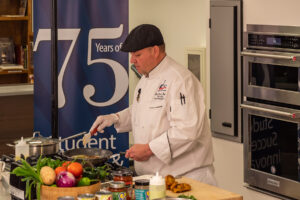
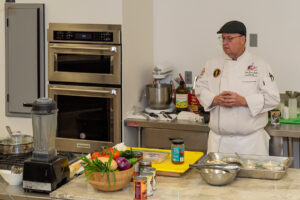
Chef Tony Parker at Renton Technical College prepares a cumin chicken breast, Spanish rice with a fresh avocado crema and Bananas Foster in under 25 minutes for a live demonstration. (Photo: Courtesy of Chef Parker)

In his sophomore year, he took stock of his future. He was having more fun in the kitchen than in engineering school. “Going to work and not wanting to go to work is something you never want to do in any job,” Tony said.

South Seattle Community College Culinary Arts

He informed his parents he wanted to drop out of engineering school to become a professional chef. With their support, he enrolled at South Seattle Community College. Their culinary arts program had a long waiting list with most students waiting more than one year to begin their studies. Each quarter the college held a roll call to admit 30 students. Tony arrived 90 minutes early to a December roll call during a snow storm. Even though he was number 150, he was admitted when few students showed up. He started the next quarter.

Just two months into his first quarter, one of his instructors sent him for an interview at The Westin Seattle Palm Court restaurant. For the next two years, he went to school Monday through Friday from 6 a.m. to 2 p.m. and then worked at The Westin from 3 p.m. to 11 p.m. so Tony’s 16-hour days began very early in his culinary career. “I was doing everything all at once on the fast track when I was young,” Tony said.

The fast track included gaining ice carving expertise after hearing a chain saw on Westin’s loading dock only to find out it was a cook transforming a block of ice into a beautiful sculpture. Tony found any reason he could to go to the loading dock when ice was flying. The cook finally told Tony to buy a some ice carving tools and he would teach him how to carve. Tony borrowed $1,000 from his grandmother for the tools and he was on his way. Leveraging his training and aptitude for engineering, Tony was a natural. He can visualize a sculpture and then bring it to life. The cook was able to sell Tony’s fourth ice sculpture so Tony’s grandmother quickly recouped her investment in her grandson’s future and then some as he progressed to a master ice sculptor.

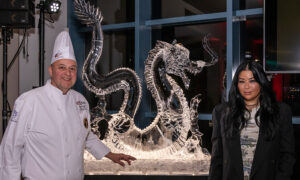
Chef Tony Parker, left, carved an ice dragon for Chef Angie Mar, right, that was displayed at a Celebrity fundraiser held at Renton Technical College on Jan. 28, 2020. (Photo: Courtesy of Chef Parker)

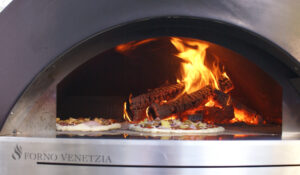
He has created ice art for clients throughout his career and recently began offering guests a fire and ice event with ice carving lessons followed by a wood-fired pizza dinner. What a very hot and very cool evening out!

Chef Tony Parker’s Italian pizza oven (Photo: Courtesy of Chef Parker)

After graduating from college in 1987, Tony became one of three apprentices under Chef Joseph Sir at Seattle’s Rainier Golf and Country Club. He worked long hours six days a week, soaking up the experience and opportunity to learn everything he could. “That was a really great choice to do that for me. It really helped me,” Tony said.

Always giving back, for 10 years while working with the Compass Group, Tony managed the food procurement operation for the Summer Special Olympic Games held at Washington’s Joint Base Lewis-McChord. With the help of the Washington State Chefs Association (WSCA), he built 5000 boxed lunches for the athletes and families.

From 2014 to 2017, he served as WSCA President and has served the organization, an American Culinary Federation (ACF) chapter, in many other capacities.

“It’s really all about education, giving back, helping young culinarians and sharing knowledge,” Tony said. Early in his career, if he had asked a senior chef for a recipe, the answer would have been no but today, chefs are more supportive. “Young chefs need to benefit from our knowledge,” Tony said.

Celebrity Chef fundraiser with Chef Angie Mar at Renton Technical College on Jan. 28, 2020. (Photo: Courtesy of Chef Parker)

Pandemic

All of his work experience and education prepared Tony and other professional chefs for the unforeseen challenges as the pandemic developed in spring 2020 and continued through 2021.

While many industries were in panic mode, the hospitality industry quickly adapted. “In the culinary industry, we wash our hands constantly. We clean our stations constantly. We’re already using these chemicals constantly. It was truly no change for us in the pandemic other than wearing masks and being conscious of your social distancing in the kitchen,” Tony said.

Chef Parker early on learned the importance of organization and cleanliness as essential to success as a professional chef. (Photo: Courtesy of Chef Parker)

The college went 100 percent online at the beginning of the pandemic but by summer 2020, the culinary arts program transitioned to a hybrid model with one-half of the students attending in person classes two days per week and the other half attending two days. Each Friday, all students were online. As of fall 2021, students are back in person five days per week.

To support students during the pandemic, the Chaîne Seattle Bailliage took the initiative to reach out to the program early on. In addition to their ongoing scholarship commitment, the Seattle Bailliage set up a separate fund to help students remain in school knowing that some parents were losing their jobs.

“The Chaîne came straight to me. I thought that was incredible foresight to think about those things then when all the craziness was going on and say, what can we do for the students. They helped a lot of students here just at my school alone,” Tony said.

Seattle has not been immune to nationwide labor shortages. “I get phone calls every single day from businesses that are starting to get back on their feet and they are looking for culinary individuals because a lot of people left. We just don’t have the people to fill the need,” Tony explained.

Community college culinary programs are an industry lifeline. Tony reports that their program is at about 90 percent capacity but it doesn’t begin to address labor needs. “We don’t have anywhere near the number of people to take care of what’s going on out there now and we’re not yet in full swing,” Tony said.

The combined efforts of community colleges, the ACF, and Chaîne to support the next generation of culinarians bodes well for the future even in these uncertain times.

“There are opportunities if you’re smart enough and you have a little fortitude to take it on to grow your business right now and be ready,” Tony said.

But first and foremost from the lessons of Tony’s career path, fortitude mixed with fun is a reliable recipe for success.

Chef Parker and his wife, Paula, enjoying their time in Maui. (Photo: Courtesy of Chef Parker)

LINKS
Renton Technical College Culinary Arts Program

Washington State Chefs Association (WSCA)

Tony’s Ice Creations

Mollydooker Wines: Down Under, Never Out, Now On Top

Image: From left, Holly, Sarah and Luke Marquis at the Mollydooker winery in McLaren Vale, South Australia.

Oct. 8, 2021 – Sarah and Sparky Marquis, acclaimed winemakers in South Australia since 1994, had $17 left in their bank account after a business partnership with a wine importer to whom they had shipped 120,000 cases was not honored. Literally and figuratively “down under” with two young children to raise, they channeled their rugged Aussie spirit to forge a future. A meeting with their 11 employees in 2005 gave birth to their award winning Mollydooker brand. “I am blessed every day to put the Mollydooker shirt on,” Luke Marquis, 25, Sarah and Sparky’s son, Mollydooker global sales manager, and Chaîne member, said to Chaîne during a March 3, 2021 interview.

Luke Marquis, Mollydooker global sales manager (Photo: Courtesy of Mollydooker Wines)

After meeting in college and getting married in 1991, Sarah and Sparky produced their first vintage in 1994 under the Fox Creek label. That vintage and those that followed burnished their reputation for consistently producing superior wines. While making wine under seven different labels, they were three time winners of “Best Wine of Show” at Australia’s McLaren Vale Wine Show, a prestigious annual event with traditions from medieval times to celebrate the year’s best wines.

In 2003, Robert Parker Jr., famous wine critic responsible for the numerical rating system, told his readers to “run, don’t walk to get these wines made by Sarah and Sparky Marquis,” Luke explained. Parker would have a pivotal role in the success of the first Mollydooker vintage three years later.

Sarah and Sparky turned the shock of not getting paid for 120,000 cases of wine in 2004 into action to control their destiny from that point forward.

Mollydooker Wines

They discussed many names for their wine business before settling on Mollydooker, Aussie slang for a left-handed person. Leigh, Sparky’s father-in-law who was their viticulture manager, suggested the name at that fateful 2005 meeting since both Sarah and Sparky are left-handed. There was no doubt the perfect name had been chosen when seven of the 11 employees at the meeting were also left-handed, an uncanny number of lefties. On average, only about 12 percent of the world’s population use their left hand as their dominant hand.

Courtesy Mollydooker wines

The Mollydooker team solidified their brand identity and began marketing. Sarah and Sparky remembered Robert Parker was also left-handed so they asked to meet with him in the United States. Financing the airline fares on a credit card, they took Parker two cases of wine for his review. He had just been released from the hospital with a broken leg but held off taking any pain medication so he could taste their wines. Sarah and Sparky returned to Australia with no indication of Parker’s review.

Looking to finance bottling the 2005 vintage for a 2006 release, Sarah and Sparky sought a bank loan but were declined. Bootstrapping a winemaking operation is a daunting challenge so it was back to the drawing board to scrape up enough capital to continue. They routinely paid their bills early but in 2006, they owed tens of thousands of dollars to many contractors and vendors.

Then a miracle happened. Neil Brine, a member of the Board of Directors from the bank that had turned them down, asked to come for coffee at their Adelaide office. Thinking it was a social visit, Sarah and Sparky were more than gobsmacked when Neil asked them how much money they needed to pay all of their bills and bottle their 2005 vintage. After a few calculations, they told Neil they needed $300,000. Neil walked out to his car and returned with a check for that amount without asking for any control of the business or even a contract. He was leaving for an extended stay in Japan so he simply shook their hands and said, “Good luck. Go have fun. I know you’re going to succeed.”

Mollydooker’s Estate in McLaren Vale, South Australia (Photo: Courtesy of Mollydooker Wines)

And succeed they did. It takes about four weeks to ship wine from Adelaide to Oakland, California. Two weeks into the trip across the ocean, Robert Parker published his article, rating many Mollydooker labels at the top or near the top of his lists. He awarded Mollydooker’s The Boxer as the “Best Value Red Wine in the World” and their The Violinist as the “Best Value White Wine in the World.” In addition, their Carnival of Love received 99 points. “So now we had every distributor and every buyer in the U.S. screaming for this product,” Luke said. When the ship docked, all 70,000 cases sold in 17 days.

Mollydooker’s Carnival of Love (Photo: Mollydooker wines)

“We started with $17 in our bank account and in 17 days, we sold out of our first ever vintage,” Luke said. “It’s a very emotional story because if it wasn’t for Neil Brine, I would not be here. We would not be here as a business. It was a miracle, a Mollydooker miracle that that situation happened to my family.”

In the busy years that followed, Luke remembers listening to his parents talk about all facets of the business at dinner each evening. Luke and Holly, his younger sister, grew up as Mollydooker matured into a highly regarded and popular international brand that included Gigglepot, named after Holly, and Blue Eyed Boy, named after Luke.

Holly Marquis (Photo: Courtesy of Mollydooker Wines)

In 2007, Sarah and Sparky purchased a winery and 115 acres of vineyards in McLaren Vale while contracting for grapes on another 150 acres about 22 miles (35km) south of Adelaide. The vineyards and the business continue to blossom year after year.

Current Production and Key Points of Differentiation

Mollydooker today produces about 80,000 cases so they haven’t increased annual production significantly since 2006. That’s just fine with them. Their grapes are in the driver’s seat but the engine is the Mollydooker team, which is led by Sarah, sole owner since 2016 and chief winemaker.

Sara Marquis (Photo: Courtesy of Mollydooker Wines)

Peter Constantine, vineyard manager, and Peter Tavella, senior winemaker, have been with Mollydooker for more than 15 years.

Peter Constantine, Mollydooker vineyard manager (Photo: Courtesy of Mollydooker Wines)
Peter Tavella, Mollydooker senior winemaker (Photo: Courtesy of Mollydooker Wines)

As global sales manager, Luke has the big picture. About 50 percent of their annual production is shipped to the United States, he said. Leveraging his parents early and lasting innovations in the vineyards and in the winery, Luke is proud to explain to distributors and customers Mollydooker’s three key points of differentiation – use of nitrogen, irrigation, and fruit weight.

Nitrogen
Nitrogen is added to preserve their wine to minimize the amount of sulfites needed. They advise customers to give their bottles a Mollydooker Shake once opened to allow nitrogen to escape before pouring.

Irrigation
During peak growing season, they irrigate their vineyards up to eight hours per day so they keep fruit on vines about four weeks longer than other vineyards. This practice gives grapes natural time to develop color, flavor, fruit weight and quality.

Fruit Weight
Their winemaking team carefully analyzes fruit weight to grade grapes throughout the growing season and winemaking process. They harvest when data on acidity and sugars tells them they have achieved the “Sweet Spot.” On their website, they state, “The Marquis Fruit Weight is our measure of quality. It’s the percentage of your palate (from the tip to the very back of your tongue) that is covered by the velvety sensation of fruit that occurs when a wine’s tannins, alcohol, and acid are all perfectly balanced.”

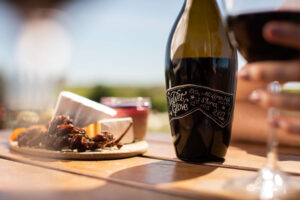
Mollydooker’s Velvet Glove (Photo: Courtesy Mollydooker Wines)

At 95 percent and higher, the entire tongue is coated with a silky sensation, a rating reserved for Mollydooker’s Velvet Glove label. Their popular Carnival of Love is rated from 85 to 95 percent Fruit Weight.

“We are not guessing. It’s 100 percent consistent,” Luke added. If grapes do not meet established standards, the wine variety is not made that year.

Sip It Forward
Grateful for their own miracle, the Marquis family and business are facilitating miracles for others in need around the world. Cheer and goodwill are bottled with the wine. Mollydooker extends that goodwill to financial support for three charitable organizations – Transform Cambodia that has opened three education centers for children; Mercy Multiplied in the United States to help women break free of controlling or abusive situations; and Hutt Street Centre, which serves the homeless population in Adelaide. Mollydooker donates 30 percent of its group tasting fees to the Centre.

Pandemic Challenges
In an Oct. 1 email exchange, Luke said while they are not yet back to a pre-pandemic normal, their MollyClub (Wine Club) has experienced significant growth in the United States and Australia with more than 200 sign ups per month. They just sent the September shipment with a special gift to members.

Supply chain issues have been a problem. Luke reported longer shipping times and even difficulty getting containers booked to the United States. Mollydooker distributes their wine from two warehouses in the United States, one in Ohio and one in California. With supply chain disruption, some labels are out of stock, which is never ideal. Overall, Luke remains optimistic though as restaurant and retail segments of the business begin to come back.

Having survived business and natural disasters to build a brand that Luke occasionally sees tattooed on people’s bodies, the Marquis family and Mollydooker team have forged a very bright future for both left-handed and right-handed wine lovers!

“We make make wines that make people go WOW through attention to detail and commitment to excellence,” Luke said.

LINKS

Mollydooker MollyClub (Wine Club)

Transform Cambodia

Mercy Multiplied

Hutt Street Centre (Adelaide)

Carole Meredith, Ph.D., a Wine Expert from Code to Cork

Sept. 3, 2021 — Do you know the parents of the Chardonnay grape? Did you even know the Chardonnay grape, and all grape varieties for that matter, have parents? Carole Meredith, professor emerita at the University of California at Davis, co-founder and co-owner of Lagier Meredith Vineyard in northern California and 2009 inductee into the Vintners Hall of Fame, does. In 1997, she and her genetics research team at the university discovered, with a little sip of serendipity, that Chardonnay’s mom is Gouais blanc and Chardonnay’s dad is Pinot noir. “That was a wonderful discovery,” Carole said during a March 2, 2021 telephone interview with Chaîne.

Lagier Meredith Vineyard produced its first commercial vintage in 1998. (Photo: Courtesy of Carole Meredith)

Carole’s esoteric work as a grape geneticist and sequence sleuth from the 1990s through 2003 rivals that of Sherlock Holmes, Nancy Drew and James Bond all rolled into one. At least those famous sleuths had other cases from which to draw inspiration. Carole and a few other scientists around the world had to make their case that advances in the 1990s in DNA technology used to solve crimes could also be instrumental in determining identities of wine varieties. The idea represented a bold and daring leap, one that proved prescient and practical as winemakers were able to confirm their varieties.

Finding grape DNA markers naturally leads to delving into history too. Carole explained the Gouais blanc variety, Chardonnay’s mom, originated in central Europe and was most likely brought to France during the Roman era.

After Carole’s years as a genetics sleuth, she retired from academia in 2003 to devote full time to the vineyard she and her husband, Steve Lagier, planted on Mount Veeder in the Napa Valley after purchasing the land in 1986.

Carole Meredith and Steve Lagier at home on their Napa vineyard property, where they have lived for 35 years. (Photo: Courtesy of Carole Meredith)

Few vineyard owners can walk their vineyard as Carole can with such deep understanding of their fruit.

Human and Grape DNA

With 23 chromosomes made up of 3.2 billion base pairs of A-T (adenine and thymine) and C-G (cytosine and guanine) nucleotides, humans are vastly similar but also different to the point that relationships can be deduced simply by matching DNA segments, or markers.

Carole pondered that application to confirming the identity of grape varieties being grown in New World countries from Old World cultivars that may have been present in Europe for thousands of years. She explained that names of grape varieties were often lost when vines were transported to other parts of the world. The only way to prove a grape being grown in a New World country, such as Australia, the United States, New Zealand and Argentina, is an authentic Old World cultivar is proving its genetic identity.

Lagier Meredith Vineyard 2019 Syrah cluster (Photo: Courtesy of Carole Meredith)

In the 1990s, her research lab at UC Davis began the laborious work of identifying DNA markers in grapes, sequences of the same base pairs present in human DNA. It’s an area of research historically not well funded but one she felt would provide valuable scientific knowledge and practical application to vintners and the wine industry in general.

“Our initial thought was that if we could develop genetic markers for grapes similar to the kind of genetic markers that were being used in humans, that we could use those markers to try to match a New World grapevine to a proposed Old World counterpart,” Carole said.

Lagier Meredith Vineyard in northern California (Photo: Courtesy of Carole Meredith)

She and her research team began sequencing grapevine DNA to identify regions on the grape genome that would be useful to deduce relationships. They approached it methodically by following a step-by-step process that became increasingly more sophisticated.

After referencing authentic Old World samples, they first discovered a California grape being grown as Pinot blanc was actually Melon de Bourgogne. While UC Davis had a reference collection of European grapevines, it did not include Melon so they obtained one from French colleagues to match the markers between the two samples.

After identifying this grape variety, they expanded their efforts to look at relationships. Carole is quick to point out that research labs in Australia and Vienna were also developing grape genome markers at the same time. The labs agreed to share results to advance the science more quickly.

Having developed a small number of genetic markers, Carole’s lab made an exciting discovery about the parents of the Cabernet sauvignon grape. Its mom was Sauvignon blanc and its dad was Cabernet franc. To prove the relationship, her team tested their findings with robust statistical tools to determine not only that was it possible but also it was probable that the grapes were a family. Similar to a court of law, Carole said they proved the relationship “beyond a reasonable doubt.”

With these successes and most likely a few toasts of Cabernet sauvignon and Chardonnay for their efforts, they kept advancing the science. In the late 1990s at a meeting of the International Plant and Animal Genome Conference, held annually in San Diego, Carole proposed a consortium of international researchers to share their results. After legal documents were signed, 20 entities participated in expanding the grape genome marker database. Through their collaboration, the consortium identified more than 400 markers for grapes.

John Bowers, one of Carole’s graduate students, wrote his doctoral dissertation in 1998 after working in France with Jean-Michel Boursiquot, an internationally known expert in cultivated grape varieties, to identify genetic relationships among grape varieties associated with northeastern France. John found the parents of 26 varieties, including the Chardonnay grape.

Carole and her team made a few landmark discoveries early on in the partnership. Eventually the consortium, called the Vitis Microsatellite Consortium, identified enough genetic markers to develop a genome map of a grape. The map is not an entirely sequenced genome but a linear arrangement of hundreds of genetic markers along the 19 chromosomes grapes have. It’s useful in identifying and isolating genes and is still relevant today. “Having a genome map is a necessary prerequisite to isolating genes,” Carole said.

Lagier Meredith Vineyard
During this time, Carole had the perfect location when she needed a break from her laborious yet exciting lab work. In 1986, she and Steve purchased 84 acres of mountainous property in the Napa Valley. Steve has been a winemaker for 40 years, leaving Robert Mondavi in 1999 as their own business developed.

Lagier Meredith Vineyard (Photo: Courtesy of Carole Meredith)

The legal definition of the Napa Valley American Viticultural Area (AVA) includes surrounding mountains. At 1300 feet above sea level, their property is not high enough for elevation to be a major factor in growing grapes but its shallow mountain soil is a key factor, Carole said. Shallow soil can only hold a minimal amount of water and nutrients so the vines are not excessively vigorous, she explained. Because the vines are not vigorous, the grapes are smaller but not shaded so they develop deep color with complex flavors. It took Carole and Steve eight years to prepare about four acres of land for their vineyard.

Steve mowing the vineyard (Photo: Courtesy of Carole Meredith)

Their location near San Francisco Bay allows marine air to bask the vineyard in cooler air, which allows the grapes to ripen more slowly than vineyards in warmer locations. Their knowledge of grapes and wine led them to believe their vineyard would produce great wine but they did not set out to open a commercial winery. They wanted to produce wine to enjoy. After planting their first vines in 1994, they added other grape varieties. Their 1998 vintage, released in 2000, was their first commercial vintage following rave reviews of their wine through word of mouth. Today they produce a total of 800-900 cases with four varieties with marketing efforts focused on social media.

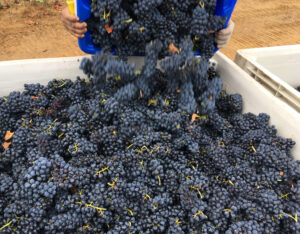
Lagier Meredith 2019 harvest (Photo: Courtesy of Carole Meredith)

Carole commuted back and forth between UC Davis and Napa but as the business blossomed, she was stretched too thin and decided to retire from academia in 2003 but certainly not from work. She is the first to admit growing grapes and making wine involves a lot of work but it’s a life she and Steve embrace wholeheartedly. They have not taken a vacation in 20 years. Standing in their vineyard overlooking the Napa Valley is a vista they love each and every day.

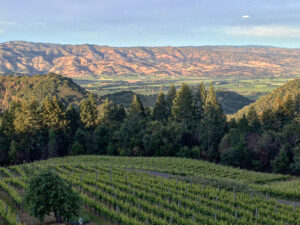
The vista from the Lagier Meredith Vineyard (Photo: Courtesy of Carole Meredith)

Their daily life is their vacation. She enjoys being her own boss but most of all, Carole said making a living off the land, a tradition vintners have done for hundreds and even thousands of years, is very rewarding.

Informed decisions, along with serendipity that has followed Carole since her genetic sleuthing days, have helped them recently through wildfires and the pandemic. When they built their house on the property, they used fire resistant materials and have kept the brush low and cleared away from the house. A devastating set of wildfires in 2017, called the Wine Country fires, encircled their house but stopped when the fire ran out of fuel – brush. The 2020 wildfires did not affect them but they are looking ahead.

“Now we’re just preparing for the next one and there will be a next one,” Carole said.

Although they sell a small amount of wine to restaurants, most of their business has been and remains direct-to-consumer, a definite advantage during the pandemic. It was another sip of serendipity when they decided to produce their first commercial vintage in 1998 just as the internet was redefining retailing. They became early adopters and now have a full eCommerce platform. The pandemic had no effect on their business. “We’ve been very, very fortunate in that regard,” Carole said.

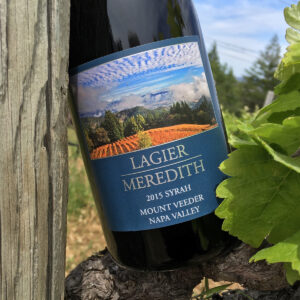
Lagier Meredith 2015 Syrah (Photo: Courtesy of Carole Meredith)

There is no need for a sleuth to unravel the mystery of why Lagier Meredith wines have had a loyal following for many years. With their hands-on, heads-up and hearts-in approach and their deep understanding of the fruit, the soil, the climate, the winemaking process and the business, Carole and Steve have the unique combination to unlock the potential of those grape genetic markers Carole identified in her lab years ago.

“It’s very, very satisfying to have bought this property and to have initially started with the idea to just make a little wine for ourselves and then finding that people liked it,” Carole said.

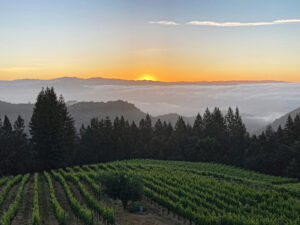
A breathtaking view in June 2021 from the Lagier Meredith Vineyard (Photo: Courtesy of Carole Meredith)

Links

Lagier Meredith Vineyard

University of California at Davis Department of Viticulture and Enology

Chef Christopher Galarza is a Catalyst for Culinary Change

Aug. 20, 2021 — Many words in the English language can prompt a collegial, verbal volleyball game played by scientists and sociologists alike. For example, chemists devote their careers to researching bonds, forces that allow chemical elements to share or transfer electrons to form chemical compounds. Thousands of years ago in veins deep in the Earth, ionic bonds joined sodium with chloride to produce table salt. But to sociologists, bonds are sometimes inexplicable forces that draw people together, the beating heart of society. Now think of the word, induction. To Chaîne members, it’s a ceremony to welcome new friends to their beloved culinary organization. To Chef Christopher Galarza, founder and culinary sustainability consultant of Forward Dining Solutions, co-host of the Sustainable Overload Podcast, and member of Chaîne’s Pittsburgh Bailliage, induction has meaning in erudite worlds of both science and sociology. As an expert in sustainable culinary solutions, he believes commercial induction ranges, which use an electromagnetic field to more efficiently and effectively heat pots and pans, will transform the way chefs and their staff work to create a healthier, more efficient environment. “The future of this technology is no longer in the future. It is now,” Chef Galarza, 31, said during a March 18, 2021 interview with Chaîne.

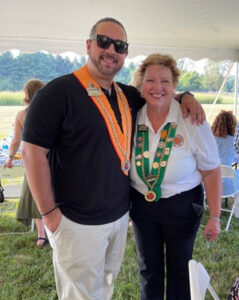
From left, Chef Christopher Galarza and Bailli Jill Kummer at a Chaine picnic in Pittsburgh. (Photo: Courtesy of Chef Galarza)

The story of how Chef Chris created his future is nothing short of remarkable, the stuff of which Hollywood movies are made. At times homeless as a first generation American with a Brazilian mother, Chris found comfort at the many cultural food festivals in New Jersey where he spent his youth. “It was my escape to a better place,” Chris said. He fantasized not only about food but also about careers around food.

After moving to Florida, at 15, a local restaurant hired him as a busboy. Although his job was primarily in the front of the house, he was often found lingering in the back of the house. “I would constantly get in trouble for being in the kitchen talking with chefs, asking them what they were doing. All I wanted to do was to learn more about the food, more about the chefs, what they were doing and why they were doing it,” Chris said.

Educational journey

At 16, he was hired as a cook. “I was god-awful at it but loved it,” Chris said. With unbridled ambition to excel, he bought the Culinary Institute of America (CIA) textbook, reading and writing it out from cover to cover to learn how to be a chef.

Now a self-taught chef at 19 years old, Chris decided he needed to earn a degree to further his career. He only applied to culinary schools in northern states because he missed seasons filled with snow and rain. A rainy day is his kind of weather because of its relaxing nature, he said.

The Art Institute of Pittsburgh accepted him into their culinary program so off to Pittsburgh he went. “It was life altering,” Chris said. He graduated with a Bachelor of Science in Culinary Management. A professor helped him land his first job at The Greenbrier where he was one of 12 apprentices to Chef Richard Rosendale, a Certified Master Chef. “I was very fortunate,” Chris said.

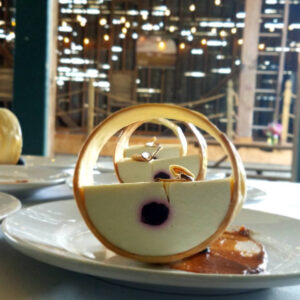
In 2019 to honor the year of the Total Solar Eclipse, Chef Galarza made this ‘Total Eclipse of the Tart’ for a Chaîne event. It was a goat cheese and pear panna cotta with a blackberry inlay. Chef Galarza reports that it was delicious and he was really proud of his creation! (Photo: Courtesy of Chef Galarza)

While there, he learned from five culinary Olympians, worked an event with three Master Chefs, and met Chef Gerard T. Kenny II who became one of Chris’ best friends. Chris said he never could have imagined as a high school student that one day he would be advancing his culinary skills, learning ice carving and being introduced to wine tasting at The Greenbrier.

From The Greenbrier, Chris went back to Pittsburgh where his girlfriend, who is now his fiance, was living. He ultimately took a job as a catering chef at Carnegie Mellon University and soon found himself catering private events for the university president.

Chris and his fiance, Kristina (Photo: Courtesy of Chef Galarza)

Few people could rise so far and so fast as Chris did without very specific goals. By the time he was in his mid-twenties, he had checked most of his boxes except one. He defined a goal years ago to perform a “world’s first” within the culinary profession. It was time to accomplish that goal.

Sustainability and all-electric commercial kitchens

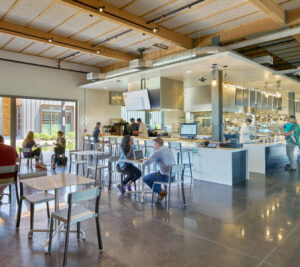
He left Carnegie Mellon to accept a position at Chatham University to develop their first sustainable all-electric commercial kitchen in Eden Hall. This time there was not an authoritative textbook to consult so he devoured information he could find about electrification, decarbonization and sustainability.

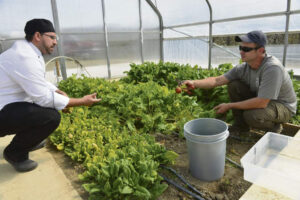
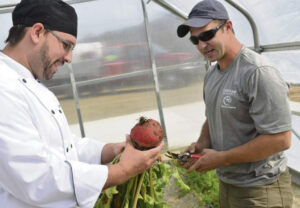
Chef Galarza inspects produce growing in the Chatham University Greenhouse. (Photo: Courtesy of Chef Galarza)

The project was a complement to the university’s farm-to-table focus with their own vegetable and fruit farms and a forest of sugar maple trees that are tapped each spring for maple syrup production.

“It was a chef’s playground,” Chris said. “I got to work with technology I never heard of before and learn all about it. It was so much fun.”

Chef Galarza inspects a beet growing in the Chatham University Greenhouse (Photo: Courtesy of Chef Galarza)

Chris is passionate about electrification with its many scientific as well as social benefits. Electric induction ranges are 93 percent efficient versus 50 percent for a top-of-the-line gas range and 35 percent as an average, he explained. Only the pan gets hot on an induction range so overall, the kitchen stays cooler with no harmful carbon monoxide emissions, which are very important benefits to chefs and their staff. Studies have shown people are comfortable working in temperatures from 60 to 74 degrees but once gas ranges are turned on, kitchen temperatures can quickly soar to over 100 degrees. “If you feel the heat in the kitchen, that is money wasted,” Chris said.

Chatham University’s Eden Hall (Photo: Courtesy of Chef Galarza)

Most important, in blistering hot temperatures, tempers can flare as quickly as the food. Keeping the air cooler keeps staff cooler, calmer, and focused on their task at hand, he added.

Finally, induction ranges are cleaned with hot, soapy water instead of harsh chemicals so less time is required for cleaning and staff are not exposed to any harmful cleaning solutions.

Chef Galarza developed the first all-electric kitchen on a campus for Eden Hall at Chatham University. (Photo: Courtesy of Chef Galarza)

In 2018, his Chatham University kitchen caught the attention of Microsoft. The software giant had been contemplating converting to all-electric kitchens at their expansive Redmond, Washington campus for three years but lacked expertise to proceed.

Microsoft hired Chris to be their project consultant, another milestone in his career that he could never have imagined as a high school student with a part time job as a busboy.

Chris formed his own consulting company (Forward Dining Solutions) and remained at Chatham until 2020 when he decided to “go full steam ahead” with his consulting business after realizing he had quickly become the leading expert on sustainable, all-electric commercial kitchens. The pandemic slowed him down somewhat but he is now busier than ever literally writing his future and that of the culinary industry in the United States.

In April 2021, Chris launched the Sustainable Overload Podcast with co-host Chef Juice of RxMusic (Joshua Weiblinger – stage name Xander Wayne) to interview industry leaders and innovators in engineering, architecture and culinary arts about sustainability.

“Sustainability isn’t a fad, electrification and decarbonization isn’t a fad. These conversations on how to better our systems aren’t just vapid discussions by virtue signalers hell bent on changing systems for the sake of change. The truth is that there are real people out there who want to do what’s best for us all and are using sound reasoning, judgment and most importantly data to make change. In a nutshell, it doesn’t’ seem like I’m alone anymore,” Chris said in an Aug. 12, 2021 email.

With strong bonds formed at The Greenbrier, a few weeks ago Chef Kenny joined Forward Dining Solutions as the company’s new Director of Strategic Operations and is Chris’ business partner.

While his focus is on commercial kitchens, Chris has been keeping an eye on the residential market.

“This tech is far more ubiquitous at the residential level than the commercial. It’s going to take education and experience before we see the proliferation of induction technology in the commercial kitchen but for now there are great gains taking place at the residential level,” Chris said.

He believes the primary barrier to adoption in commercial kitchens is twofold: education and mindset.
“As Americans, we have a real bad problem when it comes to change. We have an aversion, almost like an allergy, to change. We push back hard, never really giving it the time of day,” Chris said. The mindset is the well known adage, “If it ain’t broke, don’t fix it,” he added.

But Chris calls on chefs to think about their long history of leadership. “As chefs, we have always been innovators. We have always been those who push the culinary envelope.”

In the next few months, there will be many opportunities for chefs to tap into Chris’ expertise. Chris will be speaking in September at the NetZero Conference and the GreenBuild Conference (links below). And he will be teaching a cooking series for the Phipps Conservatory in Pittsburgh, one of the most sustainable campuses in the world, Chris said.

In a July 28, 2021 press release, Phipps Conservatory and Botanical Gardens announced their lower campus of groundbreaking green buildings received a Top Project of the Year Award in the Environment + Energy Leader Awards program. (Photo: Phipps Conservatory and Botanical Gardens)

And at the end of the year, the Design Professional’s Guide to Decarbonization of the Built Environment will be published by the William J. Worthen Foundation. Chris helped write the Guide, which will likely end up in the hands of many ambitious young chefs plotting their futures in the profession as Chris did by soaking up knowledge.

“I’ve always been a nerd. I’ve always loved the science of cooking more than actual cooking. I’ve always loved how something works more than actually using whatever equipment that is. This is the best of both worlds. I love food. I love this industry and in doing so, I get to effect change,” Chris said.

Chef Chris is clearly a catalyst for culinary change, both scientifically and sociologically speaking!

LINKS

Forward Dining Solutions
Sustainable Overload Podcast
NetZero Conference
Chatham University
The Greenbrier
GreenBuild Conference
The Design Professional’s Guide to the Built Environment (William J. Worthen Foundation)
Phipps Conservatory

SOCIAL MEDIA

Chef Christopher Galarza | LinkedIn
Christopher A. Galarza (@forwarddiningsolutionsllc) • Instagram photos and videos

Chef Bryan Frick, Friendly ‘Mad Food Chemist’ and Part-Time ‘Pirate’

July 22, 2021 – As a young boy, Bryan Frick fondly remembers sitting on a potato chip can in the commercial kitchen where his dad worked as a chef. Bryan watched people in perpetual motion turn basic ingredients into incredible meals. He liked everything about the environment. As a father, Chef Bryan Frick, Corporate Executive Chef in the Food Service Division of Nestlé; 30-year member of the American Culinary Federation (ACF); and member of the Orlando Bailliage of The Chaîne des Rôtisseurs, took his son Ryan to work with him at his own restaurant. Ryan was not as enamored with the kitchen as he had been. In fact, Ryan hated the business because his dad had to spend so much time away. But today, Ryan is the Banquet Sous Chef at the Marriott in St. Petersburg, Florida. “It’s funny how it gets into your blood so we have three generations who have all been chefs in our family,” Bryan said during a Feb. 25, 2021 telephone interview with Chaîne.

Chef Bryan Frick and his wife Jane, at a Chaîne dinner. Bryan says Jane is his “Best Supporting Actress.” (Photo: Courtesy of Chef Frick)

With his culinary heritage, Bryan carved out his culinary career path early with a lofty goal to one day work at both the White House at 1600 Pennsylvania Avenue and at Disney on Main Street USA.
Along his road to achieving that goal, each stop prepared him for his next challenge.

In college, he was working in a kitchen when the head chef announced one day he was leaving and Bryan had to make gravy for dinner. He had never made gravy before. In a bit of a panic mode, the panic quickly subsided after a call to his dad for guidance. His dad talked him through the process and Bryan was ready for his next challenge.

After graduation and a three year apprenticeship in Columbus, Ohio, Bryan bought his own restaurant in a rural farming community. “Talk about coming out of the skillet and into the frying pan was quite an understatement,” Bryan said.

Disney Dream Comes True

He operated the family restaurant for five years and then sold it to open a new chapter in his life. His dream of working at Disney came true and he was off to Orlando where he worked for 11 years as a chef opening restaurants at hotels throughout the resort. During this time, he achieved the second part of his goal to work at the White House. Through his involvement with the ACF and Disney, he fed three presidents and while he didn’t technically work at the White House, he traveled to 1600 Pennsylvania Avenue a number of times to meet with culinary professionals to plan and coordinate events that included the “Chef Moves to School” program by Michelle Obama.

Similar to what many chefs with experience at Disney say, Bryan would draw upon and benefit from those years in ways he could never have imagined while working there.

Career at Nestlé

Nestle LogoIn 1997, a friend approached him about the potential to work for a subsidiary of Nestlé. He jumped at the chance and the challenge. As the world’s largest food company, Nestlé has more than 150 United States locations in 31 states for many facets of its vast business including manufacturing locations, Research and Development, supply chain facilities and corporate offices. In 2020, the company reported $84.3 billion in total sales with their Food Service division one of their top three divisions.


When Bryan reported for work, his colleagues were world class chefs, which at first was intimidating until he reflected on his new job as a Corporate Executive Chef.

“At the end of the day, it all goes into the frying pan, it all goes into the oven, and it all gets prepped the same way. No matter what your upbringing is, it’s food,” he said.

Nestlé senior chefs took him under their wings and 25 years later, Bryan is the senior chef mentoring young chefs within Nestlé and in the community. “I would never have seen that coming,” Bryan said.

Bryan describes his role at Nestlé as a liaison between their large corporate clients and Nestlé’s food technologists based in Solon, Ohio. He works extensively with culinary teams across the country for national chain restaurants. Each chain seeks consistency so Bryan will work with them to standardize seasoning pouches and other ingredients. “Tell me what color you want it and how you want it to taste. We’re kind of like the mad food chemists, in a good way,” Bryan said.

In this 2019 photo, a Nestlé food scientist is working on microalgae for new plant-based food products, a major focus at Nestlé now and into the future. (Photo: Nestlé)

With input from his corporate clients, he then must effectively communicate product requests to food technologists and scientists. Achieving the desired food texture can be especially difficult. “Gloppy” is not a word in a scientist’s professional vocabulary, Bryan said with a chuckle.

In this 2019 photo, Nestlé food technologists are working on vegan cheese, a new plant-based product. (Photo: Nestlé)

Bryan clearly has mastered the role of building bridges between product requests and product successes. He was named Nestlé’s Chef of the Year for National Accounts in 2006, 2007, 2011, 2012, 2014 and 2018.

Nestlé Mission

On Nestlé’s corporate website next to their logo are the words, “Good food, Good life.” Highlighted in the left navigation is the statement: “We unlock the power of food to enhance quality of life for everyone, today and for generations to come.”

Chef Bryan Frick, left, unloads 10-pound boxes of produce for the July 31, 2020 Truck to Trunk food initiative during the pandemic. (Photo Courtesy of Chef Frick)


Each of the 20 Nestlé Executive Chefs works closely with communities in their geographic region to support the company’s mission. On July 31, 2020 in Orlando, Nestlé provided the time to work with Five Star Produce Company from Naples to help local farmers deliver produce to families in need so it did not waste in their fields. Through this “Truck to Trunk” initiative, eight semi trailers were unloaded for a total of more than 11,200 boxes, each a 10-pound box of produce for families.

The Second Harvest Food Bank of Central Florida has an apprenticeship program for students. (Photo: Courtesy of Chef Frick)

And Bryan facilitated the donation to support students in the Apprentice program at Second Harvest Food Bank in honor of Chef Wolfgang Bierer who was presented with the Honor of the Golden Toque. Second Harvest prepares meals for hundreds of people each day.

Bryan is also active in the Coalition for the Homeless of Central Florida, an organization that serves more than 500 men, women and children each day through their residential programs.

Chef Frick, center, participates in the Center for the Homeless “The Mission in Orlando Donation.” (Photo: Courtesy of Chef Frick)

Nestlé’s mission is closely aligned to that of Chaîne. Bryan likes to add “Good friends” after Good food, Good life to describe the Chaîne.

As an active member of the Chaîne Orlando Bailliage, Bryan said he and others have been nurturing young chefs, including Chef Jennifer Denlinger who is the Chargée de Presse of the Orlando Bailliage. They have enjoyed watching Jennifer and other young chefs grow in their profession with their unique perspective. As a professor at Valencia College, Jennifer created an escape room in one of her classes to teach important culinary concepts. “Now that is really cool,” Bryan said.

Chef Jennifer Denlinger is the 2020 American Culinary Federation Chef Educator of the Year. (Photo: Courtesy of Chef Denlinger)

Recognizing that senior chefs influence many individuals, Bryan advises culinary students to become engaged and vocal by asking questions. “They have to be pulled into the ring of fire,” Bryan said.

He agrees with Jennifer that choosing a culinary career is a lifestyle choice because the job certainly does not fit into a 9-5 mold. Even leisure time for a chef often has a culinary component.

Bryan has a fun and fascinating hobby of participating in pirate festivals. Before the pandemic, Key West hosted a large festival each year in early December. Food, drink and of course, cool costumes transport guests back to the early 1800s and the days of the pirate. Scumlandian stew boils in kettles while guests line up for a glass of grog, a combination of whatever people have in their liquor cabinets to contribute, Bryan explained. He said he could never write a recipe for grog.

Chef Bryan Frick cooks up a storm at a Pirate Festival! (Photo: Courtesy of Chef Frick)

Hopefully, festivals of all types will soon return.

Pandemic Challenges

Operating through a pandemic during the past 18 months has put enormous stress on everyone.

Before the pandemic, Bryan traveled around the world. He was always in the skies and in kitchens meeting with clients. He would return home on Friday and begin preparing for his next trip on Sunday. The pandemic totally upended that routine as he and the rest of the country switched to virtual. Bryan drew on his Disney experience. “Before I was an actor on a stage. Now I am an actor in a video in my own kitchen doing culinary demos, editing, and putting music to it. It’s a whole different mindset than we did before. My 11 years at Disney were a huge help,” Bryan said.

The challenges though continue in ways few could have predicted.

In a follow up email interview on July 18, 2021, Bryan said labor and food shortages have prevented many restaurants from operating. There are high demands for what was normal before COVID but that is currently not possible. “No matter how hard we try to make things happen, the components are so deep that the wheels just aren’t turning,” Bryan said. But he remains optimistic, noting the deep commitment chefs make to their profession. “Business is trying to correct itself and it will, and as chefs as we always do, we work with what we have and adapt. Our direction hasn’t changed, great food, great company and cheers to the future,” he said.

Editor’s Note (July 24, 2021): An earlier version of this article said Jennifer Denlinger was the Orlando Bailli but has been corrected as Chef Denlinger is the Chargée de Presse of the Orlando Bailliage.

LINKS
Nestlé

Second Harvest Food Bank of Central Florida

Coalition for the Homeless of Central Florida

SAMsARA puts Pinot Noir and Cool Climate Chardonnay on the Map and in a Glass

July 9, 2021 – On most summer evenings, a blanket of fog gently covers vineyards hugging the Pacific Ocean in Santa Barbara County in southern California, Mother Nature’s gift to local growers, local vintners and wine aficionados around the world. And Mother Nature keeps on giving. Transverse mountain ranges positioned west to east, instead of north to south, and a Mediterranean climate of cool nights, warm days, and arid summers converge to create vistas professional photographers crave and terroir winemakers cherish.

The Las Hermanas Vineyard in Santa Barbara County (Photo: Courtesy of SAMsARA Wine Co.)

Dave and Joan Szkutak, Chaîne members and owners of SAMsARA Wine Co. in Santa Barbara, California, discovered the region in 2005 when a friend suggested they visit Santa Barbara. “We were frankly blown away by how good the wines were. We think it’s still a hidden gem of an area in the world for wine, particularly in the United States,” Dave said to Chaîne during a Jan. 27, 2021 telephone interview.

Rancho la Vina vineyards (Photo: Courtesy of SAMsARA WIne Co.)

Central Coast AVA

All of Santa Barbara County is in the Central Coast American Viticultural Area (AVA), the largest AVA in California that includes 10 counties. In Santa Rita Hills, a Central Coast sub AVA (officially Sta. Rita Hills), fog rolls in at night and lifts late morning the following day. SAMsARA contracts all of its vineyards with dedicated rows of vines, most in Sta. Rita Hills and the rest from cool climate vineyards in Santa Barbara County.

vineyard in fog
SAMsARA rows at Rancho la Vina vineyards in Sta. Rita Hills (Photo: Courtesy of SAMsARA Wine Co.)

Once the fog dissipates in the area, the sun takes over. “Then the wind picks up, the fruit dries off, it gets warm and sunny and then at night, this happens again. These high diurnal shifts gives the grapes great acidity,” Joan Szkutak said to Chaîne in a second telephone interview on June 23, 2021.

Vintners have different opinions on optimal times to pick grapes, one of the most critical steps in making great wine, Dave said. “Some like to pick later because they want higher alcohol wines and very ripe fruit. We pick on the earlier side once the phenolics (flavors) are right and the pH is still low. The acidity in wines is what makes your mouth water (think lemon juice!) and higher acid wines generally pair better with foods,” he explained.

Neal Kennedy, SAMsARA Cellar Master, tops off barrels at the SAMsARA winery. (Photo: Courtesy of SAMsARA Wine Co.)

In Sta. Rita Hills, expert vintners paired with Mother Nature is a dream come to fruition.

“In our opinion, it’s hands down the best region in the United States for cool climate varietals.” Joan said. The Sta. Rita Hills sub AVA is one of the coolest climate AVA in the Americas, she added.

SAMsARA Wine Co.

Dave and Joan nurtured their interest in and knowledge of wine over many years, bringing deep business experience to their second careers as vintners. They were introduced to wine as a leisure activity while traveling around the world as corporate executives. Their memorable experiences visiting international wineries prompted them to think about getting into some aspect of the wine industry. Home base was Cincinnati so between business trips, they took advantage of educational opportunities at The Wine Merchant, a local wine shop owned by Kathee Van Kirk, a Chaîne and Mondiale member, and at formal Chaîne events. That base of knowledge prompted Dave to enroll in wine classes through the Wine and Spirit Education Trust (WSET). Begun in 1969 in the United Kingdom, WSET began offering classes in the United States in the 1990s and in 2019, opened a permanent office in Hartford, Connecticut. Completing the required coursework and tests over a period of five years, Dave recently earned a Level 4 Diploma.

In 2017, Dave and Joan were not looking to purchase a winery when they visited Santa Barbara with Mark and Gina Torkos, dear friends and fellow Chaîne members from St. Augustine, Florida who were interested in learning about the Santa Barbara wines they had enjoyed with the Szkutaks. While there, the opportunity to purchase SAMsARA presented itself. Started in 2002 by Chad and Mary Melville, SAMsARA produced Pinot Noir, Syrah and Grenache varietals. The Szkutaks were already loyal customers and wine club members so it was a natural fit.

One of the key reasons they went forward with the purchase was having Matt Brady as their Winemaker.

Matt Brady and the SAMsARA team conducted many virtual tastings for consumers and clients during the pandemic from their winery. (Photo: Courtesy SAMsARA Wine Co.)

Matt, like Dave and Joan, fell in love with Santa Barbara wine country. As a college student at the University of California Santa Barbara in the early 2000s, he spent weekends exploring wineries. After graduation, he secured a job at a winery and by 2015, was named its Head Winemaker. In 2017, he took over winemaking duties at SAMsARA. With a philosophy of minimum intervention and maximum patience to make wine, he was a perfect fit with the Szkutaks.

Matt Brady walks through the Rancho la Vina vineyards. (Photo: Courtesy of SAMsARA Wine Co,)

Old world winemaking techniques, such as native yeast, whole cluster fermentation and longer macerations to extract flavors from the stems and skins, are core to Matt’s minimal intervention style. “Healthy grapes tend to have healthy loads of yeast and that allows them to complete the fermentation,” Joan said. Matt works closely with the farmers and vineyard managers at their contract vineyards to optimally leverage Mother Nature’s gifts.

“It’s a great place to be a grape,” Joan said Matt likes to say.

Fruit coming into the winery begins the winemaking process. (Photo: Courtesy SAMsARA Wine Co.)
Grapes are fermenting at the SAMsARA winery! (Photo: Courtesy SAMsARA Wine Co.)

Having a perfect climate and an expert winemaker though is only part of the equation to successfully operate a winery. The order of operations is well known. But there are variables on the business side that require a unique skill set to solve.

“It’s difficult to make great wines but it’s a lot harder to sell great wines because there’s so much competition out there, particularly for small wineries,” Joan said. SAMsARA fits into the very small winery category with production between 3,500 to 4,000 cases per year.

Dave explains that a 2005 Supreme Court ruling dramatically changed wine industry sales and marketing. In Granholm v. Heald, the court ruled in a narrow decision that preventing out-of-state wineries from selling direct to consumers was unconstitutional since in-state wineries were selling direct to consumers.

Today almost every state allows out-of-state wine sales direct to their residents but there are a few exceptions. And selling to retail stores and restaurants still requires wineries go through a distributor.

Keeping track of 50 different sets of regulations governing the sale of wine directly to consumers is reason enough to uncork a bottle of SAMsARA Zotovich Chardonnay, one of the wines Dave, Joan and Matt are especially proud of since they started producing their cool climate Chardonnay. Joan likes to challenge people who are ABC wine drinkers – Anything But Chardonnay – to sample their varietal. Joan said a majority of people who try it like it. SAMsARA has converted ABC drinkers to CCC (Cool Climate Chardonnay) fans! Through their wine club, members get access to a limited supply of some of their single vineyard vintages, select barrels of their cool climate Chardonnay, and other varietal reserved wines.

Gina Torkos designed the SAMsARA LOTUS and OM labels. Her original artwork, seen in the background, hangs at the winery’s tasting room. (Photo: Courtesy of SAMsARA Wine Co.)

SAMsARA’s LOTUS and OM wines are bottled annually from the best one or two barrels of their Pinot Noir and Syrah varietals respectively, a tradition begun by the previous owners. In 2017, the first vintage the Szkutaks produced, they reserved one barrel of each for their LOTUS and OM brands. “It’s what we feel best represents our style of wine. It best showcases what we do,” Joan said. Normally available to wine club members only, they will soon be releasing the 2017 vintage with special hand-dipped caps instead of foil and beautiful labels.

As they pondered label designs for these special wines, they only had to call Gina Torkos, their dear friend who is an award winning artist specializing in oil painting and collage. On her website, Gina’s love of the natural world is on display with beautiful collages of shorebirds of which she has endless opportunities to observe living in St. Augustine. For the SAMsARA LOTUS label, Gina created a Lotus flower collage from magazines and existing SAMsARA labels. Upon close inspection of the label, the words “fun” and “joy” are clearly seen. “It ties into our theme of enjoyment and friendship with wines,” Joan said. For the OM label, Gina took inspiration from an oil painting hanging in her home that she painted following her travels to Cambodia. Today the LOTUS and OM originals are proudly displayed in the SAMsARA winery tasting room.

Joan is excited friends can again share wine face-to-face. The pandemic was a variable nobody saw coming. SAMsARA has two tasting rooms, one in Goleta where their winery is located and one in Los Olivos.

SAMsARA’s Los Olivos tasting room (Photo: Courtesy of SAMsARA Wine Co.)
SAMsARA tasting room at their winery in Santa Barbara, California (Photo: Courtesy of SAMsARA Wine Co.,)

Both rooms were closed from March 2020 to June 2020 and then again in December 2020 and January 2021 with outside tasting available the other months. As of June 15, 2021, both inside and outside are at full capacity although Joan said people are preferring seated tastings instead of traditional standing at their bar tastings.

Lily Hays, SAMsARA Hospitality and Education Director (Photo: Courtesy SAMsARA Wine Co.)

“It’s been incredibly challenging in particular because we never quite knew what was going to happen the next week or the next month. But we have an amazing team that pulled together and we just, as everyone likes to use the word, pivot. We quickly pivoted,” Joan said. Lily Hays, certified sommelier and SAMsARA Hospitality and Education director, planned a successful June 9, 2020 virtual tasting for Chaîne members, the type of event the winery will continue to offer.

In addition to virtual consumer tastings, they also conducted virtual events for their sales network and corporate clients, growing their business slightly during the unprecedented time. Going forward, they are looking to balance each sales channel, especially keeping their customers who found them online during the pandemic to ensure they continue to feel part of the winery.

Brodie, Lily Hays’ dog, is SAMsARA’s mascot and brings cheer to the winery. (Photo: Courtesy of SAMsARA Wine Co.)


While one cannot generalize about demographic groups, clear trends with young wine drinkers are concerns about brand identity and sustainability. With their philosophy of minimal intervention, by next year SAMsARA’s plan is to harvest 100 percent of their grapes from organic vineyards.

Dave references an annual report by Silicon Valley Bank that is a treasure trove of information about 2020 and future trends. In Silicon Valley Bank’s “State of the Wine Industry 2021,” the report reveals that in 2020, wineries were able to sell wine a new way by simply calling customers via cell phone lists, something some wineries did not even have at the start of the pandemic. And digital video sales became a new channel during the pandemic to connect with customers. (p. 5 – see link below). The millennial cohort (ages 24-39) will be incredibly important for wineries to nurture in 2021 and beyond if the industry can expect to match the robust growth it experienced from 1994-2014, the report said. (p. 39)

Sarah Newell, SAMsARA Marketing Director, is ready to welcome guests at SAMsARA’s Los Olivos tasting room. (Photo: SAMsARA Wine Co.)

For all of their customers, Dave and Joan are focused on offering them the same memorable experiences they have had around the world. As the grapes were coming in during their first harvest in 2017, it dawned on Dave they were actually making something people would consume and hopefully, love. “Intellectually, there was nothing new there. But emotionally, it was very different,” Dave said. To affect people’s lives in such a personal way drives their dedication. Dave encourages Chaîne members to come to Santa Barbara to visit and to try Santa Barbara wines.

Guests enjoy wine at SAMsARA’s first Winter Pick-Up Party in February 2018 at their new winery. (Photo: Courtesy of SAMsARA Wine Co.)

Joan said all signs are pointing to 2021 being one of their best vintages. Harvest will likely start in late August or the beginning of September for their early varietals, such as Chardonnay, and extend into late October or early November for their later varietals of Syrah and Grenache. Joan and Dave are the first to admit owning and operating a winery is a lot of hard work but with their dedicated team and their partnership with Mother Nature, SAMsARA is flourishing.

“Those Transverse Mountain Ranges are really magic,” Joan said.

Check back for an update on the 2021 vintage as their harvest progresses in the fall.

LINKS
SAMsARA Wine Co.
SAMsARA Wine Clubs
WSET 
The Wine Merchant (Cincinnati)
Gina Torkos Art
Silicon Valley Bank report: State of the Wine Industry 2021
Santa Barbara Vintners