Home Blog Page 4

County College of Morris Forges Historical Connection to Royal Guild of Rôtisseurs

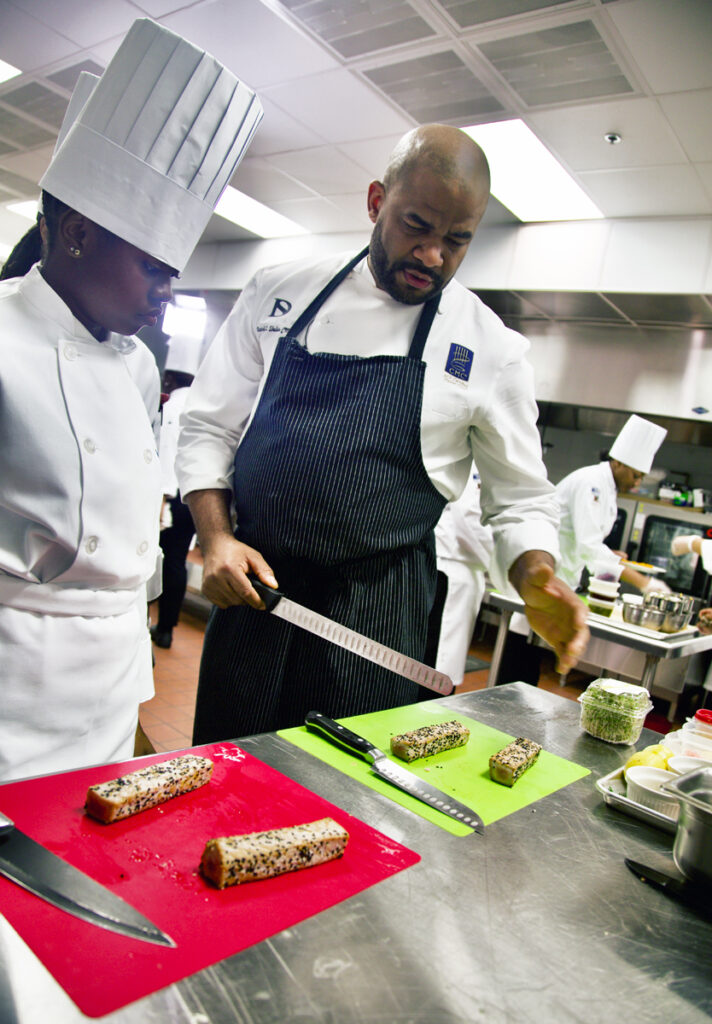
April 21, 2023 – Take the wayback time machine to 17th century France and land in a bucolic meadow outside of Paris on a beautiful fall day. Two members of the Royal Guild of Rôtisseurs are tending to a goose that is spinning, sizzling and roasting over an open fire. Their apprentices are scurrying about ensuring a superior outcome – and continuity of professional gastronomic standards for the pleasures of the table. Before lamenting the loss of such rich history, Chaîne members should mark their calendars for fall 2024 when the County College of Morris (CCM) in Randolph, New Jersey, about 30 miles northwest of New York City, will dedicate their new Entrepreneurship and Culinary Science Center. It will include a new baking and pastry kitchen, a culinary science lab, a new dining room and an outdoor culinary hearth/classroom where Professor Mark Cosgrove, CCM Department Chair, Hospitality Management and Culinary Arts, Bailli, Bailliage Joseph Donon; and Emily Guderian, CCM Lab Coordinator, Chaîne Foundation scholarship recipient and Vice Chargée de Missions, Bailliage Joseph Donon, will teach their students ancient cooking methods. “We will be offering not farm-to-table, but forest-to-table,” Mark said to Chaîne during an April 11 telephone interview. And before the event, Emily will probably be near the forest securing the goose!
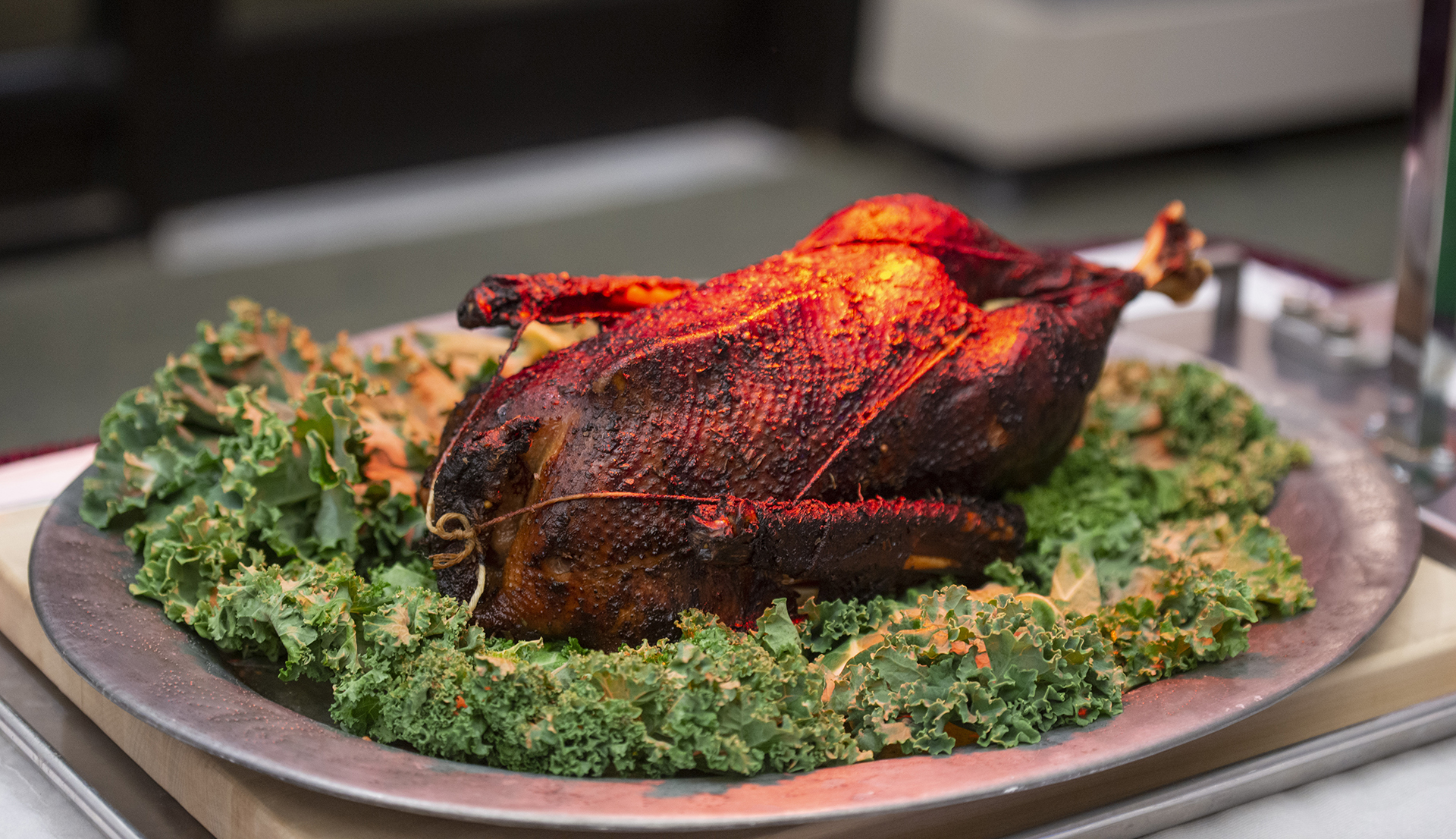
Roasted goose (Photo: Courtesy CCM)


Emily Guderian

Emily Guderian (Photo: Courtesy: CCM)

Emily hails from a family lineage of farmers, hunters, butchers and foodies. “We have a very big family. My mom is one of seven so holidays are always a big to do with lots of family and cooking and decorating for every single holiday. I’ve always had a love for it,” Emily said during the April 11 interview.

Her skills extend well beyond the kitchen. She is an avid hunter and angler so the fruits of those hobbies merge seamlessly with her vocation in Hospitality Management. CCM students must surely be amazed when she guides them through butchering a goose or a goat. Emily said she uses every part of a goose by making stock from the bones and even preparing and grilling the heart. Last year her students winced a bit when they heard what they would be tasting. “They all looked at me like I had five heads,” she said, reminding them they just had to try it, not like it, as the CCM program seeks to expand their palates. Notching an experience they will take into their careers, the students admitted they liked the taste of Emily’s goose heart.

As Lab Coordinator, her responsibilities include keeping the kitchen stocked and the equipment in working order, helping to plan events, and working with students during their hands-on learning activities that are part of the curriculum. “I’m the go-to person for a lot of things,” she explained.

Emily first came to CCM in 2015 as a student after deciding her path at another university where she was majoring in history was not for her. She followed her heart and her head when she enrolled in CCM’s Hospitality Management and Culinary Arts program. She already had a wealth of life experience in both. At age 17, she began working for her cousin who started a local rock climbing gym. Management skills run deep in the family and soon her cousin was adding locations. By age 19, Emily had more than 25 employees reporting to her as she managed her cousin’s growing business that eventually expanded to 13 locations.

As a community college, Emily completed her two-year degree at CCM and then took a position with Wegmans, first training at a few locations and then being selected to open and manage a new location in Hanover.
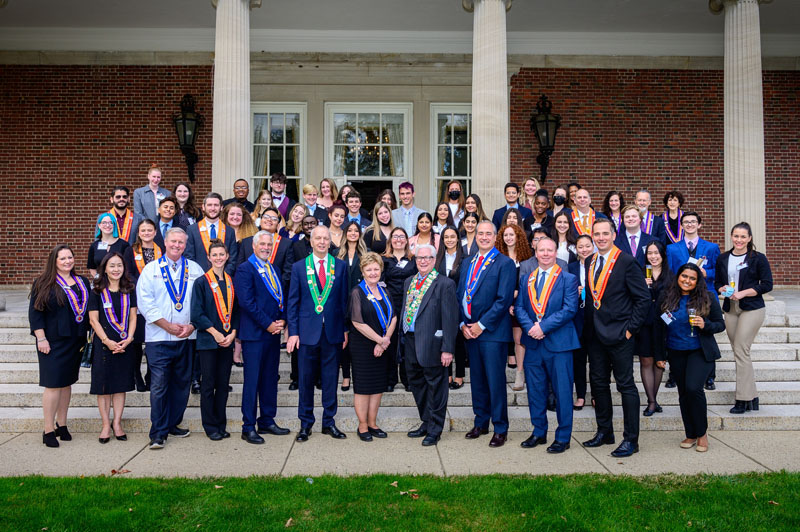
Chaîne group photo at the November 17, 2022 Bailliage Joseph Donon Goose Roast at CCM. (Photo: Courtesy Chaîne)

Almost five years ago, she found her way back to CCM when Mark recruited her for their open Lab Coordinator position. Nurturing both students and staff, a former CCM dean advised Emily to return to school to complete her Bachelor and Master’s degrees. After working and attending school full time for the past two years, Emily has five weeks remaining until she graduates with a Bachelor of Arts in Hospitality and Tourism Management from the Fairleigh Dickinson University (FDU) International School of Hospitality, Sports and Tourism Management.

Chef Mark Cosgrove
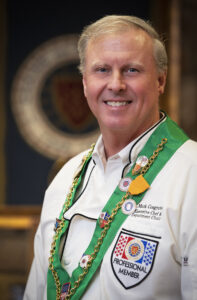
Bailli Mark Cosgrove
Bailli Mark Cosgrove (Photo: Courtesy Bailli Cosgrove)

Mark has an equally fascinating life story about how he found his way to a culinary arts career. From age two to 12, he was a “corporate brat” as his family moved from the United States to Canada and then to Paris because of his father’s job. His three years in France made a lasting impression on him. He remembers seeing Chaîne signs at restaurants and associating those signs with high quality food, in particular, a really good sole meunière. A vivid memory also includes his first visit to a McDonald’s, located on the Champs-Élysées.

“By the time we came back to the United States, I had a totally different concept of what food was. It wasn’t that the food in the U.S. was bad, it just wasn’t the same,” Mark said. As he grew, he began searching to recreate the food he had in France.

Whatever he chose to do in life was fine with his father as long as it was pursued after he earned a college degree. Mark said his father insisted he become an “educated ditch digger” so after graduating from Lasalle University in Philadelphia, Mark’s door to the kitchen opened. On a trip visiting friends in the Hudson Valley, Mark said they crossed the Hudson River and someone in the car said, “Oh, that’s the place you go to learn how to be a chef.” Mark was startled as he gazed at the CIA Hyde Park campus. “I never knew you could do that. When did this begin? So that was literally it,” Mark said.

In a New York minute, Mark enrolled in the CIA and to him, even though it was a two-year program to earn an associates degree, it was his graduate degree. With two degrees in hand, Mark began his career, quickly climbing the ladder in the corporate kitchen of a local bank. After another corporate stint, he went into the catering business on his own, a deep dive into entrepreneurship that also literally involved deep dives in the ocean as he catered tourist trips to sunken ships, such as the SS Andrea Doria off the coast of Nantucket, Massachusetts (1956) and the USS Monitor off Cape Hatteras, North Carolina (1862). While someone watched his food, he participated in the dives to explore the shipwrecks. “That was a lot of fun and it was good training,” Mark said.
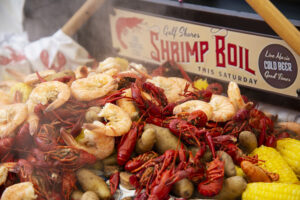
Photo: Courtesy CCM

When a CCM professor took a one-year sabbatical 27 years ago, Mark agreed to fill in as an adjunct professor. The professor never returned to campus so Mark stayed and today is Department Chair, guiding about 100 students in CCM’s academic degree and certificate programs, and another 40 students in other programs for high school students and adults with special needs.

Mark and Emily are a dynamic, fun team with students at the center of everything they do.

“Without Emily, none of this would be happening. She identifies much more easily with our students. I am the old and she is the new,” Mark said. But that doesn’t mean Mark is resting on his laurels. He is busier than ever with the college expansion project and his work with the Bailliage.

Bailliage Joseph Donon

As the driving force establishing Bailliage Joseph Donon in June 2021 and its first Bailli, Dr. John Niser, Director of FDU’s International School of Hospitality, Sports and Tourism Management (ISHSTM), shares Mark’s dedication to educating the next generation of hospitality and culinary professionals.

“As we all know Chaîne finds its roots in the guilds, a formidable and powerful mechanism for the transmission of a craft from one generation to the other. While the world of education has become more complex and obtaining skills is long and expensive, the reality is that the foundation on which the guilds worked still works today. The recipe is simple, it boils down to creating the circumstances and places where young people interact with masters in their field. The Bailliage Joseph Donon is designed to offer such a place where young professionals in the making can interact with Chaîne professionals. Today, the skill gap is narrowing but the experience gap is widening, we are trying to help bridge that gap,” Dr. Niser said in an email.
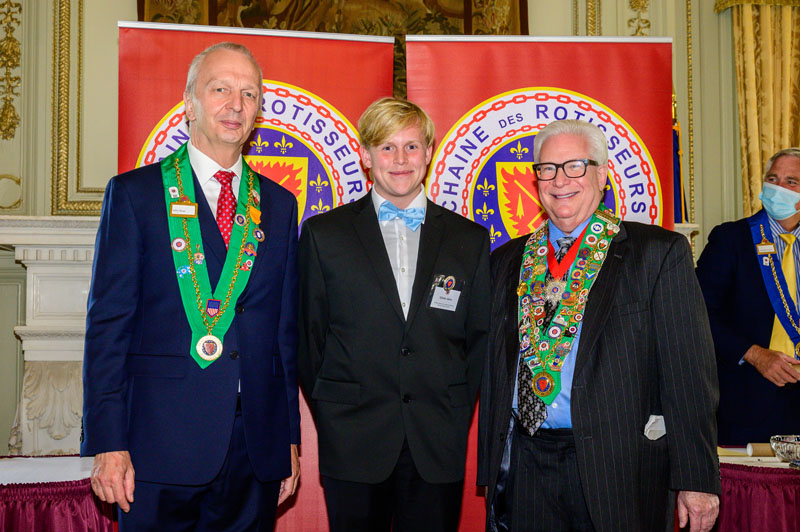
Bailli Honoraire Dr. Niser, left, welcomes a new student member of Bailliage Joseph Donon, with Chambellan Provincial Mid Atlantic and Bailli of Baltimore Bailliage Stuart Goldberg. (Photo: Courtesy CCM)

Upon becoming President of Les Amis d’Escoffier Society of New York in 2022, Dr. Niser asked Mark last summer if he would consider taking the helm of the Bailliage. Mark readily agreed. Mark also has been re-elected to another three-year term starting July 1, 2023.

With more than 100 student members, the Bailliage provides unique opportunities for them now more than ever because of the extended Covid lockdown. Mark said it took him awhile to figure it out but he and other faculty members finally realized that students beginning college last year had not been to a wedding or family party in years so had no life experience to draw upon at college.
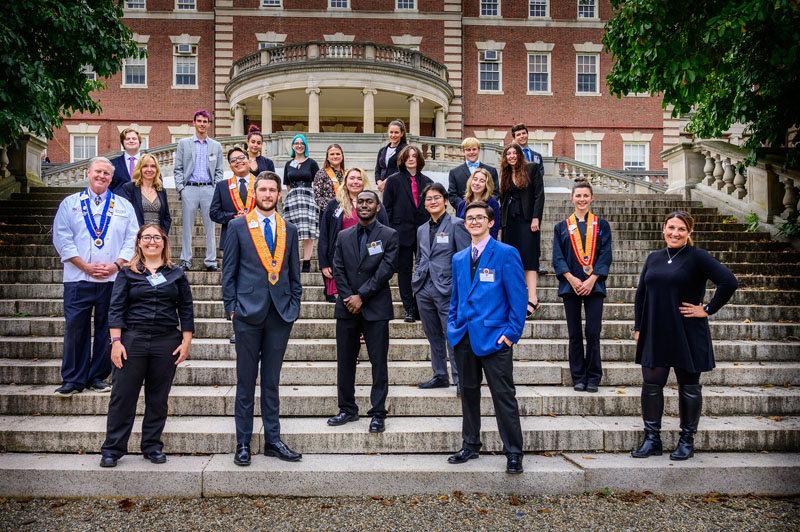
Professor Mark Cosgrove (left, second row) and Emily Guderian (right, second row) with fellow students at CCM. (Photo: Courtesy CCM)

In addition, students watched a lot of culinary shows during the lockdown and came to college thinking they were already master chefs. But the CCM core curriculum guides students step-by-step in culinary and business basics to build a solid foundation. They will learn by doing that mastering culinary arts as a chef may take a decade or more.

Having students gain experience catering college events is very helpful but there are limitations. Mark said traditionally, students are told, “Stand there, smile, keep your hands behind your back, and don’t do anything.” As they progress in their CCM studies, they are given the opportunity to operate a food truck for a day and then reality quickly hits home. Managing food costs, quantity of food needed so there is not waste, and food quality can be overwhelming yet a valuable lesson for burgeoning professionals.

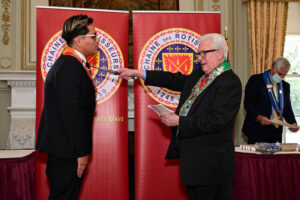
Bailliage Joseph Donon student Induction Ceremony (Photo: Courtesy of CCM)
Bailliage Joseph Donon student Induction (Photo: Courtesy CCM)


But with Bailliage events, students can be actively involved. Mark tells them to think of a Chaîne event as hosting friends at their home. They plan and execute the party from start to finish, even being allowed to eat leftovers!

On Nov. 17, 2022, the Bailliage hosted a Goose Roast at CCM. Mark told his students, “Go ahead and enjoy it but while you’re enjoying it, stand there and carve the raclette.” Students had never tasted goose before so it was another life experience to notch. “And we were pulling kids off the floor and telling them to go carve the goose,” Mark said with a chuckle. They wholeheartedly embraced the event even with one culinary mishap. Students prepared and served Turducken. “It was a bit of a disaster. It looked like it had been thrown through a wood chipper,” Mark said.
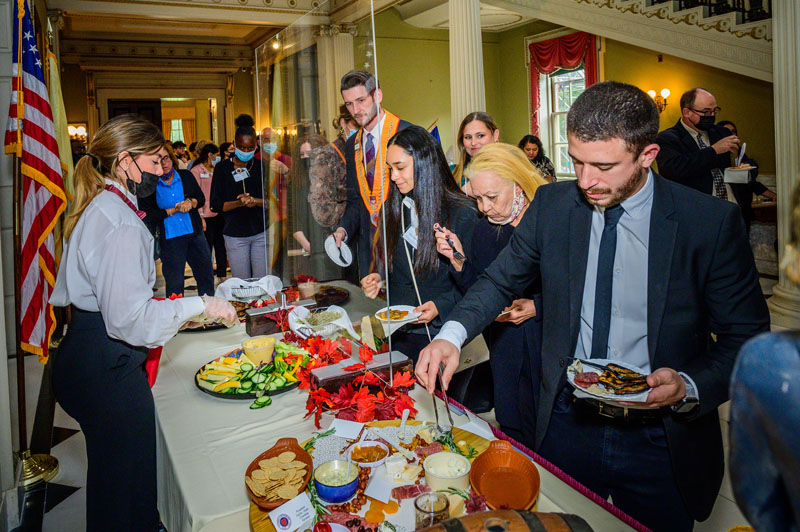
Photo: Courtesy CCM

Planning to be an annual event, Mark already has Turducken Galantine on the menu for a second attempt at next year’s Goose Roast. “The Chaîne is a really great opportunity for us, much like my sole meunière as a kid,” he added.

At the end of the evening, Emily was in the audience listening to the description of the person who would be granted a Chaîne Foundation scholarship. She said she was looking around at her students wondering who would be called when she heard her name. “First, it was a huge shock. Mark did a very good job keeping it from me. It was absolutely amazing. I was so honored and so thankful. When they called my name, I almost fell over,” Emily said.

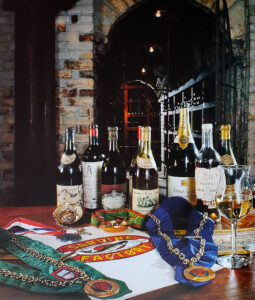
Chaine des Rotisseurs Induction medals on table
Chaîne des Rotisseurs Bailliage Joseph Donon Induction (Photo: Courtesy Chaîne)

To actively engage more students from five community colleges associated with the Bailliage and decrease travel distances, Bailli Cosgrove and his team will appoint a Chargé de Missions or Chargée de Missions at each school. Local Chaîne events will be facilitated and the entire Bailliage can come together once or twice per year at the Goose Roast and Induction.

Into the Future

Without a doubt, 2023 will remain a busy year for Mark as he is integral to both the CCM expansion and growth of the student-centered Bailliage. Mark believes the new CCM facilities will be the envy of Northern New Jersey.
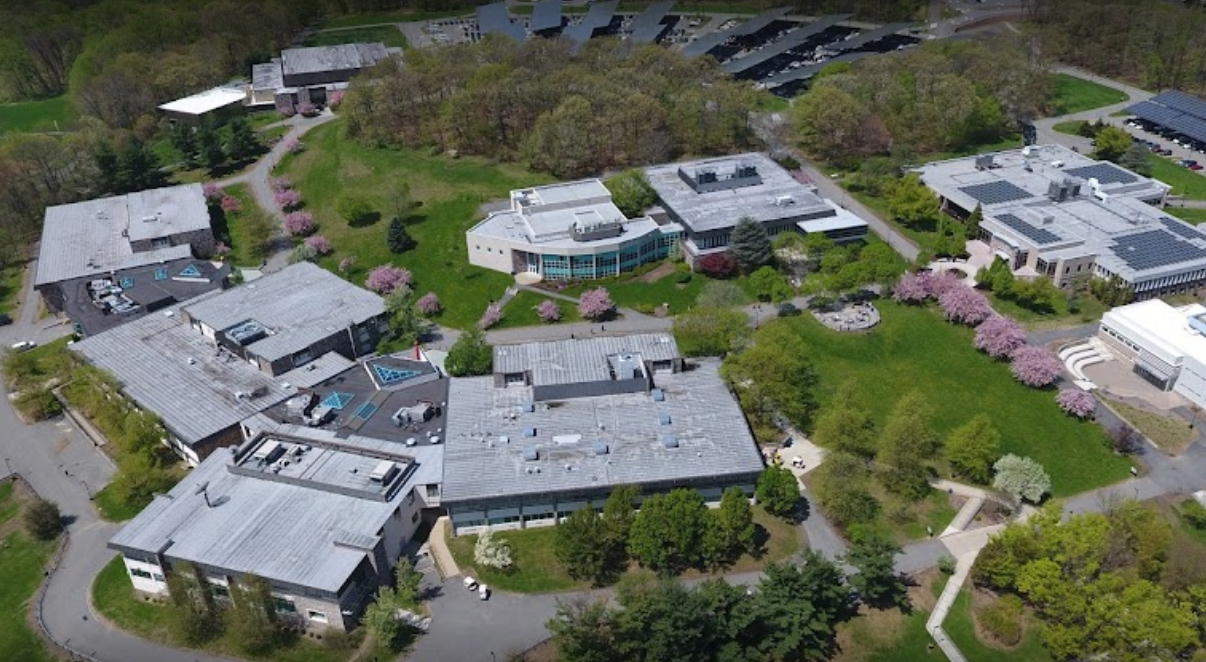
Aerial view of the County College of Morris (CCM) Campus in Randolph, New Jersey.(Photo: Courtesy of CCM)

Adapting to reality in real time is no longer a luxury but a necessity. Providing students with real work experience as early as possible is key to CCM’s Culinary Arts and Science Program. Working closely with Dr. Niser at FDU, students who complete their CCM degree then have the option to enroll in FDU where an immersion program is offered for aspiring chefs. Students live and work at the Sea Island Resort in Georgia while completing other coursework online to complete their Bachelor’s degree. There are currently two CCM graduates in the FDU immersion program.

Chaîne Medal

Emily’s calendar will clear somewhat after graduation but CCM has class until the end of June for their high school and adult students. And amid the hectic pace of finishing her degree, Emily is planning her own wedding this summer. Before she knows it, it will be back-to-school when she will be finalizing details for the second Chaîne Goose Roast.

Mark and Emily, modern day rôtisseurs with deep respect for history, will certainly host an outstanding goose roast and then once their outdoor Culinary Hearth is built, CCM and Bailliage Joseph Donon will be the envy of not only Northern New Jersey but also the world.

Get ready to take a time machine into a very bright future for hospitality and culinary students. No lightning needed.

Links
County College of Morris (CCM) Dept. of Hospitality Management and Culinary Arts
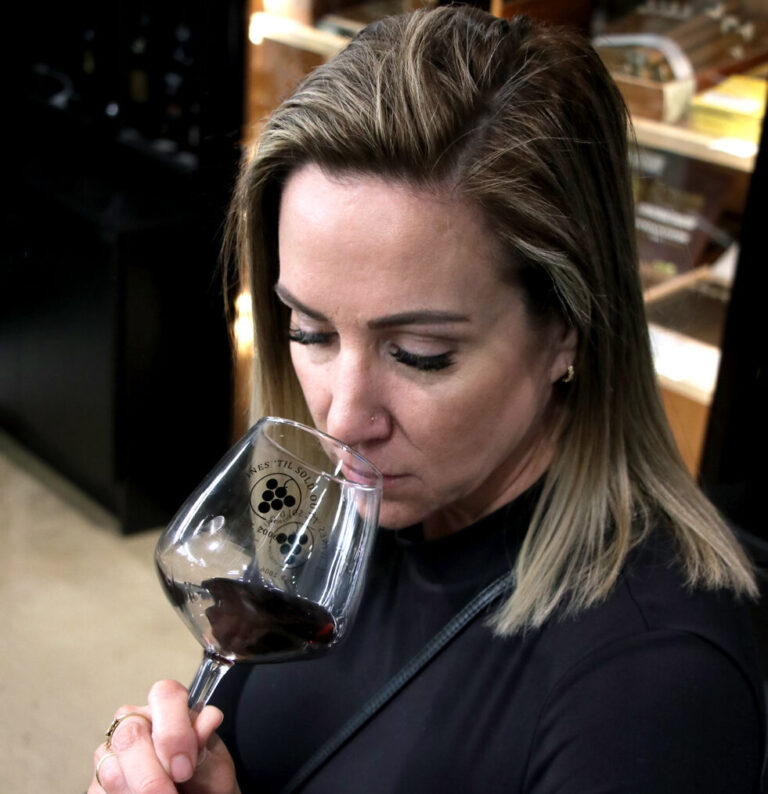
 

WTSO is a Digital Powerhouse with an Analog Foundation

March 17, 2023 – In 2006, Joe and Elliot Arking, brothers who owned a popular liquor store in South Jersey, decided on a whim to venture into the digital world to sell fine wine. That online world did not look anything like it does today. Neither the iPhone nor the iPad had been introduced. Consumers thought they were smart being able to text with their flip phones. It took an enormous leap of faith to launch an e-commerce site in those days, especially one selling wine. But the brothers already had high volume with extensive contacts in the industry. Encouraged by the second generation who solidly supported the expansion, the brothers gave it the green light. Since 2006, Wines ‘Til Sold Out, WTSO, has sold more than 26 million bottles of premium wine through flash online sales. Julie Blount, WTSO’s Executive Director of Marketing and Customer Service, has been with WTSO since the beginning. “It grew pretty rapidly. We had 100,000 customers within four years of starting,” Julie said to Chaîne during a Jan. 25 telephone interview.

Featured image above: Julie Blount, WTSO Executive Director of Marketing and Customer Service

Photo: Courtesy of WTSO

Joe Arking now leads the company as CEO. In 2018, Elliot passed away but his passion for the business lives on as the small WTSO team continues to focus on offering customers the best deals and a superior customer experience. “The entire operation is strategized to keep low overhead so that we can pass on savings with our wine deals to the consumer,” Julie said.

WTSO logo

As WTSO launched, the brothers asked Julie and one other employee to help with customer service and processing orders. “We worked around the clock. During holidays, we worked from 7 a.m. to 9 or 10 p.m.,” she said.

Offering premium wine through flash sales did not mean the e-commerce website had to be flashy. Staying grounded in customer satisfaction, the WTSO team realized that what mattered most to people was the opportunity to purchase top quality wine. But the notion of “discounted” prices must be defined in context, Julie explained.

With total focus on sourcing wine for their deals from large and small producers at world-renowned wineries and from world-renowned winemakers, WTSO’s sale prices are usually higher than retail prices of lesser quality wine on the mass market. It’s important for people to understand that nuance, Julie said. Overall, the WTSO customer is very knowledgeable about wine so they quickly recognize value. But new visitors to their website can be surprised WTSO prices do not equate to mass market discounts.

The wine is always the top priority. Criteria in both quality and quantity drive WTSO purchase decisions. “We must be able to have enough inventory to fill the demand of over 500k customer accounts,” Julie said. The buying team seeks lesser known wineries located in regions recognized for superior terroir.

It may seem as if handling the sale of thousands of bottles of wine online would require a large IT department but WTSO has a lean team of three people who handle everything in house. When a computer glitch occurs, they own it and solve it.

Photo: Courtesy of WTSO

Reflecting on the early days of the business, Julie remembers one sale in particular when BV Tapestry canceled their deal after WTSO had already sold hundreds of bottles of wine. In a way, it was a blessing in disguise. Because e-commerce technology was in its infancy, they had no other option but to call each customer to explain the situation and why they had to issue a refund. As technology improved, lessons learned from that episode still reflect their policies today. They have leveraged technology where it can be best utilized but have not abandoned the analog world of humans talking with humans.

Photo: Courtesy of WTSO

“Our customer base grew based on our one-to-one interaction with customers, really taking our time to customize each member’s experience. Starting early on in e-commerce, we knew having a policy with little to no risk to the customer would only help grow that trusting relationship with our customers. From day one we stood behind every bottle, and made sure that each shipment was delivered without any issues. In the wine shipping industry it can be tricky at times to receive your delivery due to the signature requirements. We will customize delivery to help make that experience as seamless as possible. To this day we will organize shipments to arrive when convenient for customers and over the years, have developed many programs like Long term storage to A Case Club membership, which allows customers to hold wine for a long term in our temperature-controlled warehouse. For every case shipped, customers earn rewards,” Julie said.

There are humans involved every step of the way. Each team member who interacts with customers is trained in all aspects of the business so they can answer questions about the wine or shipping. There is no ‘Dial 1’ for this issue or ‘Dial 2’ for that issue, Julie added. “It’s a great user experience if people do try us out.”

Photo: Courtesy of WTSO

About 70 percent of their marketing effort can be attributed to word-of-mouth recommendations, a phenomenon that began in 2006 when Joe’s sister-in-law spread the word about the new site to her colleagues working on Wall Street.

Steadily growing through the years, it wasn’t until the business began declining a bit just before the pandemic that they turned to data mining to better understand their customer base. During growth, they were simply fulfilling orders and buying wine, Julie said. Now they use data science to analyze customer retention and churn to define new marketing strategies.


As they ramped up their data mining efforts, something outside of their control impacted their business in a significant way. When the pandemic hit in spring 2020, WTSO experienced a 20 percent growth. “It was amazing but obviously, it was a tragic thing. While people were unable to leave their homes, online ordering in general grew rapidly. We were able to reach far more savvy wine drinkers due to the amount of people that were almost forced to order most of their supplies online. People who were only shopping in stores were now online trying to find the world’s classic wines. I think our affordable free shipping threshold and fast shipping turnaround made it even more convenient for online shoppers,” Julie explained.

As a sponsor of both the 2021 Grand Chapitre in Nashville and the 2022 Grand Chapitre in San Antonio, Julie is proud WTSO offers a vast array of highly rated labels to Chaîne members whom she describes as a world class wine enthusiasts. “The great success of our national events would not be possible without valued partners such as WTSO. Their commitment to high quality and knowledge of the wine industry perfectly supports Chaîne’s mission. We look forward to our ongoing collaboration with Julie and her WTSO team,” Kevin Dunn, Executive Director, Confrérie de la Chaîne des Rôtisseurs, said.

Photo: Courtesy of WTSO

Because technology moves at such a lightning fast pace, today WTSO is trying to encourage more customers to use an app they developed. Younger people do not want to be bothered with a deluge of emails but that is WTSO’s primary way of communicating their flash deals to their customers. As its operational core, they send out five emails per day to each of their almost 300,000 active customers to keep them informed of deals and discounts. They certainly cannot abandon that way of reaching their customers but realize they must actively engage new generations of wine drinkers who interact with technology very differently from their traditional customer. The WTSO app is a valuable tool in their 2023 marketing toolkit. Keeping abreast of user trends with technology is essential as their success over the years motivated others to enter the flash sale space. “The industry is a lot more saturated than it was 17 years ago,” Julie said.

Never content to stand still, the WTSO team is thinking beyond email and apps to engage younger generations by directly connecting with them.

Photo: Courtesy of WTSO

Launched in August 2022, the WTSO Premium Wine Club opens up new channels of connecting with customers. With 388 members, each member receives a surprise selection of two to three bottles of premium wine each month that includes a virtual tasting seminar, via Zoom, with experts. The 90-minute to two-hour session is held in the evening on the second Thursday of each month. “They’re really fun,” Julie said. “I think people enjoy the social aspect of being with other wine lovers and having conversations.” And through the power of technology, participants can connect with friends across the country and make new friends who share a passion for wine.

The WTSO team’s early experiences selling wine online laid the foundation for a successful business today. But that was not a foregone conclusion as many, many companies decided to lower overhead by replacing customer service representatives with artificially intelligent software. Smart businesses recognized there was no replacement for a human quickly helping another human solve a problem.

That aspect of WTSO’s business alone is worth a toast, all the better poured from a deeply discounted bottle of premium wine!

Links
Wines ‘Til Sold Out

Mar Azul Tequila is Labor of Love for Dynamic Duo

March 3, 2023 – Many years ago Susana Sutton faced a dilemma she was determined to resolve. Growing up in Mexico City, when her family and friends gathered to celebrate birthdays, holidays or simply the joy of being together, she would have one alcoholic drink and be “wasted.” It was an unsustainable situation given her passion for life. Always thinking outside of the box and because her husband loved tequila, she forged a path in two countries to create her own delicious tequila, made of all natural ingredients without added sugar. After years of experiments in her kitchen and a move to San Antonio, in 2011 Susana began selling her Mar Azul Tequila. In 2016, Susie, her daughter, joined her full time in the business. The dynamic duo now produces about 12,000 bottles per year. “With Mar Azul Tequila, there are no headaches, no hangovers, just happiness all day, every day,” Susie A. Pyatt, General Director, Pyatt Enterprises, said to Chaîne, with Susana P. Sutton, CEO, affirming enthusiastically, during a Feb. 7 telephone interview.

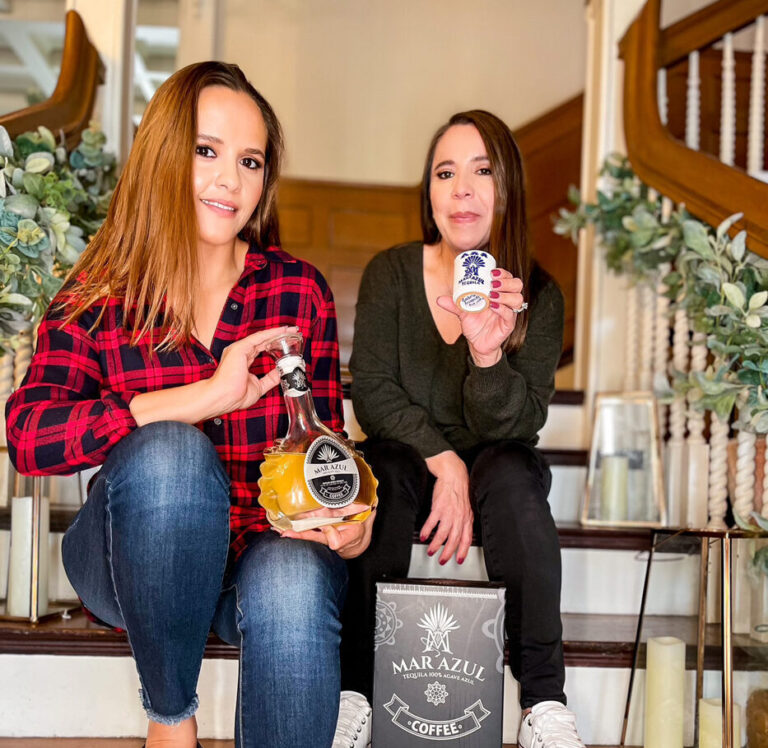
Featured image above: Susie A. Pyatt, left, and Susana P. Sutton

Tequila
Tequila is produced from fermenting the large stem of the Weber blue agave plant, a succulent perennial requiring a desert climate. Similar to wine appellations, since the 1980s, only tequila produced from agave plants grown in five states in western Mexico can be labeled tequila. Most tequila is produced in Jalisco. In 2006, UNESCO (United Nations Educational, Scientific and Cultural Organization) declared 34,658 hectares between the foothills of the Tequila Volcano and the deep valley of the Rio Grande River a World Heritage site – the Agave Landscape and Ancient Industrial Facilities of Tequila. Very specific criteria had to be satisfied to earn the prestigious designation.

Agave field in western Mexico (Photo: Courtesy of Mar Azul)

According to UNESCO, tequila has been made in the area since the 16th century and for at least 2,000 years, the plant has been used to make fermented drinks and cloth. From AD 200-900, Teuchitlan cultures created terraces for agriculture, housing, temples, ceremonial mounds and ball courts, vestiges of some that remain today. Because of this historical significance, the agave culture is integral to Mexico’s national identity. In addition, UNESCO states: “The overall landscape of fields, distilleries, haciendas and towns is an outstanding example of a traditional human settlement and land-use which is representative of a specific culture that developed in Tequila.”

Mar Azul Tequila

Mar Azul Tequila is a family business from start to finish, one part of the agave culture for which Mexico is known worldwide. Susie and Susana’s family members, living in Puebla and Guadalajara, Mexico, own agave orchards and Susana purchases the balance needed for their yearly production from neighbors, she explained. Once plants are harvested, the agave nectar is fermented, aged in white oak barrels and distilled. The delicious end result of the process that requires aging from six to 18 months – tequila – is bottled in Mexico and then shipped to the United States where it is sold primarily in Texas. Today they offer consumers 11 Mar Azul flavors.

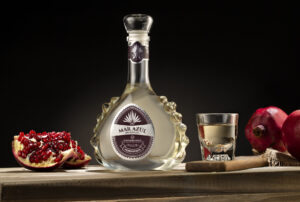
Pomegranate is one of Mar Azul Tequila’s most popular flavors. (Photo: Courtesy of Mar Azul Tequila)
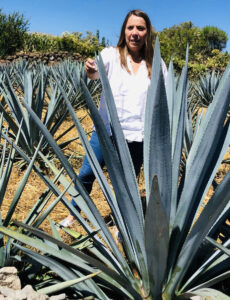
Susana in an agave field. (Photo: Courtesy of Mar Azul)

That short summary of her success belies the years leading up to it. While still living in Mexico, she was always thinking about starting a business. Her love of cooking as well as her alcohol dilemma gave her the idea to create an alcohol she could enjoy with her family. And with her husband’s love for tequila, she had a product in mind. She began experimenting at home making tequila with natural extracts for unique flavors. She wanted a tequila that could be poured on the rocks for a simple yet delicious drink. Upon tasting one of her tequila flavors, her uncle, a chemist, told her if she was serious about business, he would help her because her tequila was very good.

Early on she knew she wanted to avoid adding any sugar to her tequila. “Sugar makes me really, really energetic and then one to two hours later, I was sleeping,” she said. Her kitchen was her proving ground as she tested, mixed, adjusted and created flavor after flavor of tequila, always using 100 percent natural ingredients.

Life intervened and a move to San Antonio in 2002 rekindled her entrepreneurial endeavor. She brought her first tequila shipment to the United States in 2010 but it was not without its challenges. Because her product had no added sugar and was 100 percent natural, there was not an existing tax category. It did not fit the definition of a liquor or a spirit. “It was step by step by step. It took forever but finally we had everything in place,” Susana said. Her product was identified as a “distilled specialty spirit” because it was hand-crafted.

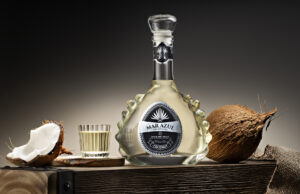
Mar Azul Coconut Tequila (Photo: Courtesy of Mar Azul)
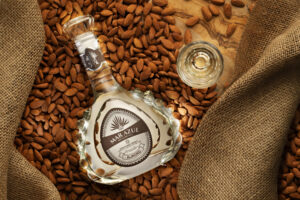
Mar Azul Almond Tequila (Photo: Courtesy of Mar Azul)


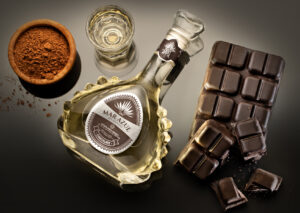
Susana eventually developed 36 flavors but her family advised her to concentrate on just a few. Today they sell 11 flavors including their top five of: Chocolate, Coconut, Banana, Almond, and Pomegranate. Their chocolate tequila took four years to develop but it was a very important flavor to Susana. “I am a chocoholic. I told my uncle we need to have a chocolate tequila,” she said. Her uncle replied, “You always choose the hardest flavors to produce.” The long process was worth it as she said it tastes just like chocolate. “I need to be in love with my product. If I’m not happy with the product, I’m not going to put it on the market.”

Mar Azul Chocolate Tequila can be used as an ingredient in Tiramisu. (Photo: Courtesy of Mar Azul Tequila)

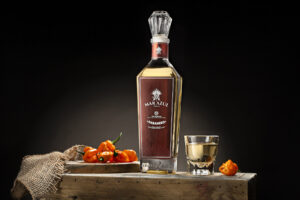
Rounding out their 11 flavors are: Mint, Coffee, Habanaro, Silver, Reposado, and Anejo. Coming full circle, Susana began thinking of ways to incorporate her tequila flavors in recipes. She suggests using their coffee and chocolate tequila to make a scrumptious Tiramisu. That definitely sounds like a winner! And Susie likes to add their Habanero Tequila to her guacamole recipe, another winner of an idea.

Mar Azul Habanero Tequila (Photo: Courtesy of Mar Azul)

When Susie joined her mom in 2016, they agreed on a one-year trial to see if they could work together. “It was a challenge for me,” Susie said. “I’m a lawyer.”

She immediately recommended changes to increase brand awareness since Susana had perfected the product. Mom and daughter are as different as night and day but merged their strengths to make a most effective and efficient day. “I’m very crazy. She has her feet on the ground,” Susana said. “Instead of the young being crazy, I’m the crazy one.”

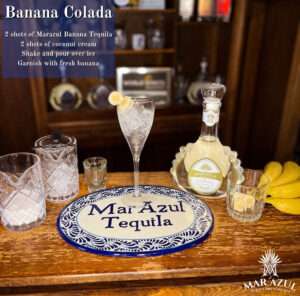
Susie had all of the labels redesigned and with younger generations excited about cocktails, they began experimenting with cocktail recipes. To expand brand awareness they conduct tastings at restaurants, wine and liquor stores, and other events, such as corporate parties where they demonstrate how Mar Azul flavors can be used in cocktails. They are busy most weekends at tastings in and near San Antonio. Stores and hotels throughout Texas carry their Tequila and a few other states are able to carry their product, including Montana, Wyoming, Idaho and Ohio.

“I joined to complete my mom’s dream and now Mar Azul is part of my life. It is something I live with, I breathe and I live every day thinking about what else we can do so people can try and know what it is – Mar Azul. It’s made with love,” Susie said. On Sunday, Susie likes to relax with a cup of coffee taken up a notch with their almond tequila. “It makes your morning very happy.”

Speaking about her mother, Susie said, “We have different tastes and different personalities but we listen to each other. We love each other.”

Susana learned from Susie that the product is only one-half of the formula for success. “It’s not good enough to have a great product. You have to learn how to promote it. Susie looked at everything and gave identity to each product,” Susana said.

The industry has recognized Mar Azul’s devotion to product perfection with a plethora of awards over many years. Most recently in 2022, Mar Azul Reposado won the Best Reposado Tequila Gold Medal The Fifty Best. And for those looking for a spicy tequila, the Mar Azul Habanero flavor was awarded the 2021 Gold Medal Spirits Award. In 2020, both Mar Azul Coffee and Mar Azul Banana won the Silver Medal World Spirits Award. In 2018, Mar Azul Anejo won the World Spirits Award Gold Medal.

At Mar Azul tastings, guests learn how to use their many flavors in cocktails. (Photo: Courtesy of Mar Azul)

The awards are not surprising given the time and energy the company has devoted to maintaining its high standards. Susana has the same passion for her product today as she did years ago when she began experimenting in her kitchen in Mexico City. “You go to some restaurants and they cook with soul. That’s how I see my product. Mar Azul is my soul,” she said. “It’s not just about selling the product and making money. I want something that people start drinking and always love. And the quality of the product never changes. I think quality should be Number One.”

Mar Azul Anejo is an award-winning flavor. (Photo: Courtesy of Mar Azul)

With a long resume of awards, tequila afficionados recognize the Mar Azul logo, a logo that honors tequila’s ancient history.

The Mar Azul logo honors hundreds of years of agave culture in Mexico. (Photo: Courtesy of Mar Azul)

The lizard is the animal that predominates in agave plantations and is depicted sitting on her throne as she keeps a careful eye on agave plants. The lizard winds around the letters M and A. The crown above honors the Aztecs and their ancient agave culture. A fine detail at the bottom of the letters represents the indigenous women who were active gears in their community.

Two women of two generations are carrying on this legacy of women from generations who came before them. As a force of nature, it’s fortunate that opposites attract.

“We are an eclectic duo. We are the perfect team,” Susie said.

Links
Mar Azul Tequila
Mar Azul Tequila Cocktail recipes
UNESCO World Heritage Site

Mim Runey and JWU Guide Students to Careers for a Lifetime

Feb. 17, 2023 – College students everywhere climb a lot of stairs and log thousands of steps as they traverse campus grounds daily to attend classes, grab some food, and participate in sports or other extracurricular activities. Their boundless energy, tempered by some sleep-deprived days, is laser focused on the light at the end of the tunnel when they climb just a few steps, walk across a stage and are handed their diplomas. It’s a proud moment for them, their families and school leadership. “One word that comes to mind for me is transformation. We have students that come to our College of Food Innovation & Technology with a passion for food and by the time they leave us they have earned the degree that will allow them to create a career for a lifetime. It is amazing to see that happen,” Mim L. Runey, LP.D., Chancellor of Johnson & Wales University (JWU) in Providence, Rhode Island, said to Chaîne during a Feb. 9 telephone interview.

Featured image above: Mim Runey, LP.D., Chancellor, Johnson & Wales University

The JWU Cuisinart Center for Culinary Excellence in Providence, Rhode Island (Photo: Sam Ho/JWU)

With thousands of successful graduates, some JWU alums are known by millions through television and their outstanding work as food industry innovators and leaders.

Tyler Florence
Tyler Florence, a 1994 graduate of JWU’s former Charleston, South Carolina campus, is a 24-year veteran of the Food Network with multiple hit shows, including his eponymous Tyler’s Ultimate. He can currently be seen as the host on Food Network’s The Great Food Truck Race. He has also launched brands in a variety of industries and published two cookbooks.

The Providence Epicurean Scholarship Society gathered on Nov. 30, 2021 for a special dinner arranged by Tyler Florence, a two-time James Beard Award nominee for Best Chef West Coast. (Photo: Mike Cohea/JWU)

Chip Wade
Chip Wade is CEO of Union Square Hospitality Group (USHG). He received an Associate in Science degree in Culinary Arts from Johnson & Wales in 1983, a Bachelor of Science degree from Widener University, and a M.B.A. from The University of Texas, Dallas. In 2006, JWU awarded him an honorary Business Administration doctoral degree in Foodservice Management. Currently, he serves as a member of the JWU Board of Trustees. As a founding board member of the Multicultural Foodservice & Hospitality Alliance, Chip is a dedicated proponent of diversity, inclusion and belonging.

Chef Lorena Garcia
Chef Garcia is a 2000 JWU graduate and was awarded an Honorary doctorate degree in 2014. Based in Miami, Florida, she is an entrepreneur, cookbook author, media personality, cookware designer, and restaurateur. She also started “Big Chef, Little Chef,” a non-profit organization aimed at addressing childhood obesity by helping children and their families take control of their eating habits and their lives.

The 2022 Epicurean Scholarship Society dinner featured a menu prepared by celebrity Chef Lorena Garcia with the help of JWU students. (Photos Mike Cohea/JWU)

JWU History

Founded in 1914 in Providence, Rhode Island as a business school by Mary Wales and Gertrude Johnson, two women who could not even vote at the time, the school grew from just a handful of students to a student body in the thousands.

In 1988 its name officially changed to Johnson & Wales University and in 1993, JWU received regional accreditation from the Commission on Institutions of Higher Education of the New England Commission of Higher Education (NECHE)

Step into Chef Branden Lewis’ Sustainable Cuisine class as they prepare a sustainable menu for waiting diners. (2022 Photo: Mike Cohea/JWU)

JWU, a NCAA Division III school, now has more than 8,000 students enrolled in more than 100 undergraduate, graduate, and online programs. Known worldwide for their culinary arts programs, JWU students at its 170-acre main campus in Providence can earn an associate, bachelor and master’s degrees in the College of Food Innovation & Technology. Bachelor and master’s degrees are offered within their College of Hospitality Management.

At its Charlotte Campus, associate and bachelor’s degrees are offered in the College of Food Innovation & Technology and a bachelor’s degree in the College of Hospitality Management.

From humble beginnings in the first part of the 20th century, JWU is earning stellar reviews in the first part of the 21st century.

In September 2022, U.S. News & World Report released its Best Colleges rankings. The JWU Providence Campus moved up 24 spots and is now ranked at 70 out of 175 schools in Regional Universities, North. In addition, the Charlotte Campus is now being included in the U.S. News rankings; it is listed at 19 out of 99 schools ranked in the Regional Colleges, South category.

Distinguished Visiting Master Sommelier Madeline Triffon. (2016 Photo: Mike Cohea/JWU)

For 2020-2021, Money Magazine ranked JWU among its Best Colleges by its value, quality of education, affordability and outcomes including graduates’ earnings, employment status, career trajectory and socioeconomic mobility.

Mim joined JWU in 1989 after graduating in 1988 with a Bachelor of Arts in English from Clemson University. At the time, JWU had a branch campus in Charleston, South Carolina. She was driven to pursue a position in higher education. “I moved to Charleston, South Carolina and literally got out the phone book and applied to institutions that were within driving distance. JWU was particularly attractive to me because of its food programs,” Mim said. She began work on July 5, her birthday, as a Public Relations Officer. In December 1990, she was named Director of Public Relations.

JWU’s focus on culinary arts and hospitality began in the 1970s when the college had a contract with the U.S. Navy to deliver food service education, which they conducted at a number of sites including on ships and at local high schools. The college had a similar contract with the Navy in Norfolk, Virginia. Due to interest from the public for their culinary arts programs, in 1984, JWU opened a branch campus in downtown Charleston as the anchor tenant in a 19th century historic building. Two years later they opened another branch campus in Norfolk. Both programs expanded over the years to an enrollment of 1,600 students and 800 students respectively.

While working full time, Mim continued her own education, earning a Master of Arts in Management from Webster University in 1998 and a doctorate in Law and Policy from Northeastern University in 2009.

Charlotte Campus and Looking to the Future

In 2004, JWU named Mim President of the Charleston Campus. Two years prior, the city of Charlotte, North Carolina approached JWU to move and consolidate their branch campuses in Charlotte as the city sought to reinvigorate its food economy. With approximately $40 million in incentives, JWU wound down operations in Charleston and Norfolk, merged the two programs, and in 2004, opened their Charlotte branch campus. About 35 to 40 percent of the university’s employees moved to Charlotte. Mim moved to Providence and became JWU’s Senior Vice President for Institutional Planning.

Johnson & Wales Charlotte Campus (Photo: Mike Cohea/JWU)

“While one might think of culinary education as simply a process of learning a skill that has been around for ages, we deliver in that regard but we are also teaching students about food innovation, sustainability, nutrition and demands of the food industry in the future,” Mim said. “We always want to be on the cutting edge and at the forefront of what drives the future of food. We have to prepare our students for what’s to come.”

Opened in 2010 on their Providence Campus, JWU’s LEED Gold-certified Cuisinart Center for Culinary Excellence is the epicenter of learning for culinary arts students with 30 teaching labs and classrooms, a wine tasting room and four dining rooms. The building’s beautiful glass design offers students, faculty and visitors sweeping views of nearby Narragansett Bay and was the perfect setting for the Center’s inaugural event – a Chaîne dinner.

The Cuisinart Center for Culinary Excellence is on JWU’s Providence Campus. (2022 Photo: Mike Cohea/JWU)

Through JWU’s Food Innovation Design Lab, FIDL, also located on the Providence campus, students, faculty and other partners take ideas from concept to product. In one semester course, students developed a candle made of maple syrup so instead of wax on birthday cake icing, only edible remnants remain after candles melt for an especially sweet innovation!

Rebecca Martin (’15) in FIDL for a 2019 JWU magazine photo shoot (Photo: Mike Cohea/JWU)
JWU’s Food Innovation Design Lab – FIDL (2019 Photo: Mike Cohea/JWU)


Named President of the Providence Campus in 2011 and JWU Chancellor in 2018, Mim keeps two issues uppermost in her thoughts and actions. First, she is committed to ensuring JWU’s curricula, across its seven colleges, are current. In the culinary arts, Mim said JWU is proud to have full time chef instructors with vast experience in the industry who stay connected with industry professionals to identify trends. “Being a chef is like being a member of a club or fraternity that provides camaraderie and support,” Mim said.

In 2019, Chancellor Runey greeted students in the FIDL lab during the maple syrup project. (Photo: Mike Cohea/JWU)

The past few years presented a unique challenge for the university and every educational institution from coast to coast. While JWU had to send students home at the beginning of the pandemic, Mim said by summer 2020, they adjusted, followed safety guidance, and brought students back to campus.

JWU students returned to campus for a special summer session in 2020 following the spring school closure due to the pandemic. (Photo: Mike Cohea/JWU)

Mim’s philosophy for preparing their students for the future is grounded in reality.

“You predict the future by what the problems are today,” Mim said. And there are many current challenges in the food industry including cost increases, distribution channel disruption, and rapidly changing technology and government policies, she added.

Fostering academic expansion is also central to Mim’s leadership role.

In 2016, JWU opened the College of Health & Wellness with degree programs including physician assistant studies, dietetics, occupational therapy, exercise and sports science, and after accreditation is complete, physical therapy.

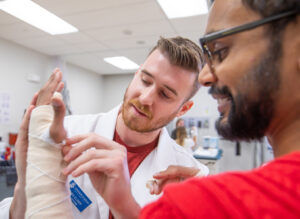
Students in the JWU Physician Assistant program learn different methods of applying splints, hopefully not needed in actual practice for culinary arts students! (2023 Photo: Mike Cohea/JWU)
Occupational Therapy Doctorate (OTD) students work with Chef Todd Seyfarth on “Chopped and Cheese” (healthy mac and cheese) competition. (Photo: Scott Bowers/JWU

New for fall semester 2023 at the Providence campus, 32 students, who already have an undergraduate or graduate degree and wish to pursue nursing as a career, will begin a 16-month program to earn a Bachelor of Science in Nursing degree. While some people thought the university was straying from their core focus by offering healthcare degrees, Mim says it is just the opposite. As just one example, culinary students can take advantage of advanced learning in dietetics and vice versa. “There is so much natural synergy between our healthcare programs and our food programs,” she said.

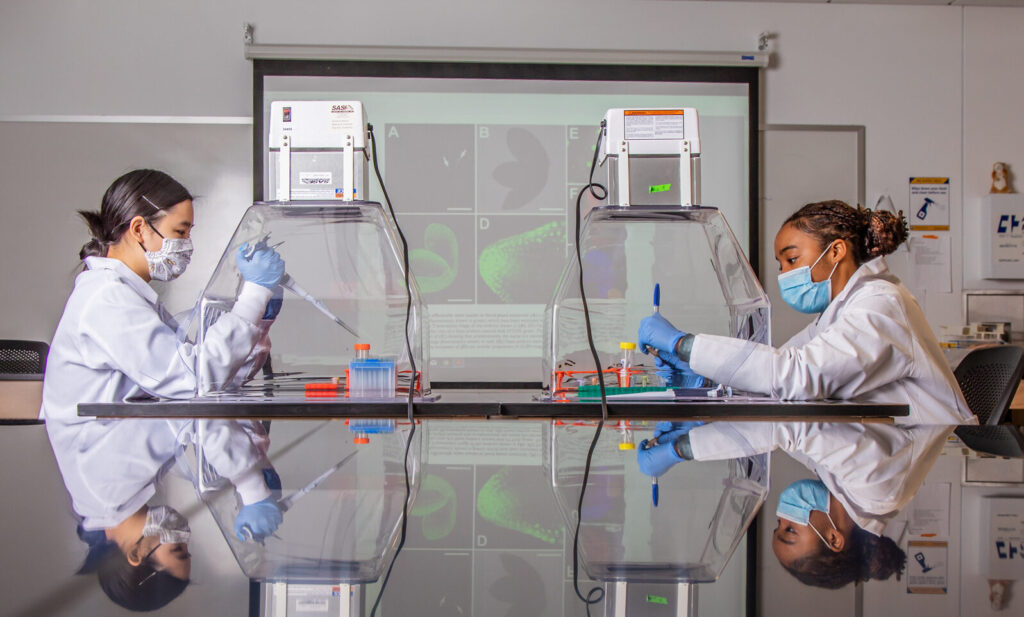
Undergrad students Kim Sacaza and Christine Wong work with Prof. Christos Dimos on a research project using portable clean rooms in the Molecular Biology Lab located in the Bowen Center. (2022 Photo: Mike Cohea/JWU)

The second issue that can keep her up at night is college affordability. “Sometimes scholarships mean the difference in a student staying in school or not. I’ve seen students leave school over a couple of thousand dollars. Thank you to the Chaîne for your scholarship support,” she said. Several members of JWU faculty and staff are Chaîne members. Mim emphasized that scholarships help with more than just tuition; the financial support helps to transform lives. More than 90 percent of all JWU students receive institutional scholarships and/or grants from the university.

On Feb. 25 at a Rhode Island Bailliage dinner event, the Chaîne Foundation will present JWU with a check for $15,000 to further support student scholarships.

With a 15:1 student to faculty ratio and a highly successful job placement rate for graduates in their field of study, JWU is certainly not an ivory tower but rather, a deliciously relevant tower of higher education.

“We couldn’t be more excited about the value of a degree,” Mim said.

Links
Johnson & Wales University


Clos de l’Obac Inspired by Centuries of Winemaking in Spain and France – and Two Hippies

Feb. 3, 2023 – As a teenager, Guillem Pastrana did not readily embrace the work he was tasked with at Clos de l’Obac, an internationally known winery in the Priorat region of northeast Spain that Carles Pastrana and Mariona Jarque, his parents, started in 1979. Wisely guided by his father to find his life’s work on his own, he became a lawyer, first practicing as a litigator and then specializing in real estate law. Soon he was advising winery owners who wanted to invest in Spain. In 2015, it was time to return to his roots in the vineyards. “I didn’t want to be a lawyer. I wanted to be a winemaker. So I came back to my father and asked my parents if I could become a winemaker and start working in the winery,” Guillem said to Chaîne during a Jan. 24 interview via Zoom. “Okay, if you’re crazy enough and you want to work with us, you can do it,” Carles told his son.

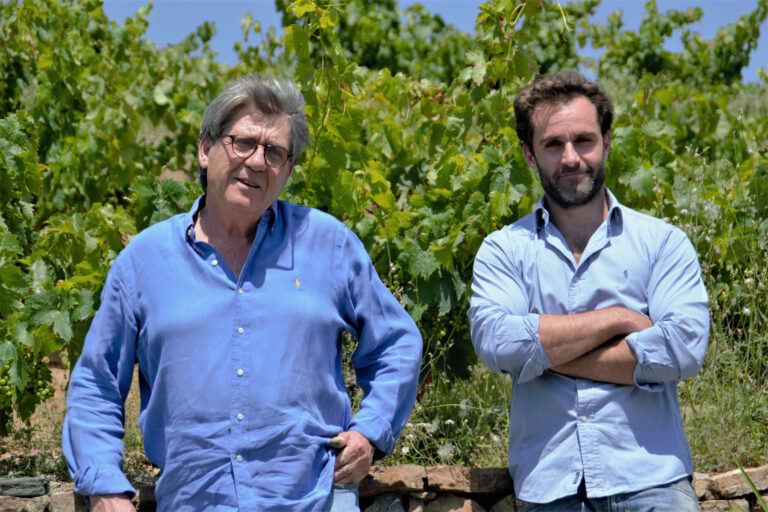
Featured Image above: Carles Pastrana, left, and Guillem Pastrana

The Clos de l’Obac Winery is located in El Priorat, Spain (Photo: Courtesy of CLos de l’Obac)

Returning to his roots meant he would be following not only in the footsteps of his parents but also in those of Carthusian monks who began making wine at Scala Dei, a monastery located in the Catalan region of Priorat, in the 13th century. Carles and Mariona’s reverence for that history became one of their essential textbooks because Carles, a journalist, and Mariona, an artist, had never made wine before. They boldly embarked on a journey defined by a dream to make wine that could compete with the best wines from the region and around the world.

Clos de l’Obac vineyard on rugged hills and slopes in El Priorat (Photo: Courtesy of Clos de l’Obac)

Their canvas was blank but they had a propitious plan for a beautiful painting. First, in 1979 Carles and Mariona began intensely studying the monks’ winemaking process from growing grapes on the rugged hills and slopes in the shadows of the Montsant mountains to the finished product in their cellars. As a natural barrier at an elevation of almost 4,000 feet, the mountains create a favorable microclimate for vines. Combined with rich slate soil and low rainfall, the terroir is ideal for vineyards, a conclusion the monks reached centuries ago that still informs soil science to this day.

Guillem explained that with average annual rainfall between 12 to 27 inches, roots will grow 49 feet (about 15 meters) into the subsoil to find water. With that deep network of roots, vines absorb minerals from the slate rock, imparting the grape vine with unique minerality. “The monks knew it. My parents copied it,” Guillem said. The area has both brownish and bluish slate with noticeable taste differences between the two. Guillem prefers taste nuances acquired from bluish slate.

As they learned about the Priorat terroir and its history, Carles and Mariona also traveled to France to learn winemaking techniques from large Chateaux producing high quality wine. To complete their learning journey, Mariona studied for about three years during this time to become an oenologist.

Carles Pastrana (Photo: Courtesy of Clos de l’Obac)

Honoring the monks’ heritage, Carles and Mariona began their viticultural journey by replanting seven hectares of vines on the same slopes and hills. When Guillem was a toddler, the family moved from Tarragona to a small village to be closer to the vineyards and winery. “When I arrived I was four years old. It was a little bit strange in a sense that they brought me in the middle of nowhere. My sister and I asked our parents where we were and what we were doing here,” Guillem said. The siblings went from attending school with hundreds of other children to a school with a total of 20 students.

“It was the first step. We were not farmers but we needed to learn,” he added.

With their dream of making superior fine wines, Carles and Mariona created their own fixed coupage system. For their signature Clos de l’Obac, the blend has been and will always be a mix of 35% Grenache, 35% Cabernet Sauvignon, 10% Syrah, 10% Merlot and 10% Cariñena. The grapes are crushed and mixed to the exact percentages before fermentation.

Close de l’Obac vineyard (Photo: Courtesy of Close de l’Obac)

Harvesting their first grapes in 1989, Carles and Mariona released their first wine to the market in 1991. At this time, Priorat farmers were selling their wine in bulk at $0.10 per liter. Other winemakers thought it was “complete madness” when they priced one bottle of their Clos de l’Obac at almost $35. “They knew they had an extraordinary product and they really believed in the project,” Guillem said.

That first year they did not sell one bottle of wine. Ditto for the next year as well. “Imagine after 10 years of hard work. We had this extraordinary wine in the market and we were not able to sell it,” he said.

Their breakthrough came in 1993 when the World Wine Guide named Clos de l’Obac among the top 150 wines in the world. Slowly wine lovers became aware of the label. To keep their dream alive, Carles was still working as a journalist and Mariona as an artist. That was about to dramatically change.

The fax machine, state-of-the-art technology used globally in the closing years of the 20th century, revolutionized international business. The din of the fax machine was music to the ears of small business owners. One moment is seared in Guillem’s memory.

“We were living as hippies in a small flat. I remember receiving an order from Puerto Rico. All of the family was waiting in front of the fax trying to see which order was arriving. They ordered two pallets of wine! All of the family was screaming. We were very happy.”

Clos de l’Obac follows a fixed coupage system that has remained the same since its first vintage. (Photo: Courtesy of Clos de l’Obac)

And then in 1994 in a blind tasting in Sweden, Clos de l’Obac was listed among the best 20 wines in Europe. From that moment on, the small winery flourished and today ships wine to 32 countries. With an annual production of 50,000 bottles from grapes they grow on 27 hectares, they are small but that is by design and will remain so. The winery produces four different wines – Clos de l’Obac, Dolc de l’Obac, Kyrie, and Miserere. Most of their vines are from 25 to 40 years old but some are 80 to 100 years old from vineyards they have purchased from village farmers.

Since its inception in 1979 and its first release in 1991, Clos de l’Obac has never wavered in its fixed coupage system and its philosophy of only releasing a vintage when it is ready to drink. “I always say that to make a good wine is something easy for a winemaker but to make a very good wine you have to be a winemaker and have the best tools. But to make an outstanding wine, you have to feel it,” Guillem said. Because of fixed coupage, each vintage exquisitely expresses the unique four seasons of that year.

U.S. Distribution – OBAC West Winery

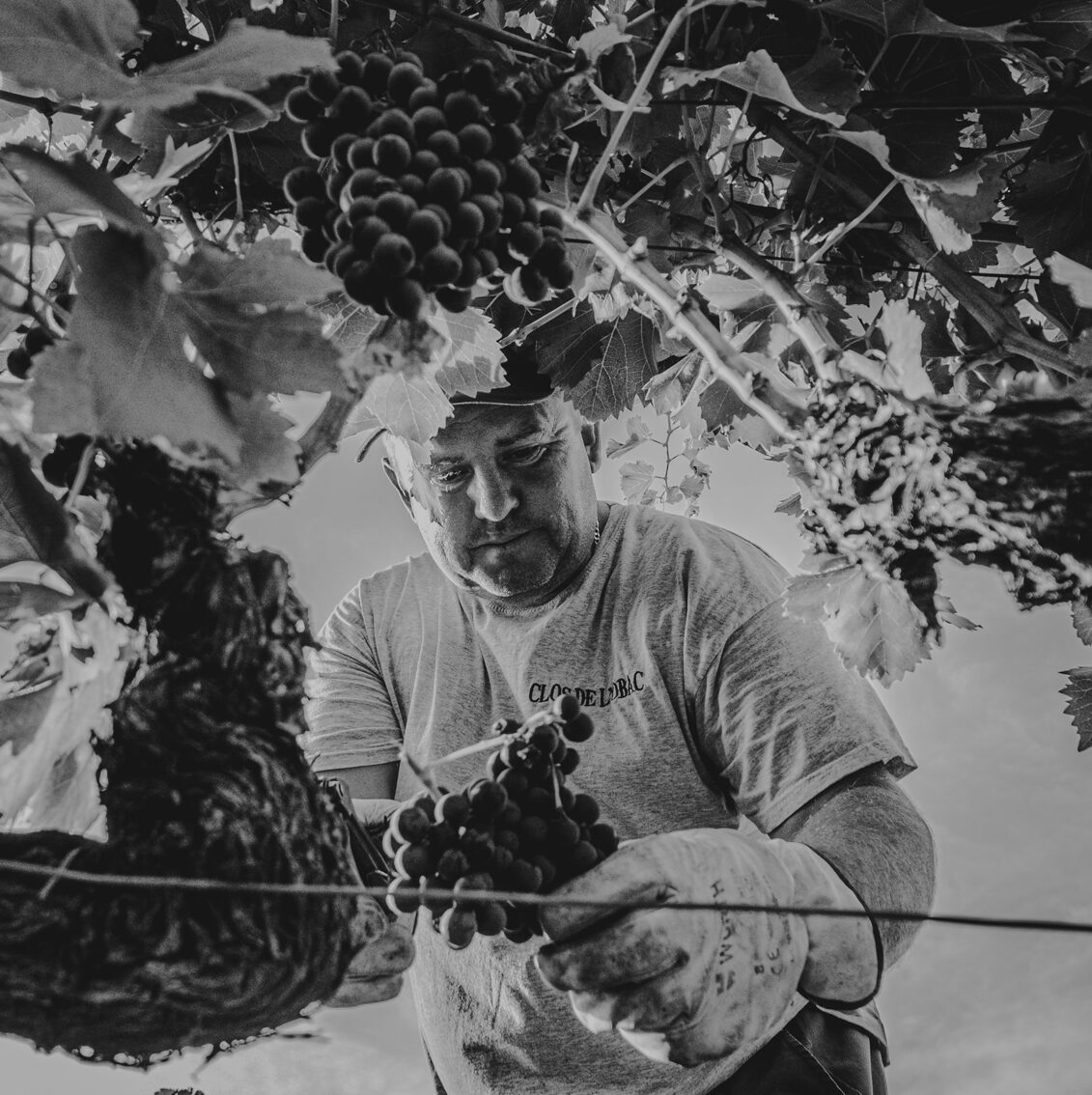
Harvest at a Clos de l’Obac vineyard (Photo: Courtesy of Clos de l’Obac)

John-Dominic Cancilla and Ana Cereijo are co-owners of OBAC Imports, the sole importer of Clos de l’Obac wine in the United States, and an integral part of the tight-knit Clos de l’Obac wine family.

John explained during the interview that there are noticeable differences in taste from one vintage to the next because of year-to-year variations in precipitation levels, temperature, and other seasonal factors, such as an early or late arrival of seasonal norms. “It’s the Hand of God in the bottle,” John said Carles often says. Carles has written a book, In God’s Vineyard, to explain how God has graced Clos de l’Obac and how God’s hand is really in every bottle, John added.

Recently inducted into the Delaware Valley Bailliage, John said there have been years the decision was made not to release the vintage, citing 2003 Clos de l’Obac as a case in point. Feeling it was not ready to drink because it was too tight, the vintage was not released until after 2006. John just received an email from a customer who reported its superior taste.

“We’re still getting people who would like to buy the 2003 vintage. There’s just not a lot of it,” John said. Their current release is the 2012 vintage.

Distribution of Clos de l’Obac in the United States is solely through their direct to consumer Wine Club so that wine lovers can have a personal relationship with the winery and the winery can maintain its worldwide footprint. They have no desire to produce wine for the market as they view Clos de l’Obac as a lifestyle and not a business. “It’s more a cultural experience than just a gastronomic experience and that’s our philosophy,” Guillem said. John added that a few of their Club members in the United States are winemakers from a number of states. “I think that’s quite a recommendation,” he added.

Guillem Pastrana, CEO of Clos de l’Obac (Photo: Courtesy of CLos de l’Obac)

Through a series of events held by the Delaware Valley Bailliage and the Union League in November 2022, Chaîne members and guests were able to meet Guillem, John and Ana, John’s wife, and experience Clos de l’Obac wines. And at the upcoming Southwest Provincial Chapitre and Jeunes Chefs Competition (Feb. 23 to 26) in Galveston, Texas, there will again be that opportunity with Clos de l’Obac tastings, auctions and a seminar.

Clos de l’Obac produces 50,000 bottles annually. (Photo: Courtesy of Clos de l’Obac)

“My feeling is that Chaîne is an extraordinary association that really supports and promotes all of the people involved with the food and wine world. We are proud to be able to collaborate with the Chaîne,” Guillem said.

For the Pastrana family and their extended wine family, the journey has been an adventure of a lifetime. A team of 15 operate the winery, including five family members. Guillem has taken the reins as CEO but his father is still “the boss.” Reflecting on the adventure, Guillem said there is no doubt his parents accomplished what they set out to create.

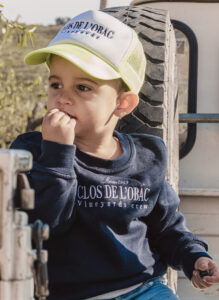
Guillem’s son Wim is the third generation of the family. (Photo: Courtesy of Clos de l’Obac)

“Nobody could expect that a family of hippies could start this revolution in Priorat so I think they succeeded in a sense that now, they are producing a wine they wanted to 40 years ago and are selling it around the world. At that moment, they could not have imagined they would succeed. But now the dream has come true. Wine connoisseurs and wine lovers come from around the world to visit and taste our wine.”

The third generation of the family are toddlers now playing in the wineries. Guillem thinks it would be wonderful if they continued the family legacy as he jokingly said he would like to retire as soon as possible so he can enjoy the wines they are producing.

“It’s important to us but they will choose their future,” he said.

The family legacy has roots as deep as their vines.

Links
Clos de l’Obac
Southwest Provincial Chapitre and Jeunes Chefs Competition

Peggy Furth Makes Her Mark as a Vintner and Chocolatier

Jan. 20, 2023 – Even a casual glance at the label on a bottle of California’s WindRacer Chardonnay or Pinot Noir evokes powerful imagery of elite horses racing toward performance perfection, an ethereal goal to achieve poetry in motion that is shared across cohorts of not only equestrians but also viticulturists and vintners. “All conversations start and end with Chardonnay,” Peggy Furth, Chaîne member, said to Chaîne during a Jan. 9 telephone interview. Peggy and Barbara Banke are co-founders and co-owners of WindRacer Wines and Sonomaceuticals. Their conversation about Chardonnay marc (pomace), the stems, skins and seeds left over after pressing grapes but before fermentation, is just beginning.

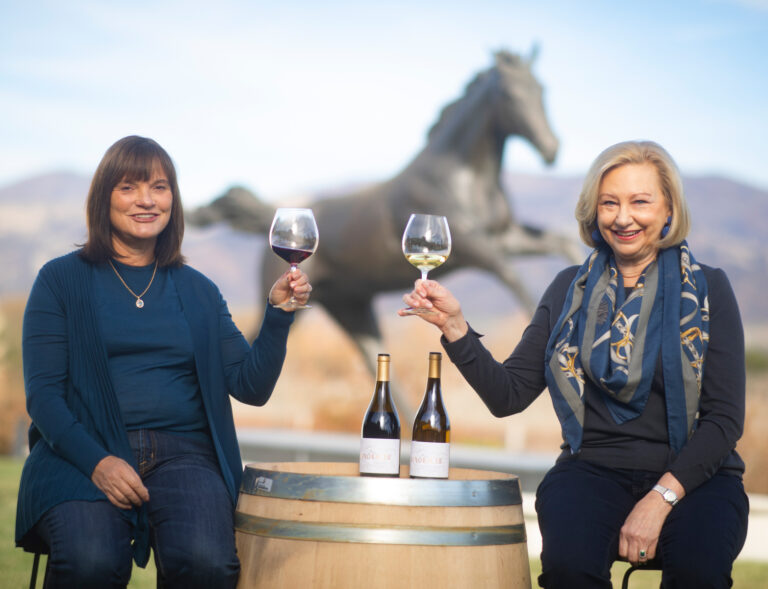
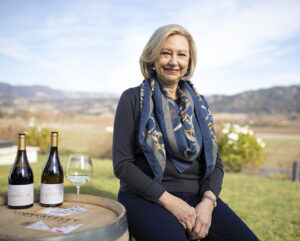
(Featured Image above: Barbara Banke, left, and Peggy Furth)

Bottle of Chardonnay
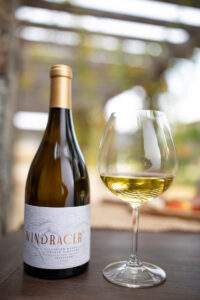
WindRacer Chardonnay (Photo: Courtesy of WindRacer Wines)

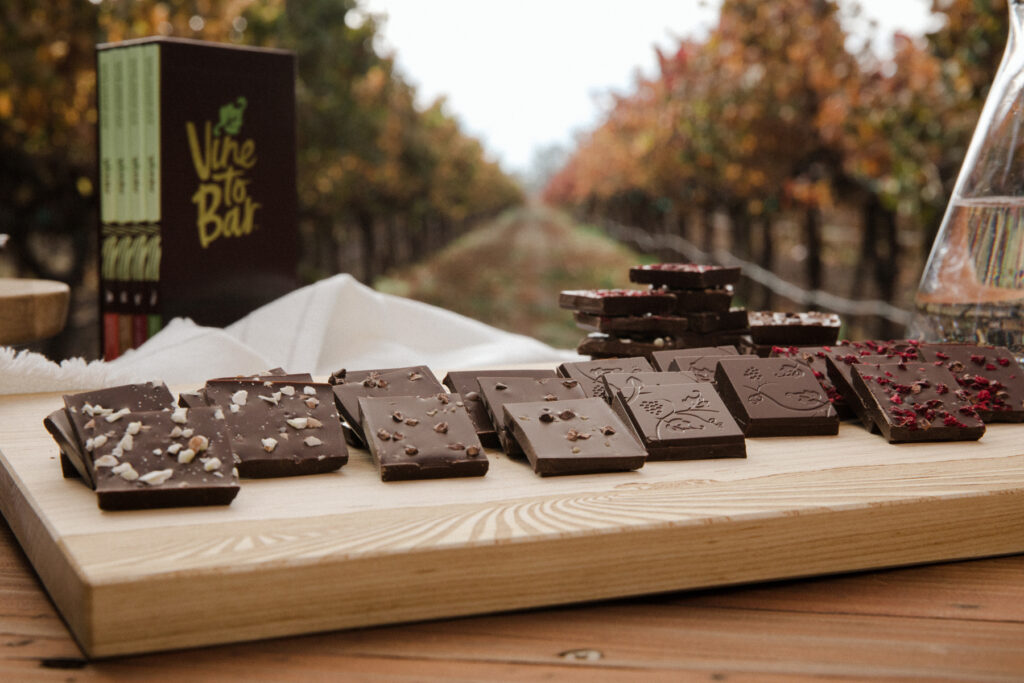
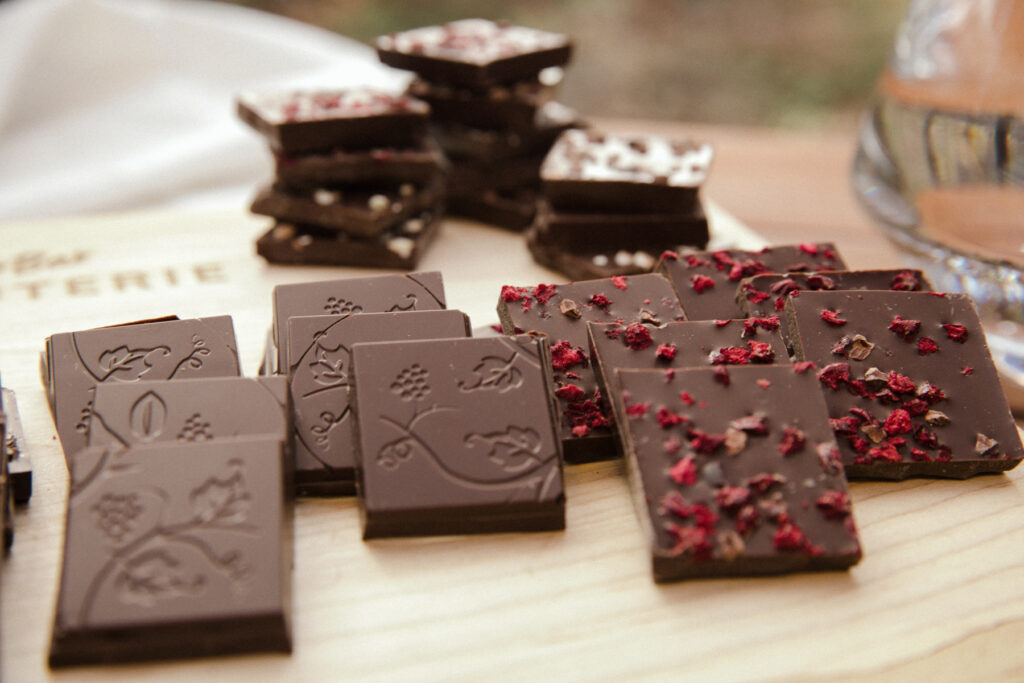
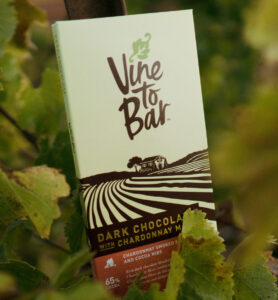
Vine to Bar dark chocolate tasting squares (Photo: Courtesy of Vine to Bar)

​In 2021 after years of fruitful collaboration, both literally and figuratively, with research scientists at the U.S. Department of Agriculture’s Agricultural Research Service (USDA-ARS) and the University of California, Davis (UC Davis), the Sonomaceuticals team launched Vine to Bar, a line of fine dark chocolate bars. The bars contain 15 percent WellVine Chardonnay Marc, the end result of a proprietary process to dry, press and mill Chardonnay marc. This new utilization of a byproduct of Chardonnay winemaking supports wine industry sustainability and offers millions of chocolate lovers a new sensory experience with potentially significant health benefits based on prior and ongoing nutritional research on plant-based natural products (PBNPs).

Chaîne members who attended last fall’s Grand Chapitre in San Antonio were able to sample Vine to Bar chocolate. They will be able to do so again at Chaîne’s 2023 Société Mondiale du Vin Weekend, being held from April 12 to April 16 in Napa, and the Jeunes Chefs Rôtisseurs competition in June in Madison, Wisconsin.

Chocolate on Chocuterie Board in vineyard
Vine to Bar dark chocolate bars and tasting squares are available in four flavors: Dark Chocolate; Tart Cherry and Cocoa Nibs; Almonds and Himalayan Pink Salt; and Chardonnay Smoked Salt and Cocoa Nibs. (Photo: Courtesy of Vine to Bar)

Previously, grape marc was either thrown away, used as fertilizer, or fed to livestock. For a first of its kind application, Peggy, Barbara and the Sonomaceuticals team have upcycled, or in other terminology, valorized, Chardonnay marc. “I think the excitement of being in a small startup has inspired all of us to continue to do better and better. Hopefully, we’re on the trail of a major disruption in fine winemaking that incorporates how to upcycle grape marc.” Peggy said.

Career Path

Before Peggy reached out to experts at UC Davis in 2009 to learn if there were protocols for commercial applications of Chardonnay marc, she had been working within the wine industry for almost 25 years after moving to Sonoma County, California in 1984. Reflecting on her early days, she said, “I knew nothing about the wine industry. I had an interest and curiosity and commitment to living among these beautiful hillside vineyards and learning as much as I could about how to grow grapes and make wine.”

Peggy Furth, co-founder and co-owner of WindRacer Wines and Sonomaceuticals (Photo: Courtesy of WindRacer Wines)

With a corporate background in Public Affairs working for the Kellogg Company, based in Battle Creek, Michigan, she brought experience in the food industry to her new career, albeit in a radically different market segment. “My experience was more in Corn Flakes and Pop Tarts,” she added with a chuckle.

She spent her formative years in the wine industry at Chalk Hill Winery in Healdsburg but after new owners purchased the winery, in 2007, she and Barbara, Chairman and Proprietor of Jackson Family Wines and her dear friend, founded WindRacer Wines in Santa Rosa. The inspiration for their brand evolved from their shared passion for exquisite racehorses and fine wine. While strolling Kentucky’s blue grass at Barbara’s horse farm in Louisville, Barbara suggested they focus on producing Chardonnay and Pinot Noir. But Peggy said she knew nothing about Pinot Noir. “It’s time you learn,” Barbara told her. One thing they both knew at that moment though was their WindRacer label would include a horse.


With a video montage in the background, the WindRacer website speaks beautifully to the similarities between racehorses and fine wine as both endeavors require extensive effort, exceptional care and a nurturing spirit as their website states. Peggy and Barbara embraced it all.

Peggy describes Chardonnay as the winemaker’s grape and Pinot Noir as the viticulturist’s grape. The two varietals are genetic relatives, research that was spearheaded at UC Davis in Carole Meredith’s lab in the 1990s.

Back in Sonoma, they began a selection process of vineyards for their two varietals from their historical knowledge of local vineyards with a reputation for superior grape production. “Our common goal was to make great tasting wine from extreme sites that people haven’t visited and needed to add to their exploration of fine wines. That’s how WindRacer was born,” Peggy said.

With annual production of 1200 cases per year, Shaun Kajiwara, WindRacer Vineyard Director, hand selects rows within mountaintop vineyards in Mendocino County’s Anderson Valley and Sonoma County’s Russian River Valley for each varietal and vintage. Sarah Wuethrich, vintner of fine wines from Maggy Hawk, is WindRacer’s winemaker.

Chardonnay Grapes

The history of Chardonnay’s popularity is reflected in statistics. From less than 1,000 acres of Chardonnay grapes planted in California in 1968, approximately 87,000 acres were planted in 2020, according to the California Department of Food and Agriculture (CFA).

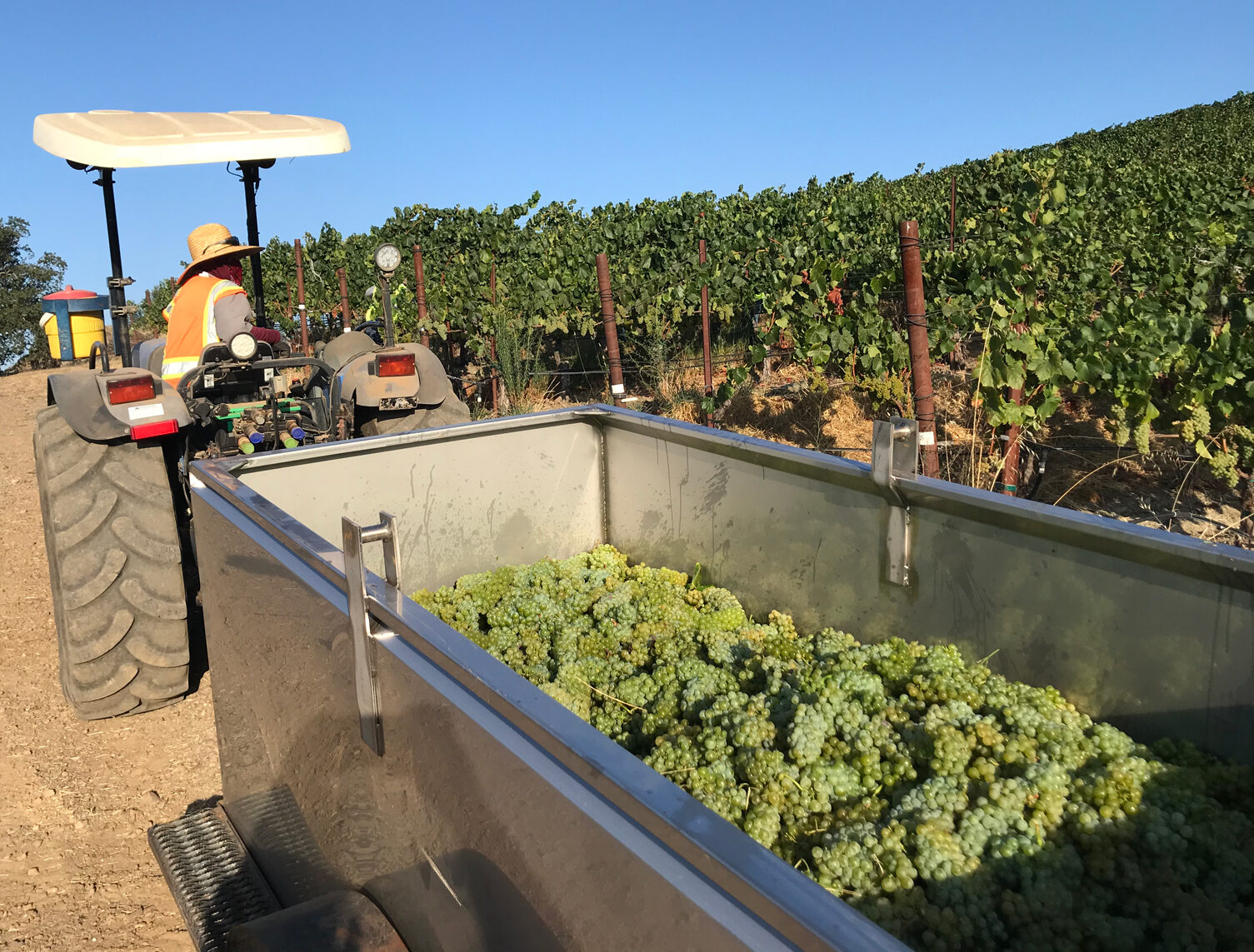
Harvesting grapes
WindRacer grapes are grown on extreme, mountaintop vineyards in Sonoma County and Mendicino County, California. (Photo: Courtesy of WindRacer Wines)

“Jackson Family Wines made Chardonnay America’s most popular beverage,” Peggy said.

A total of 3.9 million tons of grapes were crushed in 2021, an increase of 9.2 percent from 2020, according to a CFA Grape Crush Report. While more red wine varieties were crushed, Chardonnay grapes represented the largest percentage of total tonnage of any variety at 16 percent. Pinot Noir came in fourth at 7.1 percent.

About 20 percent of crushed tonnage is marc so in 2021, about 121,000 tons of Chardonnay marc were available from California Chardonnay production alone. For their Vine to Bar chocolates, Peggy said they use Chardonnay marc exclusively from Jackson Family Wines production. “We have all we need today,” she added. WindRacer is a brand within Jackson Family Wines.

Research and Product Development

Opening the wrapper of a Vine to Bar chocolate today is the result of Peggy’s curiosity, tenacity, energy and her team’s collaborative nature over many years to meet a twofold challenge to upcycle a waste byproduct and provide a delicious yet nutritional food product to consumers.

Chardonnay grapes are being crushed for WindRacer’s cool-climate Chardonnay. (Photo: Courtesy of WindRacer Wines)

“This has been a long journey,” she said.

In 2009 when she reached out to UC Davis scientists, she learned there were no commercial applications for Chardonnay marc. “We had an underutilized asset but did not know the dimension of that asset,” Peggy said. Pondering its application as a food ingredient and potentially as a dietary supplement, they began their quest by standing on the shoulders of prior research on polyphenols, a large class of carbohydrates that includes flavonoids found in fruit, tea, wine and cocoa that have demonstrated antioxidant and anti-inflammatory properties. Years ago red wine and dark chocolate lovers rejoiced at research that suggested consuming those foods helped fight a host of diseases and were particularly beneficial to cardiovascular health.

After first exploring grape seed oil expressed from dried grape seeds, Peggy and her team thought of milling grape seeds to produce grape seed flour. Using eight different grape varietals, Peggy then funded scientific research to discover whether there was an effect of different grape seed flours on weight gain and lipid metabolism. Conducted by USDA-ARS scientists with an animal model, of the eight flours, the Chardonnay grape seed flour showed the greatest effect, which led to its use as an ingredient in cookies and other baked goods.

As the WindRacer brand found its footing in the marketplace, Peggy continued exploring the potential to upcycle whole Chardonnay marc instead of just one component of the byproduct. Fast forward a number of years. Upon meeting Professor Harold Schmitz at UC Davis, Peggy invited him to join the Sonomaceuticals team as their scientific advisor to outline a program of more extensive research to identify and study specific bioactive compounds in WellVine Chardonnay Marc. Underway for three years and counting, some results are just now being published and in October 2023, Sonomaceuticals will hold its second Science Symposium to discuss its findings.

It’s exciting times for biochemists and food scientists who focus on the lean alphabet soup of carbohydrate chemistry, the C, H and O atoms that form the carbohydrate backbone – carbon, hydrogen and oxygen respectively. These three chemical elements are configured in thousands of different ways in plants to form compounds that each have unique properties, creating what the food industry terms the “circular bioeconomy.” Fundamental to that understanding is the knowledge that plants use sunlight as energy, capture carbon dioxide from the air, and absorb water to make their own food – sugar, a carbohydrate. Whether it’s a grape vine or a viola, this photosynthetic process in plants follows the same formula.

Vine to Bar dark chocolate contains 15 percent WellVine Chardonnay Marc, the first commercial food product to incorporate Chardonnay marc. (Photo: Courtesy of Vine to Bar)

A springboard for their new research was the large body of knowledge about flavonoids from rigorous prior research. Flavanols, a type of flavonoid, are found in both wine and dark chocolate. What types of flavanols are in Chardonnay marc? Are these flavanols identical or similar to flavanols in dark chocolate and do they have similar health benefits? What processes would ensure their bioactivity as an ingredient in a dark chocolate bar? And what types of interactions with other carbohydrates, such as fiber, would affect their activity, either positively or negatively?

These are some of the questions ongoing research on WellVine Chardonnay Marc seeks to answer. Results announced to date include finding an extraordinary diversity of bioactive PBNPs in concentrations over and above what has been previously identified in other red and white varietal grape marcs. And the entirety of its chemical profile gives the ingredient desirable sensory attributes (taste, smell, texture) with significant implications for the food and wine industries. Finally, results suggest additional research on the interaction of flavanols and fiber could codify the product’s potential health benefits. Add data scientists to the list of researchers as current researchers believe Artificial Intelligence (AI) models could accelerate deriving answers to some or all of the above questions.

Product Launch

Vine to Bar Dark Chocolate Bars contain 65 percent dark chocolate, 15 percent WellVine Chardonnay Marc and 200 mg of flavanols per serving. (Photo: Courtesy of Vine to Bar)

“Where Sonomaceuticals has taken this business from an idea of trying to understand the potential health benefits of Chardonnay marc to what the world is referring to as the circular bioeconomy is impressive. There is now a commercial application that demonstrates the value of this upcycled ingredient not just for sustainability but for the fact that it makes the chocolate actually taste better,” Ed Klein, Managing Director of Vine to Bar and formerly a Vice President of Marketing at Coca-Cola, said during the Jan. 9 interview. Better taste comes from Chardonnay marc’s sensory attributes that tempers dark chocolate’s bitterness.

Ed further explained Vine to Bar sources their chocolate from the Barry Callebaut Group based in Zurich, Switzerland, a company with more than 175 years of heritage as a producer of high-quality chocolate and cocoa products, according to their website. In an Oct. 27, 2022 press release, the company announced for the first time in its history, it has redesigned the farming, fermentation and roasting of cocoa beans to put ‘cocoa first, sugar last’ to respond to consumer preferences to more mindfully indulge in chocolate.

WellVine Chardonnay Marc is produced immediately after grape harvest so that it has a long, stable shelf life and can be incorporated into chocolate bars as needed. Each bar contains 15 percent Chardonnay marc, 65 percent dark chocolate and 200 mg of flavanols.

For Peggy, it’s a long way from Corn Flakes and Pop Tarts but she is grateful for the years she spent at a large corporation.

“I think the discipline of attention to detail, understanding the financial impact of decisions, and finding great people to work with is what I took from my corporate experience. But I have to say, no matter how large the company is that I’ve worked for or Ed has worked for, when you get down to it, the progress is made by a handful of individuals who work so well together and so swiftly. I will say the Vine to Bar project came together as Ed will say, ‘We went from a blank sheet of paper to a product in the marketplace in one year.’ That doesn’t happen in large corporate settings. But it can happen with small start-ups.”

As they softly launched in 2021, Peggy found herself back in Kentucky hosting a WindRacer wine and Vine to Bar chocolate tasting event at Keeneland. While the excitement of watching Thoroughbreds race was not exactly conducive to a table filled with wine glasses, the event was a rewarding culmination of years of hard work to fulfill a vision.

Vine to Bar Chocuterie board
A Vine to Bar Chocuterie board and WindRacer Chardonnay – a new pairing opportunity like no other. (Photo: Courtesy of Vine to Bar)

As Peggy, Barbara and their team bring that vision into full focus in 2023, imagine the lively and interesting conversations they will be having about pairing Chardonnay and chocolate, conversations that will be impossible to end!

Notes

Click here to visit Chaîne’s Vine to Bar Partner page for a special offer for Chaîne members.

Chaîne members: Be on the lookout in the next six to eight weeks for notice of a virtual WindRacer/Vine to Bar wine and chocolate tasting/pairing event, exclusively for Chaîne members. “Congratulations to Chaîne members on a long and storied history of the love of food and wine,” Peggy said.

Links
Vine to Bar chocolate
WindRacer Wines
Jackson Family Wines

Chef Cutino Preserves History and Destination Dining

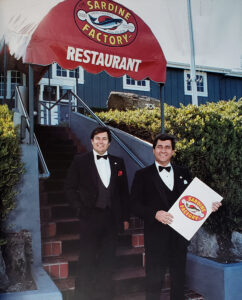
Dec. 9, 2022 – Just before the dawn of the 20th century, Bert Cutino’s uncle emigrated from Sicily to California, bringing fishing nets, and about 300 years of family experience as commercial sardine fishermen, with him to Monterey Bay. Casting for a new life to support his family, he and hundreds of other immigrants from the same fishing village (Isola delle femmine) near Palermo, including Bert’s father, eventually anchored their nets and traditions in America yet kept a piece of their hearts in Italy. Young boys at 13 would join their fathers on the boats to literally learn the ropes of the profession. In 1953, Bert began fishing on his father’s boat but already had other ideas for his future. “It was an exciting experience but I did not want to be a fisherman. I guess I broke the rule,” Chef Bert Cutino, co-owner of The Sardine Factory and Chaîne member of the Monterey Peninsula Bailliage since 1977, said to Chaîne during an Oct. 12 telephone interview.

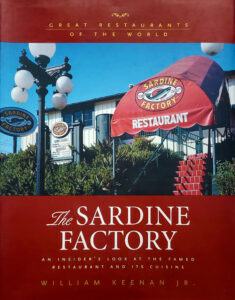
The Sardine Factory by William Keenan Jr. cover
The Sardine Factory by William Keenan Jr. was published in 2000 (Photo: Chaîne/The Sardine Factory)

Cannery Row History

In its heyday in the mid-1930s, Monterey’s rapidly growing sardine industry drew expertise from around the world as Chinese and Sicilian immigrants were among the first commercial fishermen, and Spanish and Portuguese immigrants eventually built 16 canneries, the first one constructed in 1896. Many wives of Sicilian fishermen worked in the canneries. Monterey bustled with activity and had the smell to prove it. About 300 boats (purse seiners) of different sizes fished the Bay, each with a hold capacity up to 30 tons or more in nets that were dropped into the Bay. Three canteens opened to serve all of the cannery workers. Coffee was free. A doughnut cost six cents.

Bert said his family remained in contact with their relatives in Sicily. A snapshot in time is invaluable when studying history for it compels one to deeply reflect on and connect the dots between time, place and circumstance for an appreciation of the era.

Pause for a moment to reflect on a snapshot from the summer of 1945. Bert was six years old and already helping his mother make her famous tomato sauce. They had a table for 30 in their basement that was filled to capacity on many occasions. “My mother was an excellent cook,” Bert said. It gave her great joy to receive accolades for not only her Italian cooking but also a wide variety of other ethnic-inspired dishes. “She made the best enchiladas I’ve ever had,” he added. Both Bert’s mother and his mother-in-law worked in the canneries and then came home to cook for their young families. “It was amazing how they were, hard working people,” Bert said.

A menu board from a canteen for cannery workers in Monterey in the early 1900s (Photo: Chaîne/The Sardine Factory, p.29)

In the summer of 1945 in Sicily, Europe was only weeks into peacetime instead of wartime. Sicilian fishermen could once again navigate the seas without intense fear of losing their lives. Imagine the letters between family members in Sicily and Monterey after Victory in Europe (V-E) Day on May 8, 1945. Millions of families in Europe had been liberated from fear and their American relatives celebrated with them from afar. Together they had helped win the war as sardine oil was used as a preservative in the gray paint so recognizable on U.S. Navy ships.

But the joy in Monterey was tempered with a looming crisis as sardine yields had begun to decline. To this day, fishermen still debate the cause of the decline but the reason then was inconsequential when livelihoods were at risk. Shortly after World War II, sardine fishing in Monterey Bay collapsed. Bert’s father had his first boat, a small one, until 1946 and then a 38-footer in 1948 with a 20-ton hold capacity that he named Santa Rosalia in tribute to the patron saint of his ancestors’ village in Sicily.

Bert vividly remembers at age 13 in 1953 going fishing with his father. “We did not catch one sardine,” he said. To remain in business, fishermen switched focus to squid, mackerel and other species. There was such a plentiful supply of abalone, fishermen gave it to wharf workers for free. My how times have changed! Today the retail cost of three pounds of wild abalone, cut in 3-oz steaks, is $405.20, according to Alaskan Seafood.


Culinary Career

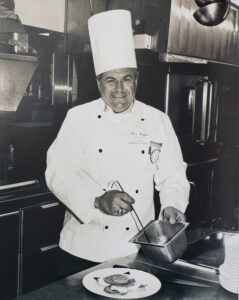
Chef Bert Cutino (Photo: Chaîne/The Sardine Factory, p. 28)

Also in 1953, Peter, Bert’s older brother, was hired as a lifeguard at the Holman Ranch, a high-end western ranch founded by Mr. Holman who owned a well known department store. The ranch needed a dishwasher. With all of the time Bert spent in the kitchen, his little brother was perfect for the job. “My brother hired me, in a sense, to wash dishes by hand for three meals a day, and besides, Peter thought he would earn some brownie points by finding someone,” Bert said.

Bert first had to convince his parents to let him take the job for the summer, a tall order because the job required him to live at the ranch. His parents finally relented. At age 13, Bert’s culinary career was off and running although he did not realize it. He liked the idea of earning $0.30 per hour.

Mr. Holman’s first love was the ranch so he checked every aspect of the business down to the food being served to his employees. He would come in daily at 11:30 a.m. to taste lunch.

One day the German chef in the kitchen asked Bert to taste his spaghetti before Mr. Holman arrived. Bert had watched him make it and declined. “First of all, it’s pasta, not spaghetti,” Bert told the chef as only a very confidant and admittedly, cocky 13-year-old dishwasher could. The chef bristled and said the next time it was on the menu, Bert could make the sauce. Sure enough, the opportunity soon presented itself. With ingredients in the kitchen, Bert whipped up his mother’s tomato sauce. When Mr. Holman arrived, he asked the chef what was on the menu. “Pasta a la Cutino,” he replied. Mr. Holman immediately put Bert’s sauce on the menu for employees and customers alike and raised Bert’s pay to $0.35 per hour.

Bert had monetized his culinary skills as a young teenager. Those skills eventually paved the way for Bert to complete a three-year apprenticeship that was certified by the American Culinary Federation (ACF) under some great chefs.

Chef Bert Cutino, left, and Ted Balestreri attend to details in the kitchen of The Sardine Factory, (Photo: Chaîne/The Sardine Factory, p. 94)
Chef Bert Cutino, left, and Ted Balestreri in front of The Sardine Factory (Photo: Chaîne/The Sardine Factory, p.43)


As college approached, Bert was unsure what to study so he asked his father. The advice he gave him was a gift Bert still appreciates. “Whatever you want to do is good. If you’re happy, I’m happy,” his father answered. “It was the best advice in the world,” Bert said.

The Conservatory at The Sardine Factory (Photo: Chaîne/The Sardine Factory, p.17)

During his college years majoring in business at Monterey Peninsula College, Bert worked at a restaurant as a busboy, in the kitchen, and anywhere he was needed. Ted Balestreri, a classmate in his economics class, also had a job as a busboy at a nearby restaurant. They became friends and often talked about their shared goal to open a restaurant one day. After graduating and logging experience in the industry, their friendship blossomed into a business partnership that has lasted 55 years with The Sardine Factory, their flagship restaurant they opened in 1968. The building was one of the three canteens that served the 16 canneries. Bert describes the building as “ugly” and “dilapidated” when they first saw it. But they were able to lease it for $400 per month so they jumped at the chance. Within two years, they owned the building.

Bert said people thought they were nuts for calling their restaurant The Sardine Factory but he wanted to both honor Monterey history and convey the idea of production by using fresh, local seafood and produce. “We were doing regional food before it became popular,” he said.

Both Bert and Ted believed one key to success was offering customers some magic, a unique and “million-dollar” experience they could not replicate at home. Bert’s passion is creating sauces and soups so he and his sous chef created their now World-Famous Abalone Bisque, which has continuously been on the menu since opening in 1968 and graced the menu at “Taste of America” during President Ronald Reagan’s 1985 inauguration. The soup became their restaurant’s “secret sauce.”

Another magical touch evolved from something Bert saw while at San Francisco’s Fairmont Hotel. He served an Intermezzo sorbet in a lighted ice swan, which they still serve today.

The Sardine Factory serves an Intermezzo sorbet in a lighted ice swan. (Photo: Courtesy of Chef Bert Cutino)

In The Sardine Factory by William Keenan Jr., a book about the restaurant published in 2000*, a review that appeared in 1968 in the Monterey area publication Game and Gossip is quoted. It confidently predicted their success. The review stated:

“People will be talking about the new restaurant overlooking Cannery Row, The Sardine Factory. To the world at large the name will become synonymous with the history of the sardine canneries, the fishing fleet, and the men and women who have made the era famous. Even the little-known people, who have been forgotten for many a decade, will find a lot of recognition on these new ‘walls of fame.’” (The Sardine Factory, p. 121)

The Sardine Factory: Bread Ring with Prawn (Photo: Courtesy of The Sardine Factory)

The author’s prediction came to fruition. The Sardine Factory took off, gradually expanding from 60 seats to 220 seats divided into themed rooms, some casual and some formal but all centered on delivering an exceptional culinary experience to customers. The elegant Wine Cellar downstairs has one long table for 28 nestled among thousands of bottles of wine, one of the top collections in the world.

The Cannery Row Room at The Sardine Factory (Photo: The Sardine Factory)
The Captain’s Room at The Sardine Factory (Photo: The Sardine Factory)

The duo and their talented, loyal staff have hosted countless celebrities and politicians over the years but credit their local clientele with their success. To honor them, stools surrounding their Brunswick bar that is more than 100 years old have plaques with names commemorating their early regulars. “They’re people who worked on Cannery Row, ordinary people of Monterey, but to us they’re famous.” (The Sardine Factory, p. 78)

The Sardine Factory: Special Dessert of ice cream and and solid chocolate ganache with mango and raspberry sauce (Photo: Courtesy of The Sardine Factory)

Their risk reaped rewards for themselves as well as the entire area – Cannery Row. Abandoned for years after the collapse of the sardine industry, the success of The Sardine Factory was a catalyst that drove redevelopment of shuttered canneries and run-down buildings into new restaurants, hotels and shops. Cannery Row became a top domestic and international tourist destination. Today Bert and Ted own five hotels and are involved in numerous real estate partnerships in Cannery Row.

“If you love what you do, you don’t really work. To me, I never feel like I’m working.” Bert said.

The Wine Cellar at The Sardine Factory (Photo: Chaîne/The Sardine Factory, p.79)
The Wine Cellar holds a collection of more than 20,000 bottles. (Photo: Chaîne/The Sardine Factory, p.133)

Culinary and Charitable Organizations

When they were building their business, Ted handled the front of the house; Bert handled the back of the house; and side-by-side they made an indelible impact on numerous culinary and charitable organizations that continues today. Bert fondly talks about his involvement with the Chaîne des Rôtisseurs, the American Culinary Federation, the American Academy of Chefs, The Drummond Culinary Academy, Meals on Wheels, and ProStart. Bert served as a state and national judge for the National Restaurant Association Educational Foundation ProStart program for high school students who participate in ProStart culinary skills competitions.

Chaîne

Cutino and others with Chaine ribbons
An early 1980’s photo of Craig Clark, Ted Balestreri, Chef Bert Cutino and Vice Conseiller Culinaire Hon. Fred Dame (Photo: Chaîne/The Sardine Factory, p.40)

“The Chaîne is in my heart,” Bert said as he recalled his early days when he wondered if he could have the honor of cooking a Chaîne dinner. He did and in 1977 joined the Chaîne as Maître de Table Restaurateur. It was the beginning of four decades of active involvement, serving in many leadership roles including Monterey Peninsula Bailli in 1995, Conseiller Culinaire Provincial in 1999, and member of the Board of Directors in 2003 as Conseiller Des Professional Des Etats-Unis. In 2016, Bert received the Brillat-Savarin Award and became a Grand Commandeur. To this day when Chaîne members are guests at The Sardine Factory, staff place a Chaîne flag in the middle of the table. “People think an ambassador is at the table,” Bert chuckled.

In the late 1990s when Bert was Chairman of the American Academy of Chefs (AAC), he and Burton Hobson, Chaîne’s Bailli Délégué des Etats-Unis, strengthened the affiliation between the two organizations. First discussed at a cocktail party, the collaboration flourished. Chaîne made a donation to the AAC to support chefs through AAC’s national footprint. Bert asked Burton to be on the AAC Board of Trustees, a tradition that continues today with Bertrand de Boutray, Bailli Délégué des Etats-Unis, currently serving as an Honorary member of the AAC Honorary Board of Trustees. Bert currently serves as Chairman of the Honorary Board of Trustees of the AAC.

Chef Bert Cutino speaks after receiving the Chef of the Year award for the Monterey Bay Chapter of ACF at an Oct. 16, 2022 Gala Dinner. (Photo: Courtesy of Will Elkadi/eLab Communications)

Bert’s list of awards and accolades continues to grow. He was recently honored for his lifelong contributions to the industry. On Oct. 16, 2022 with 60 members of his family present, Bert was honored as Chef of the Year for the Monterey Bay chapter of the ACF and a scholarship launched in his name, the Bert P. Cutino Professional Chef Scholarship Fund. Education is near and dear to his heart. Years ago, a judge called to ask him to start a culinary school for at-risk and underserved youth. The judge had the property secured so Bert developed The Drummond Culinary Academy, a one year culinary school on the Rancho Cielo Youth Campus in Salinas, that teaches basic culinary skills and mentors students who wish to pursue a culinary arts/hospitality career.

The Sardine Factory has a wine collection known around the world.  (Photo: Chaîne/The Sardine Factory, p.50)

At 83, Bert continues to work, primarily with his charities, which he said are very important to him. However, he still goes to the restaurant two to three times per week to see if his staff (his restaurant family) need anything and are maintaining their focus on consistency in food and service. Bert is a stickler for cleanliness, something he learned from his mother and two years serving in the U.S. Navy as a medical corpsman, a job he wholeheartedly embraced. “The Health Department loves me. They take pictures of my kitchen to show to other owners,” he said.

Since 2020, Bert has faced a health challenge with sinus surgery that left him without taste but he is gradually gaining back his most vital sense as a chef. Strong flavors returned first, including vodka. “A martini is terrific once a week,” Bert said with a laugh. “But I love wine.” While red wine tastes sour to him, he said he can still enjoy whites.

As 2022 comes to a close, it’s wonderful Bert will be able to raise a glass of white wine from the beautiful table in The Sardine Factory Wine Cellar to toast 54 years in business, decades of success that really began years before at a similar large table in his family’s basement with his relatives in Sicily seated there in spirit. “We had a great family life. Family is everything,” Bert said.

*The Sardine Factory: An Insider’s look at the Famed Restaurant and Its Cuisine, William Keenan Jr., Lebhar-Friedman Books, New York, 2000.

Links

The Sardine Factory
The Drummond Culinary Academy
American Academy of Chefs


Master Chef Daryl Shular Innovates Culinary Arts Education

Nov. 11, 2022 – In 2014 as Chef Daryl Shular waited to hear if he had passed the 130-hour, eight-day cooking exam to reach the apex of his career as a Certified Master Chef (CMC), he was operating on about five hours of sleep each night for the previous seven nights and had just finished cooking nonstop for 10 hours on the final day. “It’s really like sitting in the doctor’s office,” Chef Shular said to Chaîne during a Nov. 2, 2022 telephone interview. “I just remember my stomach, the worst feeling you can have.” And then the judges held glasses of champagne to welcome Daryl and one other chef, out of 11 who began the exam, to the elite society of less than 75 Master Chefs in the United States.

Master Chef Daryl Shular (Photo: Courtesy of The Shular Institute)

Chef Shular did not arrive at this pivotal moment in his life accidentally. Daryl traces his interest in and inspiration for a culinary career to his mother who cooked not only for her family but also for her neighbors. Daryl fondly remembers waking up to the aroma of his mom’s oxtails simmering on the stove with her special blend of aromatics and spices, and hearing that his mother’s coconut cake would cap off dinner. “My mom was a really good cook,” he said. She also had a big heart.

Daryl said his mom always made more than the family could eat so she would take food to her church on Sundays and distribute meals to her neighbors. After dinner, she would wrap six or more meals in foil. “I would go up and down the street like a mailman and deliver the food packages. That’s one of my wonderful memories of my mother,” Daryl said.

Braised Beef Short Rib (Photo: Courtesy of The Shular Institute)

In 1992, Daryl left his home in central Florida to enroll in the hospitality/culinary arts program at The Art Institute of Atlanta. Commencement keynote speakers are often quickly forgotten but to this day, Daryl credits Chef Darryl Evans, his commencement speaker, with inspiring his path forward. Chef Evans was a member of the 1992 U.S. Culinary Olympic Team. “I was so much in awe. His name was Darryl. My name was Daryl. I said, Wow, you can combine sports and cooking together and make a career out of it. That’s what I wanted to do. From that moment on, everything I did led me to becoming a member of the U.S. Culinary Olympic Team.”
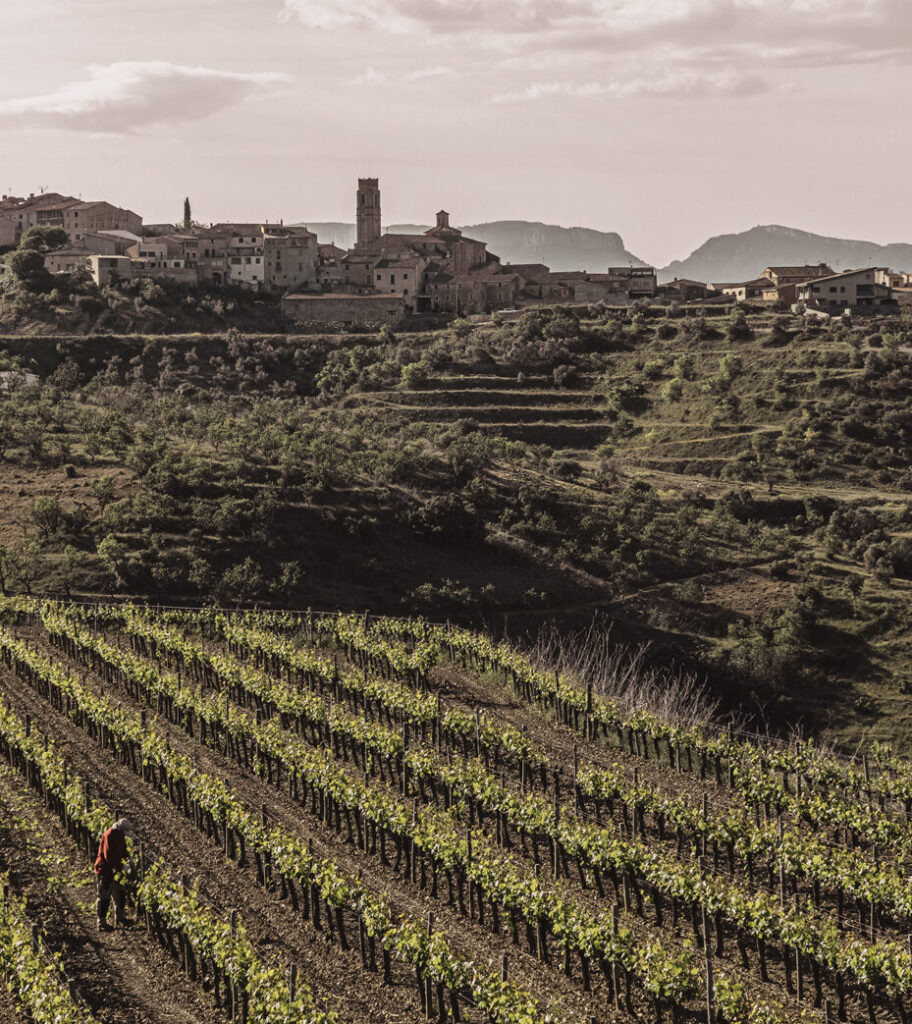
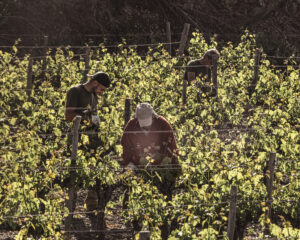
U.S. Culinary Olympics

Steel Cut Oatmeal and Quinoa (Photo: Courtesy of The Shular Institute)

He joined the American Culinary Federation (ACF) in 1993 to learn about culinary competitions and network with colleagues. It did not take long for Daryl to succeed. In the next few years, he notched 12 Gold Medals and eight “Best in Show” awards in local and national competitions. In 2008, he did what Chef Evans inspired him to do and became a member of the ACF U.S. Culinary Olympic Team. But that was just the beginning.

Against 63 teams at the 2008 IKA Culinary Olympics (Internationale Kochkunst Ausstellung), held every four years in Erfurt, Germany, the U.S. team earned an Olympic Gold Medal. Daryl was then named team captain for the ICS International Culinary Regional Team that competed at the 2012 Culinary Olympics.

There was one proud mom in central Florida. “Her words of affirmation inspired me to pursue the path of greatness,” Daryl said. It was also a dream she had years before that motivated Daryl to succeed. Before he was born, his mom had a dream the baby she was carrying was a grown man sitting on a large chair in a large, grand room. Her baby was destined to greatness, she dreamed. “I owed it to her to try and make that dream come true,” he said.


Master Chef Daryl Shular, right, helps young chefs choose produce during Chaîne’s Jeunes Chefs Rôtisseurs competition, held in June 2022 in Atlanta. (Photo: David Ramsey Photography/Chaîne)
The CMC exam is a grueling, eight-day test of a chef’s expertise and endurance. Pictured here is Chef Shuler’s Blackened Shrimp Roll. (Photo: Courtesy of The Shular Institute)

Certified Master Chef Exam

Following his success as an international culinary competitor, in 2014 he decided to apply to take what he describes as “the test of a lifetime,” the CMC examination. It’s not so much a matter of being ready to take the exam but rather, a natural progression in a chef’s career that dictates the best time for individual chefs to seek the gold standard of certifications. Chefs put years of experience on the line and most of them fail to achieve the certification on their first try. Daryl’s understanding of both the physical and mental challenges the exam presented were instrumental to his success.

As he arrived in Pasadena, California in 2014 to take the exam, he realized it was 20 years of hard work that brought him there. “Your heart starts to pound. The emotions start to kick in. For me, I wanted to find my own strategy in how to deal with the anxiety.”
And what a unique strategy he developed! “I printed photos of all of the judges and taped them to the mirror in my bathroom so when I was getting ready for that day’s work, I could look at their faces and have a mental edge.”

That solitary time was enough to solidify the mental edge he wanted during each of the exam’s grueling eight days. He set his alarm for 4 a.m. so he could be out the door by 5 a.m. to have time for breakfast at a local coffee shop. With a 7 a.m. report time, Daryl decided to strategically arrive at 6 a.m. so he had plenty of time to be mentally ready for that day’s five-hour cooking assignment.

Chef Shuler did not bring any recipes to his CMC exam in 2014. Pictured here is Chef Shular’s Fried Chicken and Sweet Potatoes (Photo: Courtesy of The Shular Institute)

The candidates’ days ended in late afternoon after they picked their start time and assignment for the next day. But there was a second shift. After grabbing dinner, Daryl said it was back to his hotel room to research the next day’s assignment and submit his food requisition by mid evening. He had to be spot-on with the requisition. “If you order two quarts of heavy cream and only need one cup, you get dinged,” he explained. After completing that last task and winding down, it was close to 11 p.m. and time to grab a little sleep before starting all over again.

Similar to a marathon, the exam was truly a test of stamina and fitness but also not far off from reality. “I put in almost 100 hours last week,” he said.

The final day, with only five of the original 11 chefs still standing, included two back-to-back, five-hour cooking segments, first a global segment and then a free-style mystery basket in which the chefs had to prepare 10 portions of a five-course meal for the judges. Daryl performed the entire exam without any recipes, just notes.

It’s that level of experience, expertise and energy that CMC initials represent.

Chef Shular brought 20 years of experience to the Certified Master Chef exam and is now passing along those skills to the next generation as seen here with his chicken, wildberry waffle. (Photo: Courtesy of The Shular Institute)

At the conclusion of his mystery basket segment, Daryl joined the other four chefs in a waiting room. One by one, the candidates were called into a room to learn their fate. Three of them came out after 20 to 30 minutes to say they did not pass. As Daryl and another chef sat there experiencing a roller coaster of emotions, both of them were called into the room. One judge said, “Grab your #@%& and let’s go. You guys just passed. We’ve got a party for you.” They walked across the street to be greeted by all of the judges holding glasses of champagne.

“You just fall to your knees. It’s such a swing of emotions that even now I feel it. You saw grown men on the floor crying,” Daryl said.

Daryl’s mom passed away in 2016 so she lived to see her son become the first African American chef become a CMC. Her legacy lives on in Daryl’s ongoing focus on culinary education.

The Shular Institute

Master Chef Daryl Shular, left, and Chef Sean Rush, Vice President of Operations for The Shular Institute and Daryl’s business partner (Photo: Courtesy of The Shular Institute)

He knew he always wanted to be a businessman so in 2014 shortly after achieving his CMC certification, he began writing a business plan for a new kind of culinary school. Actively working in and carefully studying culinary education, Daryl concluded culinary schools were not keeping up with the times.

As students enter traditional culinary schools, they are instructed in the basics and find themselves spending a lot of time peeling onions and making chicken stock, all of which ends up in the trash. And worst of all, it does little to prepare them for the real world.

“Students spend all of this money in culinary school learning how to peel onions in a pot but when they get hired, they freeze up when they get on the line and hear that ticket machine start to roll off the hook,” he said.

Shular Institute students take notes from Master Chef Daryl Shular in their 7,000 square foot kitchen. (Photo: Courtesy of The Shular Institute)

To set a new standard for culinary education, in 2020, Daryl and Sean Rush, his business partner and Vice President of Operations, founded The Shular Institute in Tucker, Georgia near Atlanta. By aligning with corporate partners, their students gain real world experience from day one. The Institute also covers the basics by offering students a comprehensive curriculum that includes instruction in high level cooking techniques, the science of those techniques, technological innovations, best business practices and last but not least, the role of a chef as a global citizen. By 2024, they anticipate an enrollment of 200 to 300 students.

On their website in bold letters, they say, “We Start Where Culinary School Ends.”

The Shular Institute operates the FARMED Kitchen + Bar in Tucker, Georgia near Atlanta to give students real world experience. (Photo: Courtesy of The Shular Institute)
Master Chef Daryl Shular demonstrates technique to a student. (Photo: Courtesy of The Shular Institute)

The curriculum has three different tracks to meet the needs of all students interested in pursuing a hospitality/culinary arts career. Their Culinary Introduction track has been developed for students with little to no experience in culinary arts. Students must apply for the program and go through a vetting process. The Advance 1 track has a focus on International cuisine with a management focus. The final option is an Entrepreneurial track. Their student to teacher ratio is never more than 12 to 1. With their corporate partners, The Shular Institute is able to offer students low tuition costs, work-study options, and merit-based grants to make education affordable and even tuition free.

In summer 2022, Daryl and Sean launched a program in Milwaukee for at-risk students in the criminal justice system to help them rebrand themselves by channeling their street skills to a new career. “If you’re a hustler on the streets, hustle in the kitchen. If you’re marketing on the streets, market within the industry,” Daryl said. “We’re just trying to save lives and do it in a way they can get jobs or be on a track to be a future entrepreneur. And make their families proud as well.”

With workforce challenges facing the industry everywhere, Daryl believes technological innovations that are already here will expand. Robots will most likely be delivering food to tables in the not so distant future and even performing basic tasks in the kitchen. But there will never be a robot to replace leaders committed to nurturing youth and supporting the industry.

Master Chef Daryl Shular demonstrates plating to two students at The Shular Institute. (Photo: Courtesy of The Shular Institute)

“Seeing my students graduate with the mind of helping others, to me, that is truly the ultimate reward because if you have the mindset of helping others, you’ve tapped into the heart of hospitality,” Daryl said.

Little did Daryl know as he was delivering meals to neighbors years ago that his mother had given him such a strong heart that he would one day reach the pinnacle of his profession and deliver excellence to a global neighborhood.

Bar in the FARMED Kitchen + Bar on the campus of The Shular Institute (Photo: Courtesy of The Shular Institute)

Links

Chef Tom Hannum Prepares ‘Elegant Comfort Food’ and the Next Generation for Success

Oct. 28, 2022 – On his first night as a student at the Culinary Institute of America (CIA) in Hyde Park, New York, Tom Hannum, from Wilmington, Delaware, reported to the Great Hall for dinner. There he would unknowingly have his first culinary lesson at the prestigious institution. After the entrée was served, Tom commented to a fellow student that the beans were not cooked. He quickly learned the beans had been prepared al dente. “I never had an al dente vegetable in my life. That’s not the way our moms cooked in the 50s. It was canned green beans or overcooked beans if you had fresh ones,” Chef Tom Hannum, member of Chaîne’s First State Bailliage, said to Chaîne during an Oct. 21 telephone interview.

Tom’s culinary curiosity as a young boy laid the foundation for Chef Tom Hannum’s career that includes 33 years working at the historic Hotel du Pont in Wilmington, beginning in 1978 as a cook’s helper and then in 1993 being named Executive Chef. Now a business partner in Buckley’s Tavern and Goober’s Diner nearby in Wilmington, Tom vividly recalls not only observing his mom and aunt cook and bake for frequent family gatherings in their home but also asking them to explain how they did it.

Hotel du Pont (Photo: Courtesy of Hotel du Pont Press Room Gallery)

While his father, uncles, and brothers were playing cards or watching television, Tom was drawn to the action in the kitchen. “My mom was a homemaker. She made things at home. You did not go out and buy cakes. You made cakes at home,” Tom said.

His father and both of his brothers were World War II veterans. “That era fascinates me – the 30s, the 40s and how they grew up in northern Wilmington. It was a different lifestyle. It seemed to be a lot easier back then, no computers, no phones to mess with you,” he said.

During that era, Wilmington was a company town and had been for more than a century before when Pierre Samuel du Pont de Nemours opened a gunpowder business along the Brandywine River in the early 1800s. By the mid 20th century, the DuPont Company, now a chemical business important to the automotive industry, employed thousands of Wilmington residents.

For Tom’s generation, his friends in elementary and high school didn’t have to think too long about a career. Most planned a future as a legacy working for DuPont. Not so for Tom. “I knew in seventh grade I wanted to be a chef.”

Unlike today when 3,000 high school students in Delaware are in a Culinary Pathway program with the comprehensive ProStart curriculum, Tom’s only culinary option was enrolling in one class – Bachelor Cooking. “I learned how to make pizza out of an English muffin,” he explained. “There wasn’t a lot of cooking.”

But his high school experience included terrific support from his guidance counselor who had followed his class since eighth grade. He helped Tom figure out how to pursue post-secondary education at the CIA.

Following his first eye-opening dinner at the CIA, Tom completed eight months of courses, a four-month externship and then another eight months of class before graduating with an associates degree. Tom already had his future planned back in Wilmington. “The only place I had wanted to work was the Hotel du Pont.” The beautiful building, built in the early 1900s, was simply known as “The Hotel” as it was the front door for DuPont’s corporate headquarters. “The center of the world for us in this area was Hotel du Pont.” The world class hotel is still going strong today under new ownership independent of DuPont.

Interior of the Hotel du Pont (Photo: Courtesy of Hotel du Pont Press Room Gallery)

After graduation and securing a job there, it did not take long for Chef Tom to travel the world as an esteemed Hotel du Pont chef. Just three years into his 33-year tenure, he was sent to the Imperial Hotel in Tokyo for a two-week Hotel du Pont America event. For the next five years, they had a chef exchange with Japan.

In 1998 on the 360th anniversary of Swedes landing in Delaware, the King and Queen of Sweden came to the United States. A team of Swedish chefs from the Grand Hotel in Stockholm came to Delaware to highlight Swedish food for a week. The international team capped the unique culinary week with a grand gala.

Through these special events, Tom learned from chefs based around the world so he never felt he needed to leave for additional training and experience. On weekends, Tom said they could have up to seven weddings between the hotel’s two ballrooms and The Grill. “Some Saturdays were crazy busy.”

Buckley’s Tavern and Goober’s Diner

Buckley’s Tavern in Wilmington, Delaware was built as a private residence in 1817. (Photo: Courtesy of Buckley’s Tavern)

In 2011, it was time to move on but with deep roots in Wilmington, Tom stayed in the area. Vance Kershner and P. Coleman du Pont asked Tom if he would join them as business partners to restore Buckley’s Tavern to its glory days. Built as a private residence in 1817, Dennis Buckley opened a tavern in 1951 and operated it until 1970. Launched in 2012 with 140 seats inside and 140 seats outside, the new Buckley’s Tavern offers a mix of traditional comfort food and fine dining options such as seared scallops, sweet corn risotto in summer months, and a quinoa burger for a vegetarian choice. A local food critic described the menu as “elegant comfort food.”

A popular item on Buckley’s menu is their mac ‘n’ cheese with roasted tomato jam. (Photo: Courtesy of Buckley’s)

“We try to meet a lot of different needs here,” Tom said. It’s not unusual to have guests eat at Buckley’s three to four nights per week. “I have people come in every week just for the mac ‘n’ cheese.”

Buckley’s also serves tour groups, the icing on the cake for tourists visiting old du Pont family mansions that have been turned into museums. Winterthur and the Nemours Mansion and Gardens are two museums near the tavern.

A sketch of Buckley’s Tavern with a Rolls Royce in one parking spot and a pickup truck with a dog in another space says it all. “Once you walk in the door, you’re not a customer; you’re not a CEO, which we have plenty; you’re not a landscaper; you’re just a Buckley’s guest,” he said. The menu does not change too often.

Buckley’s Tavern sketch (Photo: Courtesy of Chef Hannum)


A few years ago he pulled his New England Clam Chowder for a Crab Chowder. It was a short-lived change. “I don’t change the menu often because I get so much grief,” Tom affectionately said of his loyal guests. He and his staff get to know them personally. “We have one guest that as soon as he comes in we bring him a pitcher of iced tea. He will drink two pitchers with his meal.”

Buckley’s Tavern “elegant comfort food” includes Philly Cheesesteak Rolls. (Photo: Courtesy of Chef Hannum)


Buckley’s Tavern interior (Photo: Courtesy of Chef Hannum)
Buckley’s Tavern offers something for everyone. (Photo: Courtesy of Chef Hannum)


One of his business partners has a collection of about 140 classic cars and had an idea to open a two-story diner at the museum where the public can view 40 of his cars. Built in Atlanta, Goober’s Diner was transported to Wilmington on 14 Lowboy trailers and reassembled. Opened in December 2020, their signature dish is hash browns that are prepared daily with 50 pounds of potatoes in clarified butter. How cool is it that guests waiting for a table can tour the museum!

With vast experience as a successful chef and his deep knowledge of all aspects of the industry from fine dining to diners, Tom is now mentoring the next generation of students to help them forge a path to a fulfilling and successful culinary career.

Goober’s Diner in Wilmington, Delaware. (Photo: Courtesy of Goober’s Diner)

ProStart
To support youth interested in culinary careers, Tom volunteered to be a judge for the Delaware ProStart Student Invitational. According to ProStart’s website, ProStart is a two-year, industry-backed culinary arts and restaurant management program for high school students that reaches approximately 145,000 students in nearly 1,800 schools in all 50 states, Washington, D.C., and the Territory of Guam. Along with sponsors, the National Restaurant Association’s Educational Foundation is the driving force behind the ProStart program and competitions.

With about 10 minutes left in the competition, the Caesar Rodney Culinary Team finishes their entry at their work space. (Photo: Courtesy of Chef Hannum)

The Culinary Team from Caesar Rodney High School, located in Camden near Dover and about one hour south of Wilmington, won the 2019 Delaware ProStart title. At the competition, each team of up to five students was given a 10’ x 10’ space; two eight-foot tables; two butane burners; and a battery-powered thermometer and a timer. They had neither refrigeration nor electric. Teams had 20 minutes to set up and one hour to prepare a three-course meal of their choosing.

Tom offered to help prepare the 2019 state winners for the National ProStart Invitational and they finished in fifteenth place. In 2020, Tom became their coach and the team again won the state competition but nationals were canceled because of the pandemic.

Chef Tom Hannum and the Caesar Rodney Culinary Team just after winning the 2022 National ProStart Invitational competition in Washington D.C. (Photo: Courtesy of Chef Hannum)

After the hiatus, Tom had his students more than ready to roll in 2022. Adhering to the adage that “practice makes perfect,” Tom took their practices to another level by timing each task the students performed and organizing those tasks on a spreadsheet. One month before the state competition, the team practiced three to four days per week for four hours after school. One student on the team is the captain/manager. Tom mentored their manager so that she could tell each student who was cooking if they were ahead or behind on each task as the 60 minutes ticked away to zero. After winning the state competition, the team traveled to Washington D.C. for the national competition, which was held from May 6-8 over Mothers’ Day weekend. Out of 42 teams, the Caesar Rodney team took first place, earning renewable culinary scholarships for those who opt to pursue a post-secondary culinary arts career. Two members of the team are now in their first year at the CIA.

What is even more impressive about the competition is that each team had to submit a recipe book to all eight judges that included their recipes, costing sheets and credit to entities that inspired their menu. Tom said it is amazing what high school students can do and how far culinary arts has progressed since his days making English muffin pizzas.

His team is already practicing for the 2023 state competition.

The 2022 Caesar Rodney Culinary Team who won the National ProStart Invitational. (Photo: Courtesy of Chef Hannum)

Chaîne

Buckley’s Tavern cocktail (Photo: Courtesy of Chef Hannum)

Tom has a long involvement with the Chaîne, first as the chef for many of Philadelphia’s Induction dinners that were held at the Hotel du Pont and then as a member of the Wilmington Bailliage for the past ten years.

With a deep commitment to the industry, Tom is thinking outside of the box for ideas on how to sustain the many organizations with which he is affiliated with a mission to support culinary professionals. Possibly a common membership between two of the organizations would help recruitment, he posits.

Tom considers one of his students from his winning 2022 ProStart team, who is now at the CIA, his protégé and is recruiting her to compete in Chaîne’s Jeunes Chefs Rôtisseurs competition. She wants to observe this year but Tom said she may compete during her second year at the CIA.

He has a realistic view of the challenge to bring young culinarians into organizations. “I’m going to work as hard as I can to have younger people compete and get them interested in the Chaîne but they also have to see value in what it brings to them,” Tom said.

Guidance for the next generation

Buckley’s Tavern seafood plate. (Photo: Courtesy of Chef Hannum)

Tom attributes much of his success to his work ethic – putting his head down and doing what he was told to do by his boss or his instructors when he was at the CIA. He believes it’s why after just three years at Hotel du Pont, he was sent to Japan over chefs who had been there much longer.

“Do the best you can, keep your head down, do it the right way every time, and don’t veer from that and you’ll do well,” he advises young students seeking a successful career as a chef.

During his years at Hotel du Pont, each quarter he would participate in a career fair at the CIA. One constant he told every student is that they must really want to do the job because they will be working on weekends, holidays and when their friends are off.

“You have to have dedication. Do what you’re told,” he said.


Editor’s Note: Chef Tom Hannum is a member of Chaine’s First State Bailliage and not the Wilmington Bailliage as stated previously. 

LINKS
Buckley’s Tavern
Goober’s Diner  (time-lapse video of construction)
2022 National ProStart Invitational (video summary)
Delaware ProStart Invitational

Chef Franck Bacquet Brings Old-Style, Traditional French Cooking to Boise and Beyond

Oct. 7, 2022 – To mere mortals, there are 24 hours in each day. But there is a culinary conductor and artist in Boise, Idaho, born and raised in France, who may not be a mere mortal. Chef Franck Bacquet, co-owner of Bacquet’s Restaurant in Eagle, Idaho and member of the Chaîne des Rôtisseurs Boise Bailliage, currently devotes 14 to 15 hours per day operating his popular, fine dining restaurant. During the pandemic, he was there from 17 to 18 hours per day to adapt and keep the burners on. In the evenings after work, his wife Michele can often find him painting in his home studio. Some of his paintings are sold at auction to raise money for local and global charities. Chef Franck is a 21st century Renaissance man with deep roots to old-school, traditional French cooking. “I am a chef today. I was a chef 20 years ago, but not before. Before, I was a cook,” Chef Franck said to Chaîne during a Sept. 26 telephone interview.

Chef Franck plates sweetbreads at Bacquet’s Restaurant in Eagle, Idaho. (Photo; Courtesy of Chef Franck)
Chef Franck was born and raised in France. (Photo: Courtesy of Chef Franck)
Chef Franck paints in his home studio. (Photo: Courtesy of Chef Franck)


That distinction is deeply rooted in Chef Franck’s culinary trajectory in France. As a teenager, he was always in the kitchen baking and cooking at home so he sought a job in a restaurant. He set a goal to secure an apprenticeship but when that failed to materialize, he settled for a job as a server to gain real world experience. Soon he was serving flambé desserts tableside and loving every minute of it. After 18 months, he began climbing the professional culinary ladder when he was promoted to cook. With both feet firmly planted on that lower step, he graduated from Le Touquet near Paris and then spent years learning and practicing his craft, finally reaching the top step that had him preparing meals for the Chancellor of Germany, the King of Belgium and many of the top European soccer teams. But he did not call himself a chef until he had more than 20 years of experience.

“Nobody in France after 10 years will be a chef. And we work very hard. It’s not possible,” he said emphatically.

Chef Franck Bacquet. (Photo: Courtesy of Chef Franck)

During his career, he has worked around the world and spent 15 years in Germany running a catering business that routinely served thousands of people at events. As he began contemplating slowing down a bit and thinking about retirement, in 2002 he visited a friend in Boise, Idaho. He pulled up his roots in Europe and moved to the United States. “I came here and loved it. I love the people,” he said.

His idea of slowing down though was not in the cards. “It will be easy,” he thought. “But it’s not. We are so busy, you cannot believe.

It didn’t matter that Boise’s culinary climate for fine dining was ice cold when he arrived. Without speaking any English, within six months of moving to Boise, he opened a business and has not stopped since.

Photo: Courtesy of Chef Franck

Bacquet’s Restaurant (Eagle, Idaho)

Franck and Michele opened Bacquet’s Restaurant in 2018 after completing a major renovation to an existing space in seven weeks. With Michele running the front of the house and his command of the kitchen, it’s a total team effort as they seat between 250-400 guests daily. Franck said when they opened in 2018, he decided to open in the middle of the week to ramp up gradually but they were slammed from day one. He brought fine dining to Boise by not being “too crazy.” He opted for a menu in the middle but with exceedingly high standards. “We make everything from scratch. I don’t use any powder. We are an old, traditional French restaurant,” he emphasized.

Bacquet’s Restaurant in Eagle, Idaho (Photo: Courtesy of Chef Franck)

Echoing other successful chefs, Franck said he and his staff work very hard on consistency. Three of his most popular entrees are seafood pasta, duck confit with orange sauce, and escargot. Speaking of the duck confit, Chef Franck said: “Oh, my god. People love it. We sell lots of that.” And for more than 30 years, he has been making and serving his grandmother’s recipe for escargot with 22 spices in the butter. “We cannot take it off the menu. People would be upset. It’s fantastic. It’s a very big hit.”

Seafood pasta is one of Chef Franck’s most popular dishes. (Photo: Courtesy of Chef Franck)

The season for fresh tomatoes and many varieties of basil from local farmers is winding down but Chef Franck said he makes large batches of pesto and tomato sauce to freeze. Processing 150 pounds of tomatoes at a time is a long process but one that is worth all of the effort when in the dead of winter, he pulls a container of frozen tomato sauce, thaws it slowly over two to three days, and then incorporates it into his menu.

One may think Bacquet’s has a large freezer but it does not. Chef Franck will freeze tomatoes and basil but never seafood or meat. The restaurant receives three shipments of fresh fish each week. “I don’t want frozen stuff,” he said.

Noted for traditional French cooking, insistence on fresh ingredients, and consistency, Bacquet’s has not only refined the palates of Boise residents but also has earned Chef Franck a stellar reputation beyond Idaho. His restaurant is now a destination dining venue for out-of-state residents who will take a private jet to Boise, dine, stay overnight in Boise, and fly home the next day.

With a focus on his cohesive team of employees as integral to his restaurant’s success, Chef Franck believes this approach is what separates high-end restaurants from others. Again citing his training in France, keeping customers happy and consistently preparing fresh, high quality food drives his operation, a business he describes as very traditional yet a family endeavor. As an example, he said if he has four or five plates on the front line ready to serve, any waiter who is available will serve the dish so it does not sit. And if something comes to his attention that needs to be cleaned, he and Ernesto, his Sous Chef, will often address the issue – no questions asked. “Everybody works together. This is the old style and I love it,” he said.

Chef Franck’s approach to wine is also old style.

Bacquet’s has more than 300 bottles in its collection. (Photo: Courtesy of Chef Franck)

Customers will ask both Michele and Franck for advice on wine selection from Bacquet’s collection of more than 300 bottles. “I have been serving wine for more than 40 years. I know wine very well. I am picky. I am old school when it comes to the wine business. I like old vineyards that have been operated by three to four generations of winemakers,” Franck said. “We have wine from A to Z.”

Chef Franck Bacquet has been serving and recommending wine for more than 40 years. (Photo: Courtesy of Chef Franck)

Because Chef Franck is passionate about his profession, he insists on excellence and the traditional order that can occasionally include a hefty portion of tough love. He laments the current dearth of culinary professionals and bristles at the notion that someone with one year of culinary school is a chef.

Always seeking new talent in his kitchen, someone recently came in for an interview and immediately stated the salary he wanted and the days he would work. Needless to say, even though Chef Franck has been looking to hire a cook for five months, he declined to hire the candidate. And a new cook he hired called on the day he was to start to say he wouldn’t be in that day. Chef Franck told him not to return. With a prelude of colorful words not fit to print, Chef Franck said, “It’s what is happening today.”

Once a team member though, Chef Franck describes Bacquet’s work environment as a lot of hard work with a lot of fun. “I have a good crew in my kitchen. I teach them every day. But you have to be ON all the time and you learn, you learn, and you learn.” He said he is still faster than the young chefs!

From left, Chef Franck Bacquet and Bailli Délégué des Etats-Unis Bertrand de Boutray enjoy a Chaîne Bastille Day event by the Boise Bailliage, held at Bacquet’s on July 14, 2022. (Photo: Courtesy of Chaîne)

Larger than life personalities often have big hearts and Chef Franck is no exception.

Recently a cook was late for work so he asked him to explain. His employee had a flat tire. Without hesitation, Chef Franck gave him $200 to fix his car. “It’s the way we are. When I can, I do it,” he said. During the pandemic, Bacquet’s survived by offering two different “To Go” dinners each day that served between six to eight people. They also opened a small market and responded to the needs of the community, sometimes at no charge. Old-fashioned compassion never goes out of style.

Chaîne Affiliation

Chef Franck has been affiliated with the Chaîne since his days as a chef in Europe. Interestingly, he said people forget to try good food and wine. Chaîne serves as a vital link to the past so people do not forget. “I love it. I worked with the Chaîne des Rôtisseurs for a long, long time in France. Chaîne events have opened palates again to discovering the old style of cooking. Everyone forgets that,” he said.

Lessons for up-and-coming cooks aspiring to be professional chefs abound from the culinary experiences Chef Franck has notched during his more than 40-year career. If what is old is new again, all signs point to fine dining flourishing for mere mortals in Boise and beyond!

Links
Bacquet’s Restaurant (Eagle, Idaho)