Home Blog Page 2

Kelly Sanders Embodies the Aloha Spirit

Jan. 17, 2025 – Kelly Sanders, President-Group, Highgate, begins each and every day of the year with responsibility for 6,000 hotel rooms, a myriad of restaurants, and 3,300 employees across 16 properties within the Hawaii Highgate portfolio. He shoulders that responsibility with confidence and commitment as he manages the properties with one goal always top of mind – to consistently deliver superior, authentic Hawaiian experiences for guests. A clearly defined focus on helping employees nurture their potential and think outside the box has been Kelly’s operational philosophy throughout his more than 30 years of experience in hospitality management. His end result transcends guests’ benefits and bottom line metrics because of his track record of elevating hospitality to a level that cannot be quantified. “I’ve always said that you know when you walk into a hotel that is well run, the employees are happy and engaged and excited. That hotel has soul,” Kelly said to Chaîne during a Jan. 7, 2025, telephone interview.

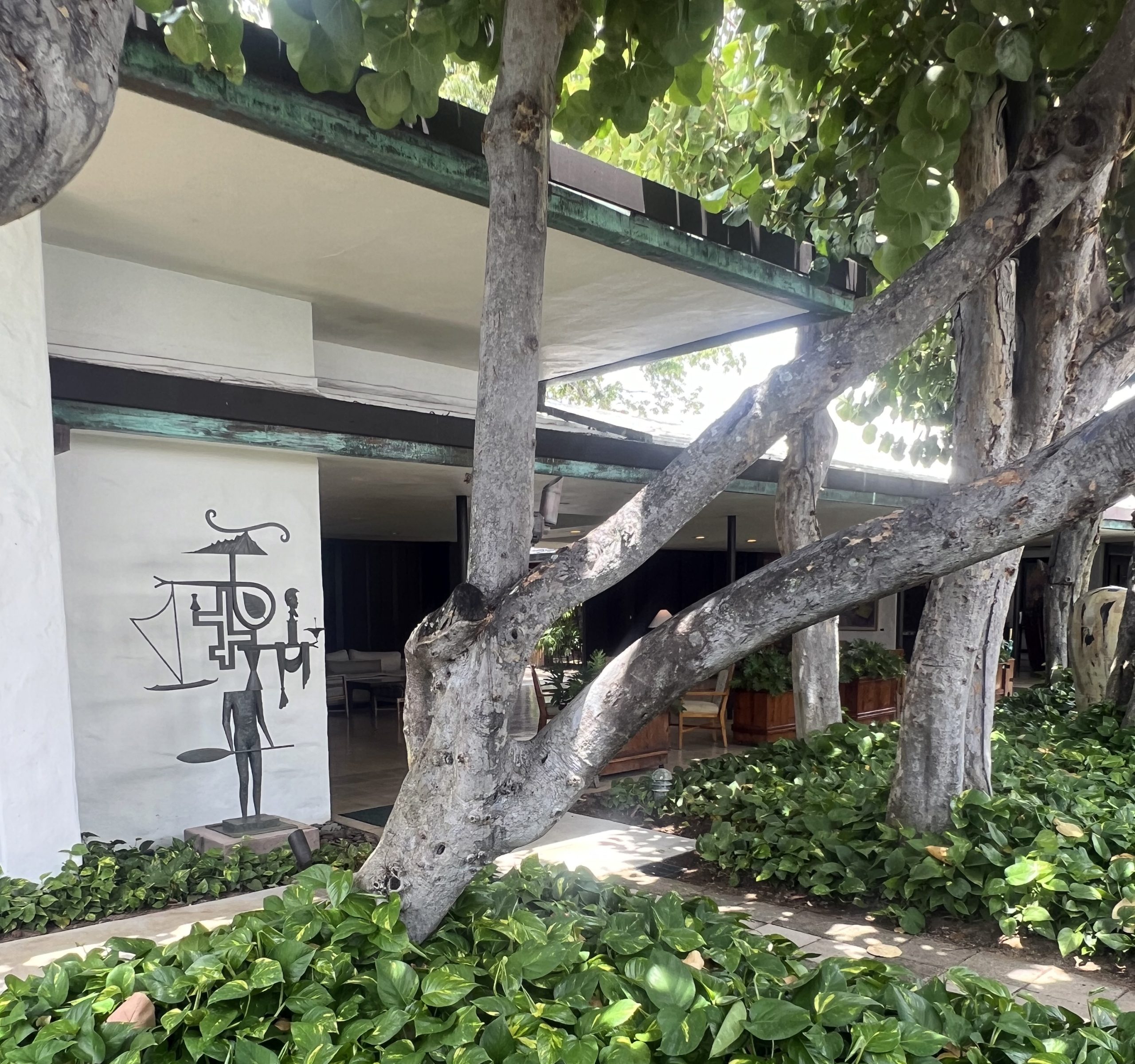
The ‘Alohilani Resort on Waikiki Beach in Honolulu is the host hotel for the 2025 Grand Chapitre. (Photo: Courtesy of Highgate)
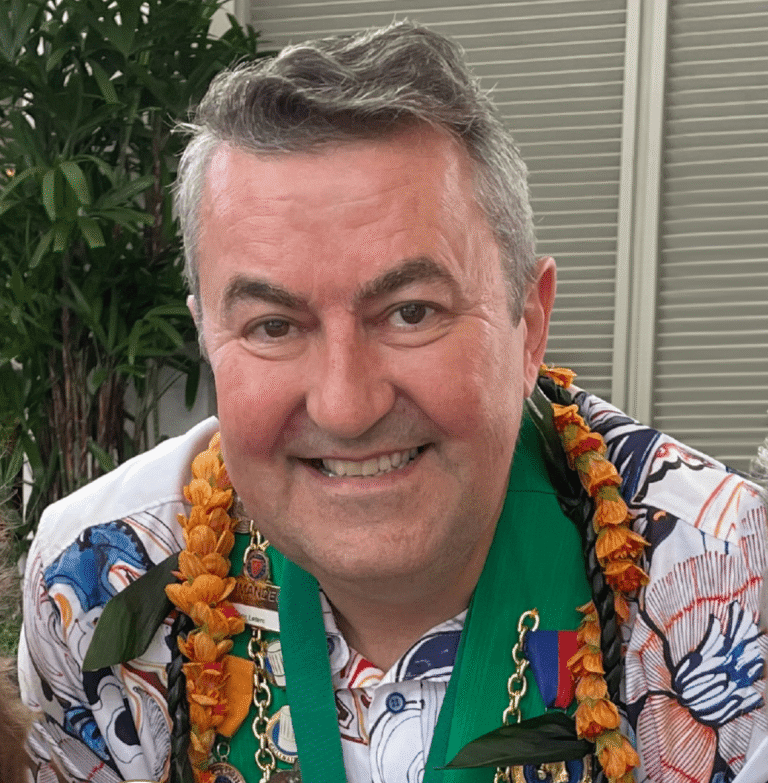
Kelly Sanders, President-Group, Highgate (Photo: Courtesy of Highgate)

Kelly’s heart and soul have been in the hospitality industry since he was in high school working as a busboy at a hotel restaurant in a small Idaho town where he grew up. When he graduated, he was the hotel’s front desk clerk. It was then off to the University of Utah where he secured a job as night auditor at a local hotel in Salt Lake City. Throughout his college years, he worked the hotel’s graveyard shift and attended classes during the day, a combination of real world and ivory tower experience that forged a rock solid foundation for his future success. “It was the good old days,” Kelly remarked.

After graduating in 1989, he and a good friend caught the entrepreneurial spirit. Going for it all, they placed an ad in the Wall Street Journal to purchase a restaurant. Within two years, they had four restaurants – one in California and three in Texas. With everything going well, they decided to open their own restaurant in Salt Lake City where they managed their business. “We were young and dumb,” Kelly said. After a series of unfortunate situations, they lost everything. “But I still had my night auditor job,” he reflected.

San Diego

The hotel offered him a promotion to front office manager so he never skipped a beat advancing his hospitality career. At age 26, the hotel moved him to San Diego to manage a small hotel. And then in what he describes as luck, Starwood purchased the hotel and kept him on as manager. Recognizing his talent, Starwood promoted him to General Manager of the Sheraton Harbor Island. Kelly now had responsibility for not only managing 1,053 rooms but also leading the charge to integrate new ways of delivering service as Starwood implemented a plan for Sheraton to reclaim its status as a world class brand. As Kelly supervised and completed the transformation, Starwood decided to host their World Conference at the hotel. “I had a lot of eyes on me,” he said. He meticulously planned the event from both an operations and food and beverage perspective. “I’ve always been very big on food and beverage. I don’t think, in a hotel, you can run a quality operation if you don’t have a great food and beverage operation,” he said.

Drinks on a bar at one of HIghgate’s 16 properties in Hawaii. (Photo: Courtesy of Highgate)

Following the success of the conference, Kelly received a lot of job offers. He had opportunities to move to New York City and Hawaii but turned down both of those offers. He had been with the hotel for nine years and loved his team so he decided to stay in San Diego. Then on a Sunday afternoon, the Starwood CEO called him. They talked for two hours. The CEO recounted his own career path and did not mince words in his advice to Kelly about the job offer in Hawaii. “You need to move. You have to take this job,” the CEO told him. “He convinced me to move to Hawaii,” Kelly said.

Hawaii

In 2006, he was named General Manager of the Sheraton Waikiki, the largest Sheraton in the world at the time with 1,636 rooms. He again found himself leading the charge to reimagine a hotel, this time with a $200 million budget. “It’s like you have a day job and a night job,” he said. With his years of experience working around the clock, it was second nature for him to excel at both tasks. “I ran the hotel during the day and then I would lock myself in a room with my food and beverage director of operations to review flow charts, brainstorm, meet with designers, and create mood boards,” he said. Kelly kept this schedule for the two-year period during which the entire hotel was transformed. “I was able to really spread my wings,” he said.

Highgate’s ‘Alohilani Resort on Waikiki Beach in Honolulu. (Photo: Courtesy of Highgate)

On Dec. 23, 2008, they opened Sheraton’s Rum Fire, a restaurant overlooking Waikiki Beach offering 101 different brands of rum and initially, small plates. Kelly collaborated with the Culinary Institute of Hawaii to create the menu. “One of the things I am most proud of is that we brought these young chefs. They didn’t have a lot of experience but we allowed their creative process to infuse the menu,” he said. Cyndi Lauper performed at the grand opening and held her New Year’s Eve concert there. “Rum Fire, I will say, to this day is one of the coolest places to go have a drink and appetizer in Waikiki,” he said.

It was an instant success as was Kelly and his team’s other new restaurant at the Sheraton – Kai Market, an open air and enclosed restaurant with views of Waikiki Beach and the hotel’s Infinity Pool. Definitely thinking outside of the box and touching his past, he took out an ad in the local newspaper to invite families to submit treasured recipes for the buffet-style, Hawaiian fusion restaurant. After selecting those to include on their menu, Kelly invited the families to cook their recipes at the restaurant while celebrating their contribution. “We were able to pull really unique, different recipes from local families. They were so proud. In the beginning, we had lines out the door. It was very, very successful, very grass roots in trying to engage the community in a new concept. Tourists also wanted to come,” he said.

With the Sheraton Waikiki’s success, for the next 10 years, Kelly found himself managing more and more Starwood hotels in Hawaii including The Royal Hawaiian in Honolulu, the iconic “Pink Palace of the Pacific” that opened in 1927.

Highgate

In 2018, Kelly accepted a position with Highgate, a real estate investment and hospitality management company with more than 500 properties primarily in the United States but with locations around the world. Today, Kelly manages Highgate’s 16 Hawaii properties and is actively involved in evaluating Hawaiian properties for acquisition. On average, that process takes about one year but can be longer. Two years ago, Highgate completed a deal for a new resort property that was in development on Kauai, one of the eight main Hawaiian islands. “It’s going to be a spectacular new resort on Kauai that we’ve been a part of from the beginning,” Kelly said. Scheduled to open in 2026, Kelly has a very capable team to ensure its success as 40 to 50 members of his Starwood teams followed him to Highgate.
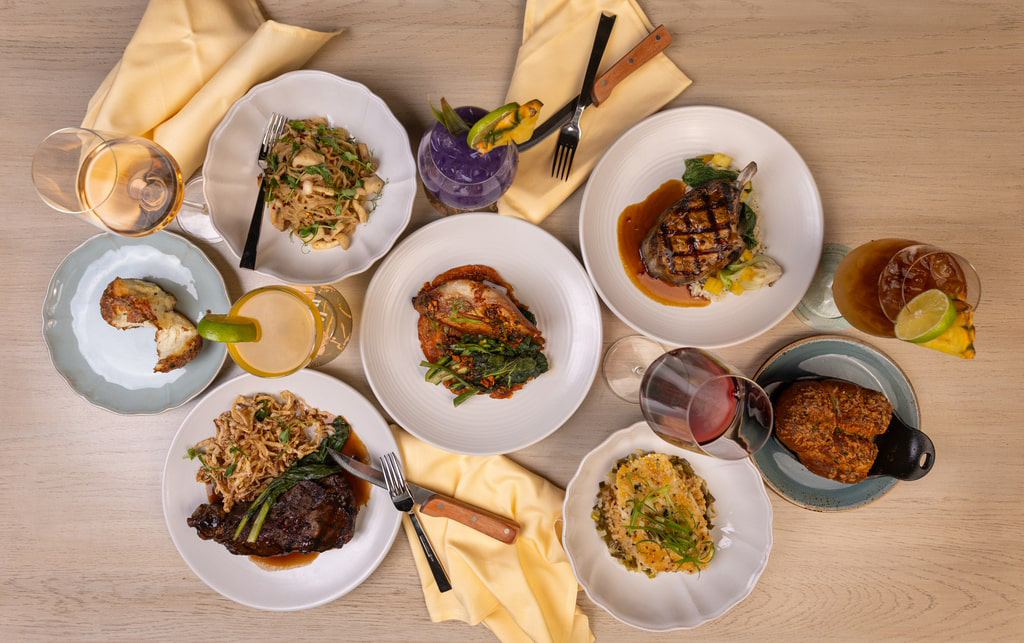
Kelly manages a myriad of restaurants throughout Highgate’s portfolio of 16 hotels in Hawaii. (Photo: Courtesy of Highgate)

“My strength has always been in building great teams and allowing people to explore their talents within their role, working outside of the box versus dictating what they can and can not do,” he said. “When you allow people not to just come in and do their job every day but really invest in the business and invest in their part of the business, you create a culture that redefines the experience. That culture creates a soul in the hotel.”

Building great teams equates to creating cohesive teams of employees working toward and achieving a common goal. Kelly said he constantly reminds his teams that Hawaii is an aspirational vacation for many tourists in that they save their entire life to be able to afford a trip to Hawaii. When formally or informally greeting guests, Kelly tells his employees to assume it is their first visit to Hawaii. He also empowers his employees by giving them resources to use at their discretion to personalize their guests’ experience.

A Hula dance performance during a Luau at a Highgate property on Maui. (Photo: Courtesy of Highgate)

“People come to Hawaii to experience the culture of Hawaii. It’s not just about sun and sand and beaches. It’s about the deeper sense of that true aloha spirit,” he said. Kelly further explained that the word, aloha, means “breath of life,” which is communicated through language, the Hula dance, flower leis, textile weaving, basket weaving, and of course, by authentically welcoming everyone who visits the islands.

It’s not a modern marketing campaign. Kelly said Hawaiians internalized the aloha spirit hundreds of years before Hawaii became a popular tourist destination. Passed from generation to generation, families share traditions, share knowledge and demonstrate an authentic concern for others, defining the aloha spirit by their actions.

The ‘Alohilani Resort Mai Tai, Hawaii’s iconic cocktail. (Photo: Courtesy of Highgate)

Within his Hawaii Highgate team, the aloha spirit is alive and well. “We’ve got the Hawaii tribe because we’re all interconnected. We all are there for each other. We’re supporting each other no matter what hotel, what role, what opportunity or what challenge faces us,” Kelly said.

Kai Coffee, hand-crafted Hawaiian coffee, at the ‘Alohilani Resort. (Photo: Courtesy of Highgate)

That spirit was tested as never before during the pandemic in 2020 when all but one of Highgate’s seven properties at the time closed within one day. Having an existing employee-centric philosophy, Highgate adapted by centralizing operations within three new companies. Employees were deployed where needed from these new companies, a practice that was so effective, the company kept it in place following the pandemic. From 2020 to 2024, Highgate added nine new properties and more are in the pipeline, Kelly said.

Many companies find success early on only to fail as the business grows. For Kelly it always gets back to people. “For me and for many organizations, growth means change. It also means you have to scale your business appropriately. You have to ensure you have the capabilities and resources around you or within your organization to drive success from every level of the organization. Scaling appropriately and leading with a vision that everyone can get behind and understand, I think is critical,” Kelly said.

Chaîne

When Kelly first arrived in Hawaii in 2006, the only person he knew was Dr. John Magauran, now Bailli Provincial, Hawaii/Pacific Islands Province. “The first thing he did was sign me up for the Chaîne. I’ve become an avid member of that organization,” Kelly, Vice Chargé de Missions of the Kauai-Oahu Bailliage, said. Officier Cheryl Dickerson, Kelly’s mother and member of the Kauai-Oahu Bailliage, is currently assisting John as he coordinates and plans Chaîne’s Grand Chapitre in May.
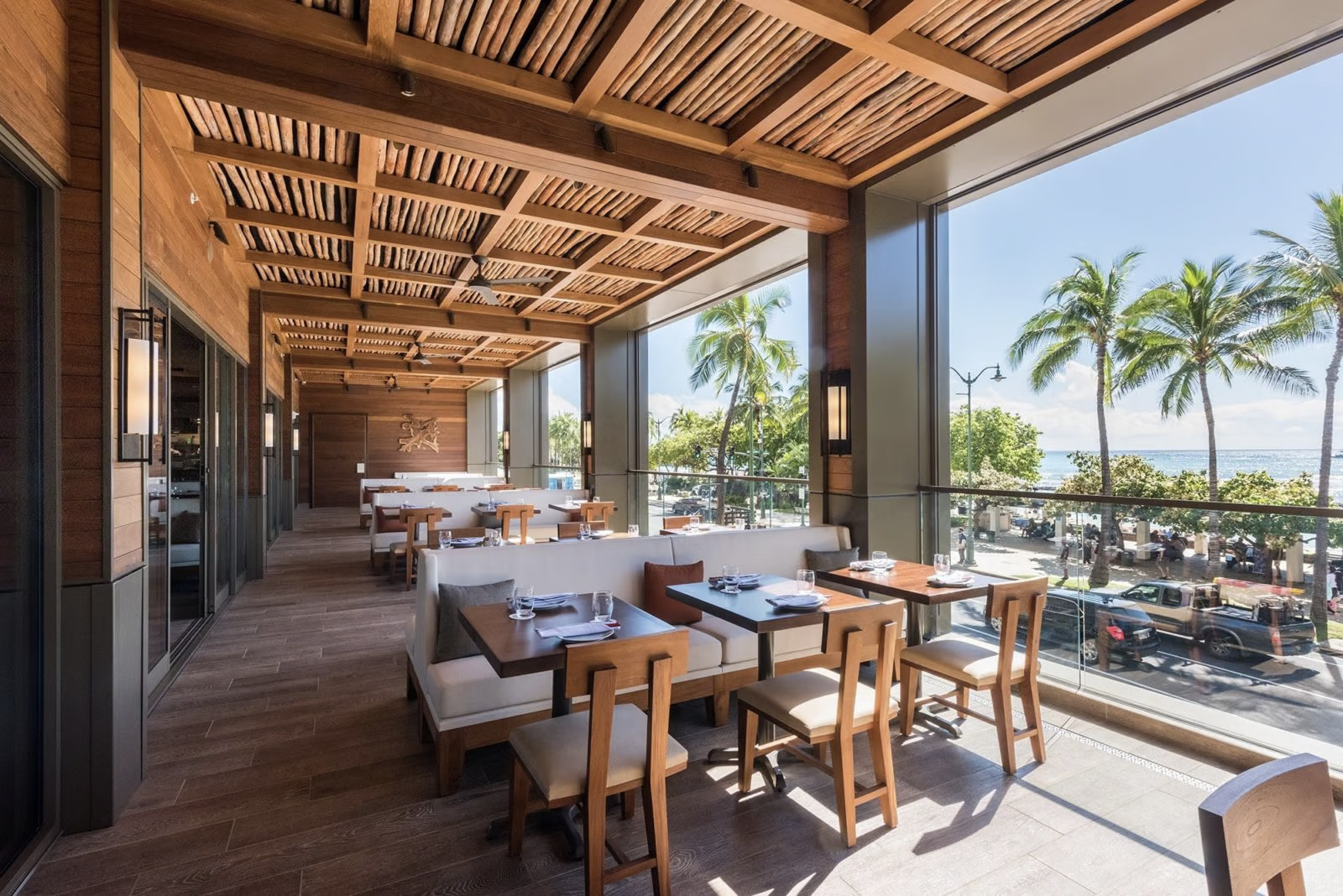
‘Alohilani Resort outdoor cafe. (Photo: Courtesy of Highgate)

“My goal as the host hotel [‘Alohilani Resort] is to really make sure people come here and feel that aloha, that breath of life, and that they have these amazing experiences and go back and tell the world why Hawaii is the best place on the planet to visit,” Kelly said. “For Chaine members, if they haven’t been to Hawaii, Hawaii has become a culinary mecca, I would say. The food scene, the beverage scene here in Hawaii has exploded over the last 20 years. We have James Beard award winning chefs on the island creating unique experiences. There’s an opportunity to experience Hawaii in a new way.”

Touch Points

Kelly mentioned the importance of each touch point, every interaction with hotel guests, from taking their reservation to checking them out, and even with potential employees. Those brief moments in time are opportunities to advance and achieve their mission, he said.
‘Alohilani Resort  (Photo: Courtesy of Highgate)

It takes constant attention to detail, commitment, communication at all levels, and vital support from the top to consistently deliver excellent service. Impersonal as it is, Kelly said technology in the form of text messaging has helped them personalize the guest experience by being able to easily check in with their guests throughout their stay. But it’s certainly a balancing act as nothing can compare with the human touch.

He instinctively knew long ago as a teenager standing behind a front desk checking guests in and out that the secret to success rests with people. “As long as you can put the right people in the right seat, give them tools and allow free expression of ideas, you can change the world.”

When he walks into each of his hotels, what a joy it must be for him to feel the soul he created as steward of the property and leader of the thousands of human souls working together to achieve a shared goal.

Links

Chef Jay Marshall Had Pivotal Role in Elevating Campus Cuisine

Nov. 22, 2024 – In 1989, Chef Janet Marshall, a Culinary Institute of America (CIA) Hyde Park graduate who was born and raised in California, told her husband, Chef Jay Marshall, also a CIA Hyde Park graduate, that she was done with New Jersey winters. She sorely missed California’s sun and surf so they made the cross country move. Without experience cooking California cuisine, Jay had a difficult time finding a job even with his CIA credentials and a few years of experience, including three years at Walt Disney World Resort in Florida. Then he received a CIA newsletter that advertised a job opening at San José State University. Soon he was commuting from the Bay area one hour each way to the university. He thought the long commute was crazy. “I was going to spend six months there and find another job. It turned into 21 years,” Chef Jay Marshall, CEC, AAC, Chaîne Conseiller Culinaire Provincial Pacific Northwest, said to Chaîne during an Oct. 2 telephone interview.

Tower Hall, San José State University, San José, California (Photo: Public Domain, Daderot, CC0, via Wikimedia Commons)
Janet and Jay Marshall, both graduates of the Culinary Institute of America (CIA) in Hyde Park, New York. (Photo: Courtesy of Chef Marshall)

Jay’s path to his culinary career began on the boardwalk in Asbury Park, New Jersey when he was a teenager. Born and raised in New Jersey, his uncle owned a restaurant on the boardwalk where Jay worked in the summer to earn extra money. “It was just boardwalk food, nothing spectacular,” Jay said. His uncle recognized his talent and suggested he gain experience at another restaurant.

In addition, Jay’s parents had a part-time catering business. “One thing led to another and after high school, I didn’t know what I wanted to do so I looked into culinary schools and applied to the CIA and Johnson & Wales,” he said. He chose the CIA. “It was so eye opening and as a student, to see the chefs working there. It was just so inspirational to become a chef. Back in 1977 and 1978, chefs were not all over television. It wasn’t a glorious job. It was just the passion you had to cook and serve people fine food. As a student, you were in awe every single day.”

Jay completed his four-month CIA externship at Disney World and met Janet when he returned to New York to finish his degree requirements. “One year later, we got married. We’re still married – 45 years,” Jay said. Janet is retired from her career as a chef at the Veterans Administration (VA) Medical Center in Martinez, California. Speaking of Janet’s career, Jay said: “It was special for us because we live there and she saw many veterans come through the hospital whom we knew or our children knew. Sometimes the result was good and sometimes the result was not so good. That was the hardest part for me. I don’t know how Janet could do that,” Jay said.

San José State University Career

Jay accepted the position at San José State to support his young family. In the hierarchy of culinary careers, he knew it was not a prestigious job, particularly in the early 1990s, but a good stepping stone for him. He worked eight to 10 hours per day, five days a week, with responsibility for the residence hall dining rooms. His schedule worked well with his young family. And then much to his surprise, the long commute was no longer that crazy. He found himself looking forward to going to work. “I kind of liked it,” he said.

His boss, the director of university dining services who previously worked at Cornell University, made all the difference. In his first months there, he told Jay they were going to up the ante for food service on university campuses. “It started a movement,” Jay said.

Jay thrived in the innovative environment providing 1,000 meals per day in the residence halls and a total university footprint of 10,000 meals per day. He stopped looking for another job. “The job got so good. My director and his assistant director made the job so inviting and so fun that we were on the cutting edge of making the difference in food service on university campuses,” Jay said.

Chef Jay Marshall recently retired from Sysco. (Photo: Courtesy of Chef Marshall)

In the early 1990s, Dr. Shirley Everett, director of dining services at Stanford University, sought to assemble a panel of five university chefs to discuss campus dining at the annual National Association of College and University Food Services (NACUFS) conference. She could only find four chefs for the panel. Jay was one of them and spoke about the exciting changes San José State had made. He explained their culinary team was now cooking food to order, batch cooking, frequently changing menus, cooking in front of students and tossing salads in front of students. “In the early 1990s, that was an amazing feat on campuses. I can say we were spearheading fine dining on campuses that you see today,” he said. They were able to pivot quickly to innovate because food service at the university was operated in house and not outsourced. “If we wanted to change something, we would meet and change it the next day.”

About one year after the conference, Shirley asked Jay if he would approach the American Culinary Federation (ACF) to ask them to sanction a competition of university chefs. Jay collaborated with the ACF to create a “Special Category” competition. Admitting that the first couple of years were a bit “clunky,” eventually the NACUFS Culinary Challenge found its legs. As university chefs learned ACF competition rules and word spread about it, more and more university chefs entered the competition to vie for an ACF Gold, Silver or Bronze medal. “It’s the feather in the cap of NACUFS and the ACF right now,” Jay said.

For 2025, regional Culinary Challenge winners will advance to the National Competition to be held before a live audience at the NACUFS National Conference in Salt Lake City in July.

Sysco

After 21 years at San José State, Jay decided to leave in 2011 to accept a position with Sysco. Originally in the sales and marketing department, he was quickly asked to be an Executive Chef of the Sysco operating company in the Napa/Sonoma area. In that consulting role to Sysco customers, Jay went from cooking for thousands to cooking for less than 10 people per day. “It was a big adjustment,” he said. “It’s been a lot of fun and Sysco has been really good to me.”

Last week, he retired from Sysco to cap a fulfilling and successful professional culinary career.

Jeunes Chefs Rôtisseurs

For more than 10 years, Jay has volunteered his time to judge Chaîne’s Jeunes Chefs Rôtisseurs competitions. Chef Reimund Pitz asked him a couple of years ago to become Chaîne’s Conseiller Culinaire Provincial for the Pacific Northwest and he agreed. “Watching young chefs is just inspiring for me. It brings back so many memories when I was young. I just want to pass along knowledge and experience to them and help them grow in their careers,” he said.

Chef Marshall (back row, far right) with chefs and young chefs competing in Seattle at the 2024 Jeunes Chefs Rotisseurs competition. (Photo: Chaine)

Echoing other chefs who mentor young chefs, Jay said that while technology has innovated culinary education, foundational skills will always be integral to success. “The great chefs have a great foundation of culinary skills.”

When he was a student, the only way he could learn a new skill was to read about it, watch a chef in action and then try to replicate it himself. Now students merely watch a video and are ready to go but mastery of the skill will always take practice. Jay has observed that as he watches young chefs compete. Eager to demonstrate current trends and cutting edge techniques, students must build upon basic skills.

“It’s a lot easier today. I think it’s great. But there are still basic cooking skills that they have to know before they can do the advanced skills and a lot of them show that during the competition,” he said. “If you have 100 people dining at a fine dining restaurant, every single plate has to be perfect and there’s only one way to do that – practice and practice and practice.”

Chef Jay Marshall (fourth from the left) at the 2023 Jeunes Chefs Rôtisseurs competition in Madison, Wisconsin. (Photo: Chaîne)

In a post pandemic environment, enormous challenges remain not only in the Bay area but also across the country, Jay said. Before the pandemic, particularly in the Bay area where the cost of living is very high, people were working two jobs to make ends meet. But after the pandemic, many people left the industry and have not returned. Jay is the first to admit he and his fellow chefs do not have the answer.

He is definitely looking to the future. “I think we’re at a point in our industry that things are really going to get interesting. Who is going to rise to the top? Is it going to be the fine dining restaurant or is it going to be the chain of restaurants that can sustain with a minimal amount of skilled labor yet produce a nice meal for their customers?”

A promising development he has seen in the Bay area is the idea that all employees share equally in both tasks and tips. Everyone stays to help close and tips are distributed evenly among employees. After visiting a restaurant with this operating philosophy, Jay said: “I’ve never seen happier employees both in the front and back of the house. I think that’s going to be the wave of the future and I look forward to that. That might bring people back or people will get into the industry because they know it’s a good life.”

Military – John L. Hennessy Award

Jay’s support for young chefs extends to the U.S. military as well in his role as a judge for the National Restaurant Association Educational Foundation’s Military Foodservice Awards competition. “It’s one thing our service members look forward to and that is eating a good meal,” Jay said.

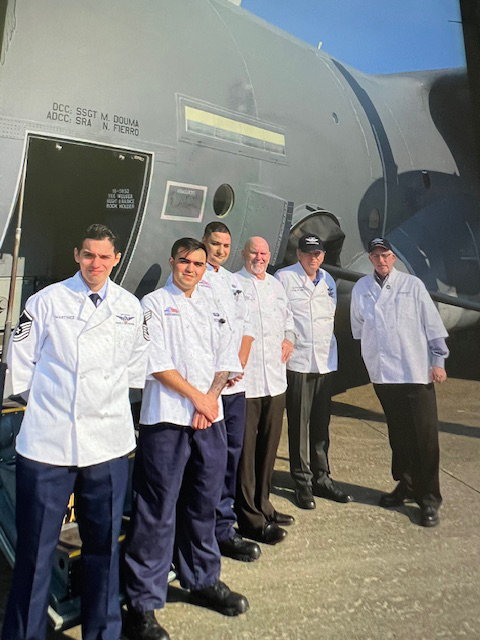
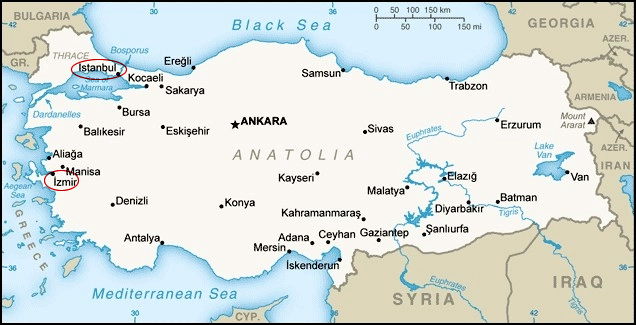
Foodservice operations on military bases here in the United States and around the world compete annually to be recognized for excellence. As a judge, Jay has traveled to Turkey, Belgium and the Netherlands visiting military bases to evaluate their culinary operation. Last year he was a judge for the John L. Hennessy Award, which honors excellence in foodservice on Air Force bases. He spent three days evaluating the 701 Munitions Squadron on the Kleine Brogel Air Base in Belgium, the 2024 Hennessy Award winner in the “small site” category.

The John L. Hennessy Award trophy for excellence in food service at Air Forces bases around the world. (Photo: Department of Defense)
Chef Jay Marshall (fourth from the left) with other chefs at the Kleine Brogel Air Base in Belgium. (Photo: Courtesy of Chef Marshall)

“We go from top to bottom – paperwork, serving skills, cooking skills and cleanliness,” Jay said.

“The skills and character displayed by military foodservice personnel are a great fit for our industry, which offers numerous opportunities for career growth and advancement,” Rob Gifford, president of the National Restaurant Association Educational Foundation, said in a May 20, 2024 press release. “We remain committed to helping these American heroes build professional skills while in-service and connect them with post-duty career opportunities.”

California School of the Deaf

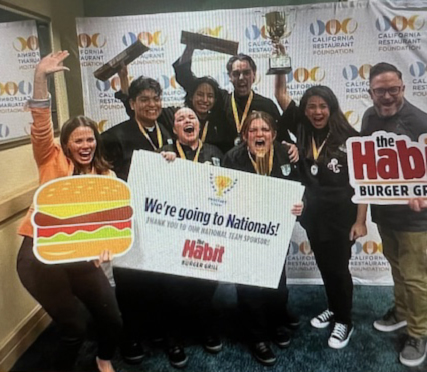
2023 California ProStart (high School) competition. (Photo: Courtesy of Chef Jay Marshall)

Jay is a member of numerous local and national committees and is currently the ACF-San Francsico Chairman of the Board.

One of his outreach efforts to which he remains deeply committed was the result of an introduction from Kelly, a graduate of San José State who went to work for Wilcox High School teaching in their culinary program after graduation. Kelly asked Jay to speak to her students to tell them his story as a professional chef. One session turned into monthly sessions as the students learned about the culinary industry. With his ability to connect with students, the California School for the Deaf asked him to conduct similar sessions with their culinary high school students.

He used his playbook from his early days at San José State. Now a member of the school’s Technical Advisory Committee, in 2019, Jay helped mentor students for the Deaf Culinary Bowl, a national competition of high school culinary students attending Schools for the Deaf throughout the country. Ten schools competed in Las Vegas. “It was the most interesting and inspirational thing I have ever seen, how they work together without being able to hear. They produced some amazing food,” Jay said.

Throughout his career, Jay has certainly walked the walk, begun on that New Jersey boardwalk, to spread his knowledge and experience far and wide to help culinary students and young chefs. And he certainly upped the ante on long commutes!

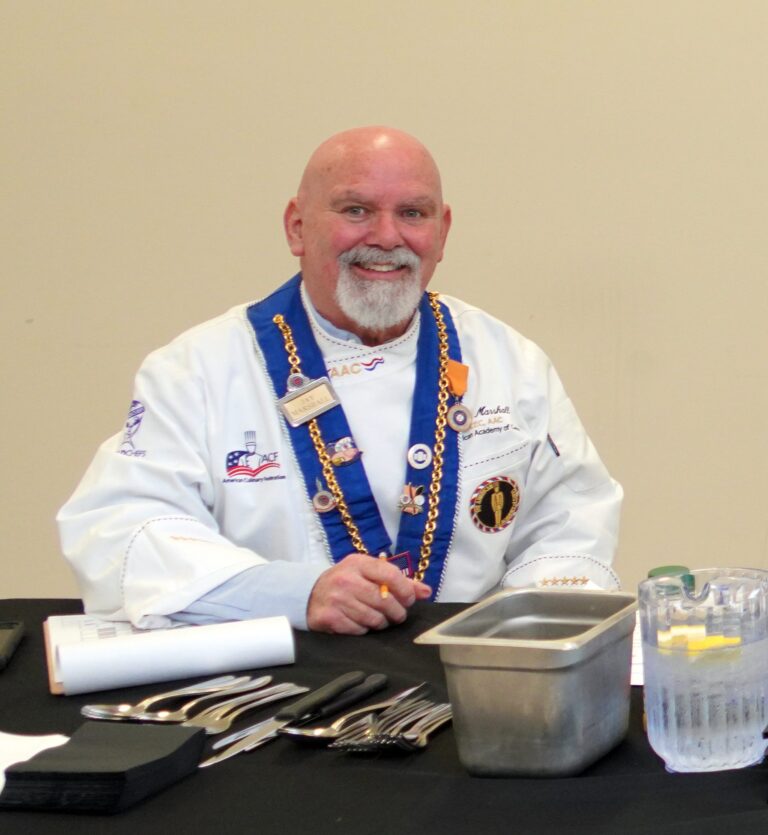
Featured Photo: Chef Jay Marshall, CEC, AAC, Chaîne Conseiller Culinaire Provincial Pacific Northwest was a tasting judge at the 2024 Jeunes Chefs Rotisseurs competition.

Links

2024 Chaîne Jeunes Chefs Rôtisseurs

ACF – San Francisco Chapter

National Restaurant Association Educational Foundation – Military Foodservice Awards

San José State University

California School for the Deaf

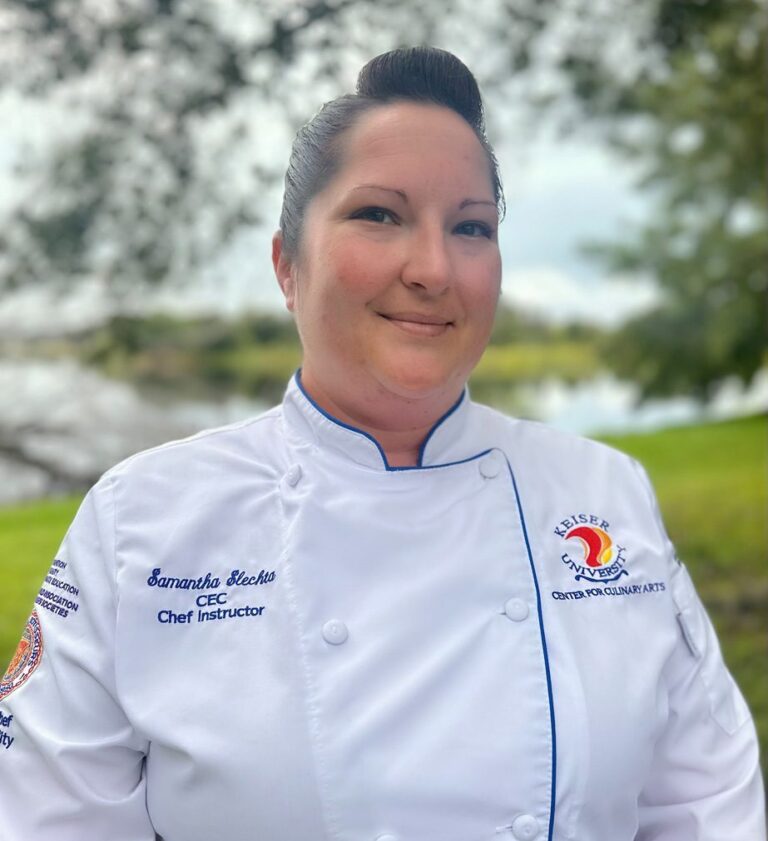
Chef Samantha Slechta is a Culinary Career Matchmaker Par Excellence

Nov. 8, 2024 – Keeping one hand on her bicycle handlebars and the other hand holding a cake for her best friend’s birthday as she rode to middle school in Melbourne, Florida, Samantha Slechta’s future in the culinary industry was never in doubt. After school, she rode her bike to her mom’s restaurant to help her for a couple of hours doing small jobs to prepare for dinner service. As the eldest of five children, she then rode home to finish making dinner for her siblings and help them with their homework. Her youth and future career path spun in harmony. “I just always wanted to make people smile with food. It was always going to be food,” Samantha Slechta, CEC, Chaîne Conseiller Culinaire Provincial Southeast (SE), said to Chaîne during a Sept. 27 telephone interview.

Having mastered the front of the house at her mom’s fine dining restaurant, during high school, she was finally old enough to work there and began to take notice of what the chefs were creating in the kitchen. She asked a lot of questions. To her surprise, one of the “big” chefs said to her: “Women didn’t belong in the kitchen.” Samantha was taken aback to say the least. “It wasn’t really long ago, the late 1990s or early 2000s. He said that when I was 16. At 18, I decided to go to culinary school,” Samantha said.

Culinary School at Keiser University

Keiser University’s Sarasota campus (Photo: Courtesy of Keiser University)

She enrolled in the Culinary Arts program at the Melbourne campus of Keiser University, a private, not-for-profit university founded in 1977 that now has more than 19 campuses throughout Florida, 10 international locations, and a vibrant online division. Three locations – Melbourne, Sarasota and Tallahassee – have Culinary Arts programs where students can earn an Associate of Science degree as well as their first American Culinary Federation (ACF) certification as an ACF Certified Culinarian (CC). At the Sarasota campus only, a second Associate of Science degree in Baking/Pastry is offered.

Samantha said students can complete the first degree in 16 months and because both programs share four required classes, students can earn their second degree in Baking/Pastry in eight additional months. Many students choose that path to be a well rounded chef and elevate their appeal to future employers.

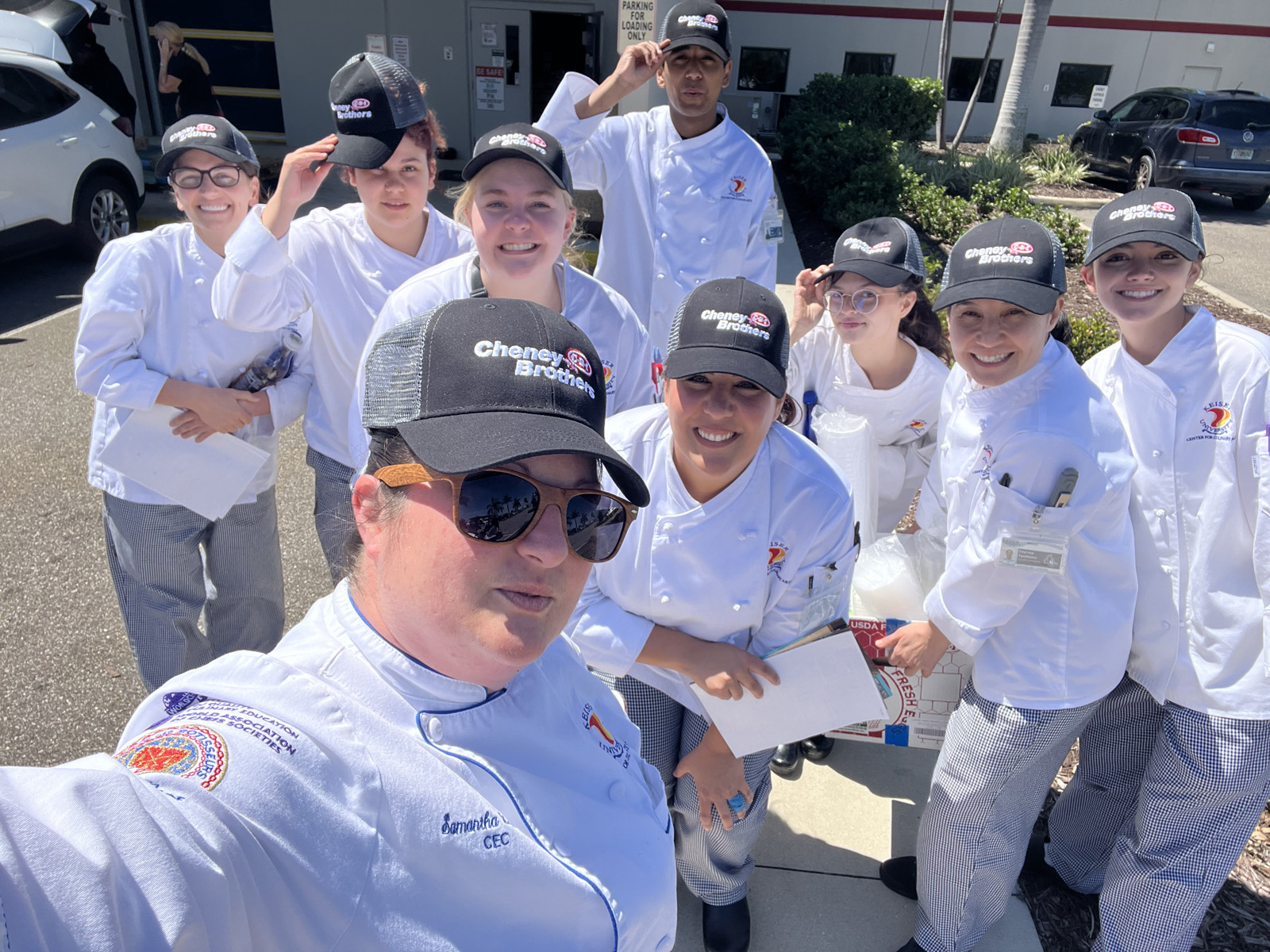
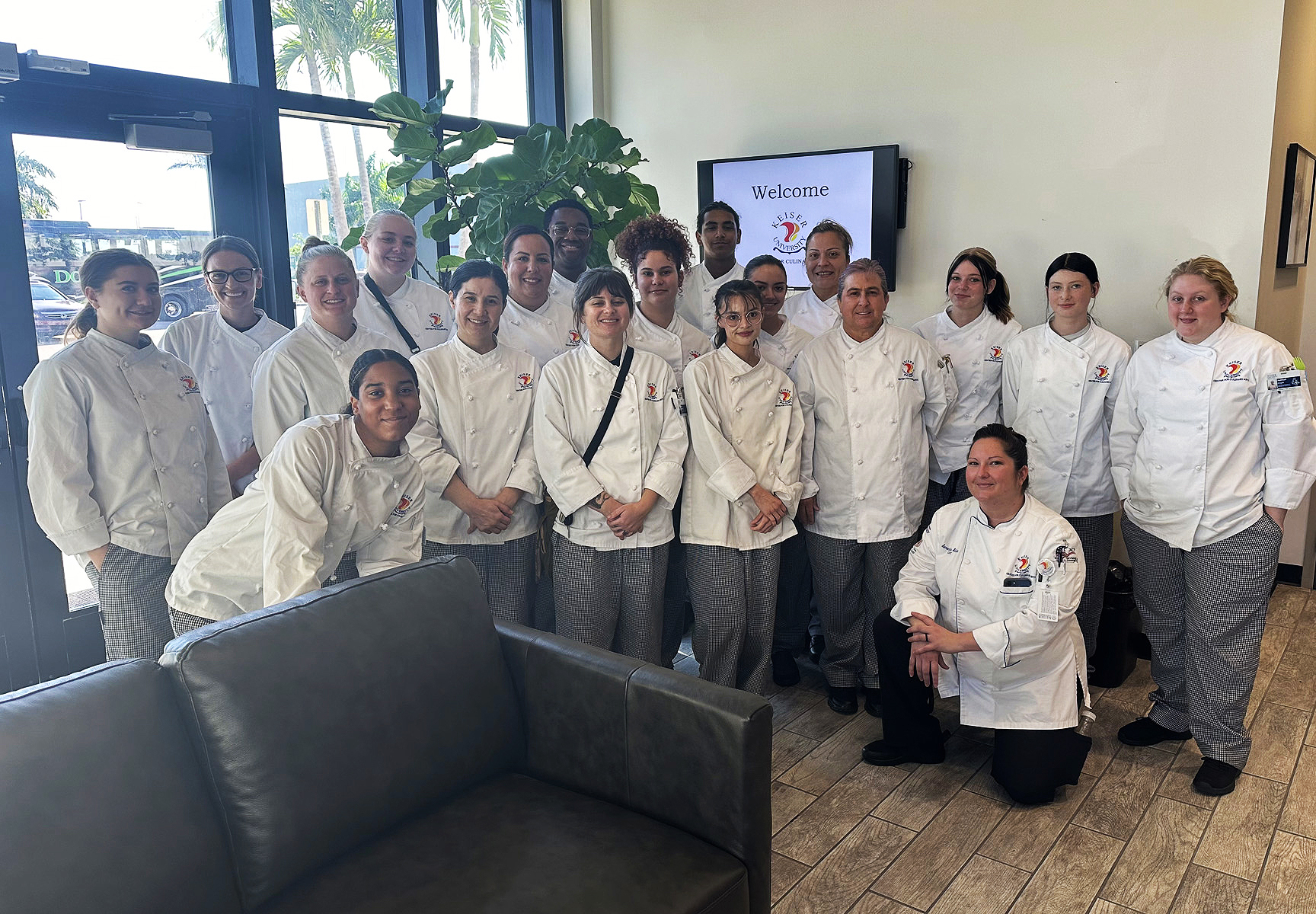
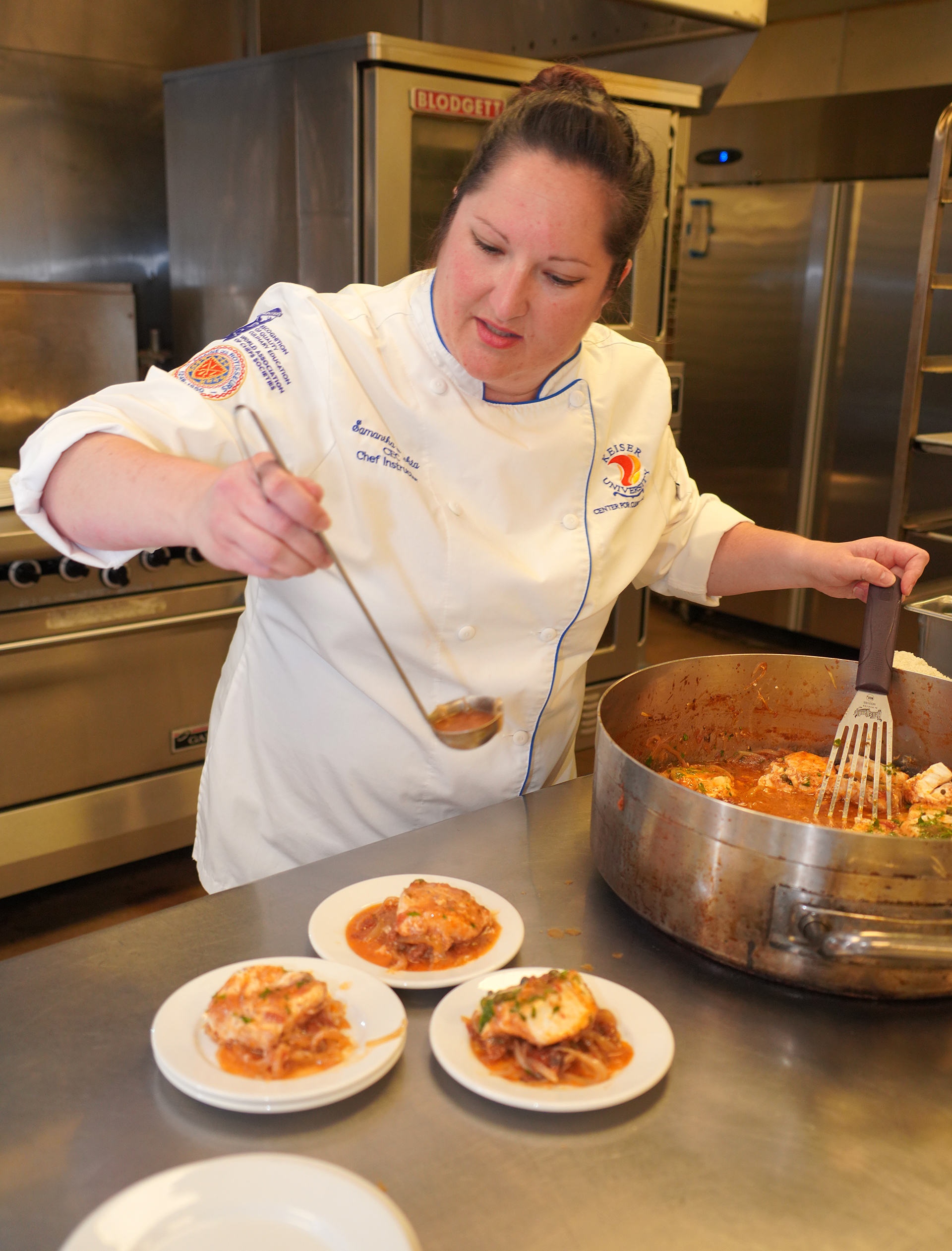
Chef Slechta and her students at Keiser University in Sarasota, Florida. (Photo: Courtesy of Keiser University)

From her own experience as a Keiser graduate, Samantha began working immediately after graduation for the DoubleTree and Hilton Hotel chain in Melbourne Beach, going back and forth between the hotels as needed. Guests who stay at DoubleTree hotels across the country look forward to receiving a complimentary, warm chocolate chip cookie upon check-in. Samantha said the recipe changes depending on the region of the country but the magic is in the hospitality. Each hotel has a special oven to keep the cookies at just the correct temperature and humidity. “It’s very comforting. The cookie warms your heart, part of the hospitality,” Samantha said.

Five years of the frenetic pace and overtime demands as a hotel chef ultimately motivated Samantha, who was now a mother of two young children, to seek a career change. “I was just getting burnt out working in hotels and wanted to look for something where I could see my children more often,” she said.

In 2010, she spotted an ad for a Chef Instructor at Keiser University’s Sarasota campus. She applied and was hired. “I was thrilled to have weekends and holidays off and even be able to come home and help the kids with their homework before bed,” she said. “That was a great transition.”

The job was a little bit stressful her first year as she went from teaching line cooks at a hotel restaurant to students in a classroom. The most difficult aspect for her was the age difference because she was much younger than many of her students. Keiser attracts a large number of nontraditional students, many who are veterans, adults, and parents. She worked diligently to earn all of her students’ respect. ”I demand a presence. I make the students pay attention,” she said.

Chef Slechta (front, kneeling) and her students at Keiser University in Sarasota, Florida. (Photo: Courtesy of Keiser University)

Culinary Career Matchmaker

With her personal and professional background, she grew seamlessly into her role not only as a teacher but also as a trusted mentor. To fulfill degree requirements, Keiser students must complete a four-month externship, working under a chef at a full service operation at a restaurant, hotel or resort. Samantha is currently the faculty coordinator for the externship program, a culinary matchmaker par excellence.

She approaches placement with a student-centered philosophy by matching students, whenever possible, to their goals post graduation. And even after graduation, she helps her students find their first job in the real world.

“I have students all over the state working right now. Most of them stay there a little longer, at least one year after they have graduated,” she said. She keeps a “Wall of Fame” to highlight her students’ successful culinary careers. “It’s not hard for me to find a job for students, especially in Sarasota, Tampa, and the Orlando area.”

If a student wants to work outside of Florida, either for their externship or for a permanent job, she gladly reaches out to her national and regional contacts to help them.*

With small classes and individual attention, the Keiser University Culinary Arts program has a very high graduation rate and works with Keiser’s Student Services team to place students who are eligible in positions all over the country. Keiser offers lifetime job assistance to all graduates as part of their Students First philosophy. Culinary Arts professors supplement this placement through their own contacts across the country. With their diplomas in hand, Samantha helps graduates complete the paperwork to receive their ACF CC certification

Chaîne

Samantha gives back in many ways. She is President of the ACF Sarasota chapter and serves as Chaîne’s Conseiller Culinaire Provincial Southeast, a responsibility that includes coordinating the annual Jeunes Chefs Rôtisseurs (JCR) competition. Keiser is one of just a few Chaîne regional training facilities for JCR, she explained. This year’s national competition in Seattle was quite remarkable for her and one of her students.

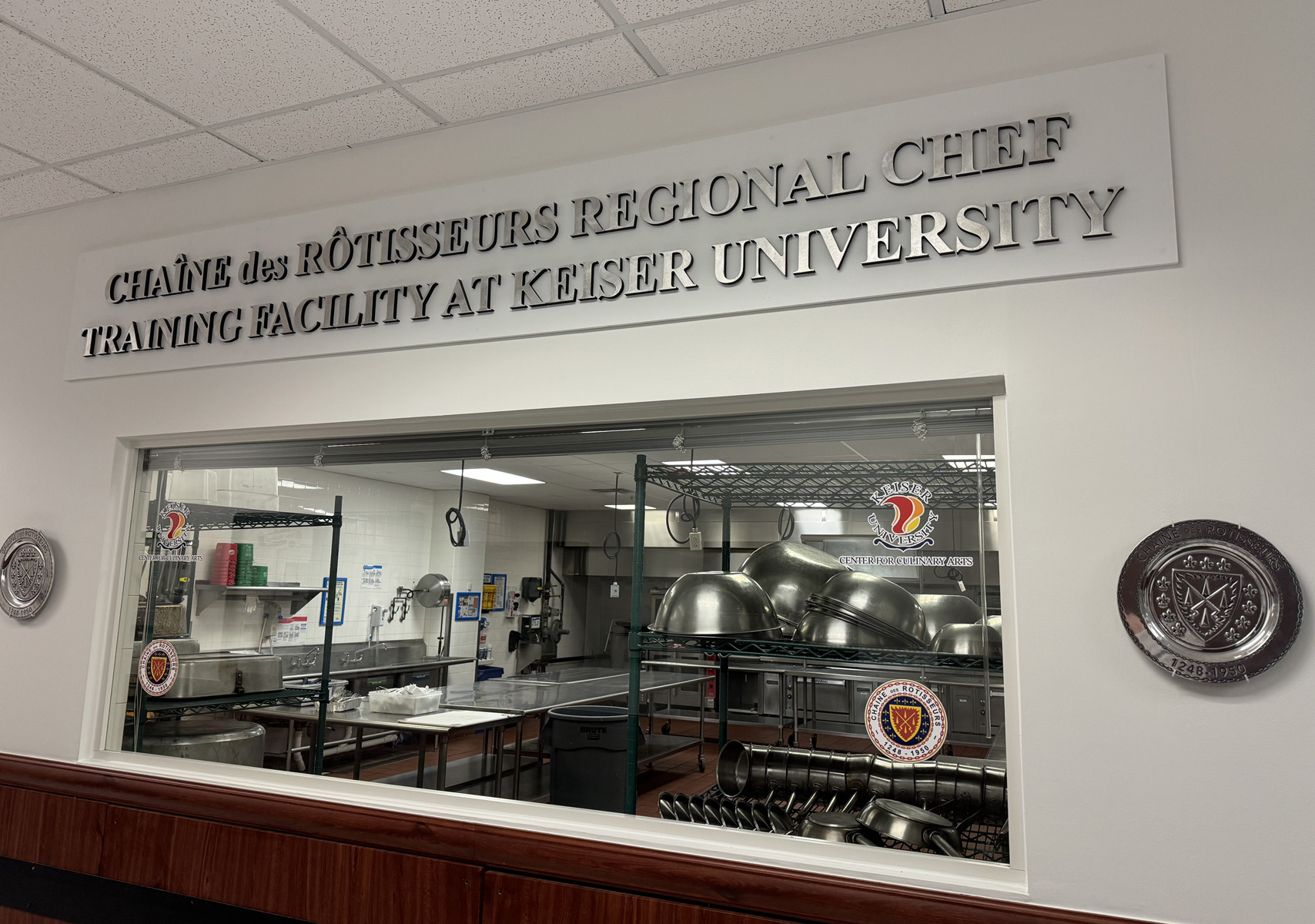
The Chaîne des Rotisseurs Regional Chef Training Facility at Keiser University (Photo: Courtesy of Keiser University)

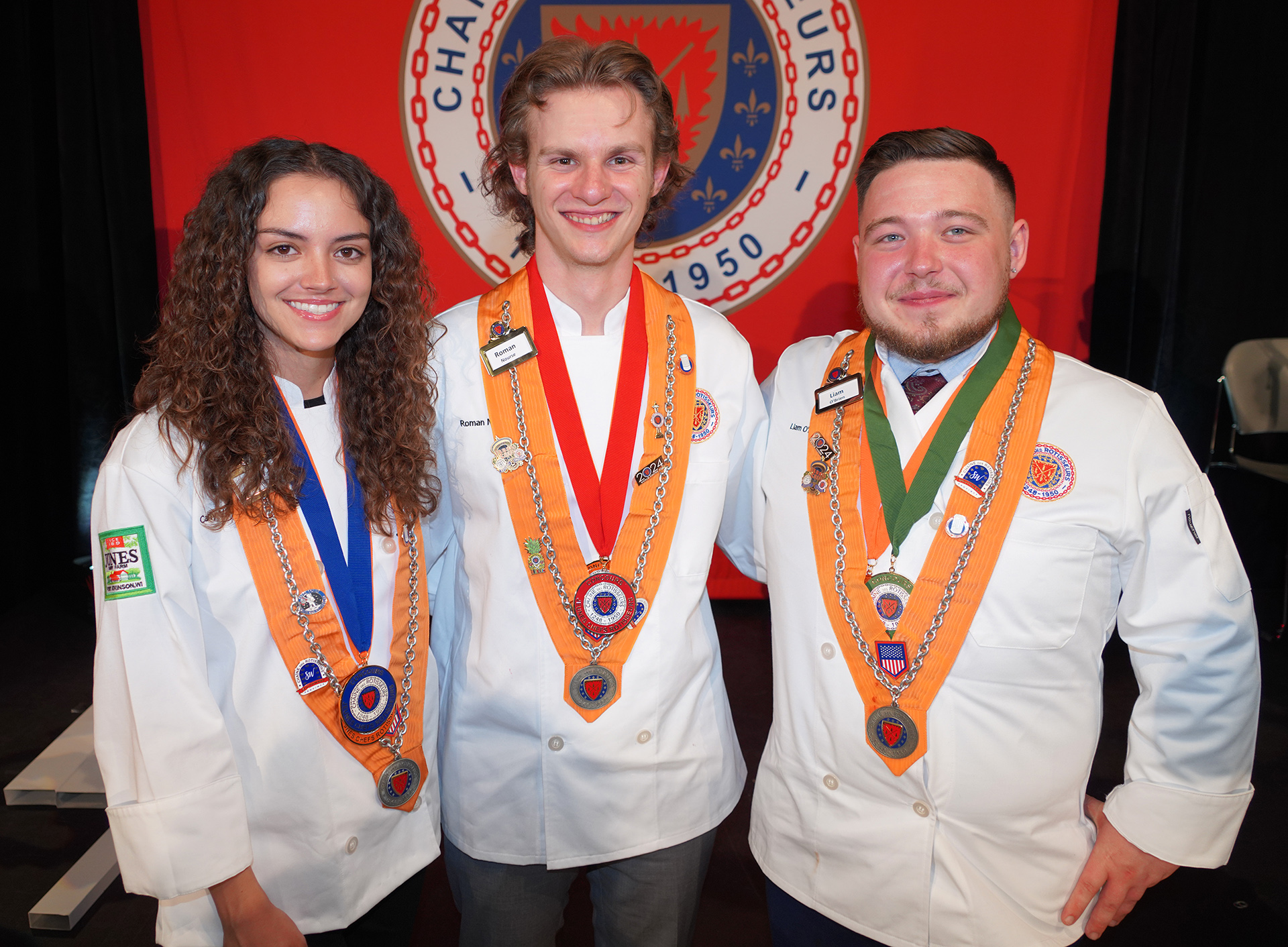
Leading up to the national final in June, Samantha first held an internal competition at Keiser for her students. Carly Villanueva topped her fellow students to advance to the SE Provincial JCR where she again won first place. In Seattle, she was awarded second place, or runner up to the JCR winner, Roman Nourse.

Winners of the 2024 JCR Competition – From left, First Runner up Carly Villanueva of Southeast Province, First Place Roman Nourse of South Central Province, Second Runner Up Liam O’Brien of Northeast Province (Photo: Chaîne)

For all JCR competitions, young chefs and young culinary students (26 years old or younger) have 30 minutes to write a menu and then three hours to prepare and plate a three-course meal. Samantha said almost all of the judges (Floor and Tasting) in Seattle were Chaîne professional members.


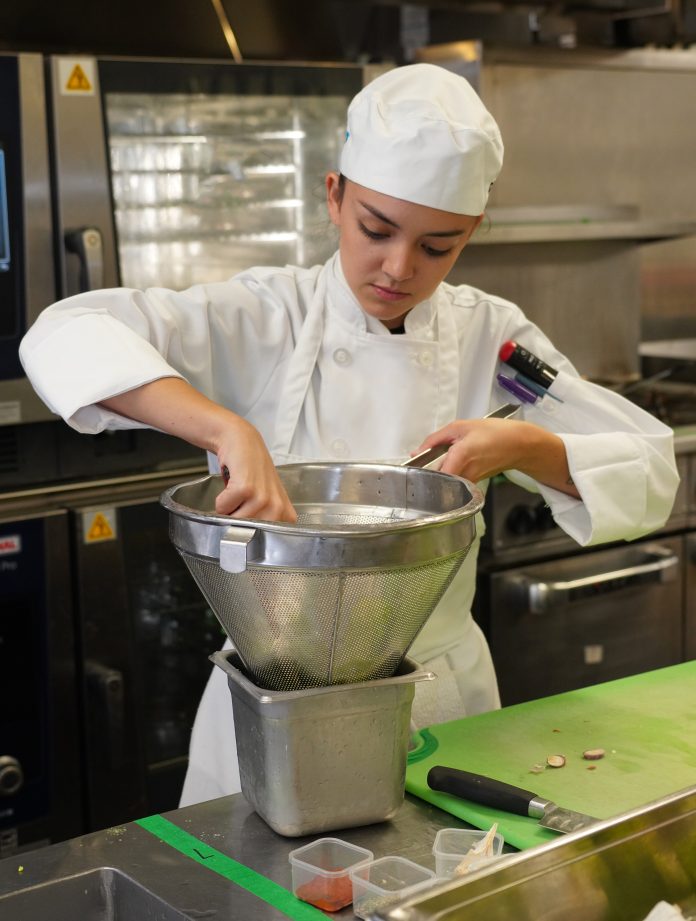
Carly Villaneuva prepares one of her courses at the 2024 JCR Competition in Seattle. (Photo: Chaîne)

When the final results were announced, Samantha was stunned but not surprised by Carly’s performance. “She started culinary school in January,” she said. “She is so new and so passionate about it. I knew she would do well but I didn’t realize it would be second place well. She did phenomenal. She has an eye for beautiful plates. The detail she puts in is just fantastic. I was so proud of her. It’s fun to watch her.”
Carly kept following her passion to culinary school after pursuing two other careers so Samantha is really excited about her future. “She’s learning and training with as many people as I can get her in front of to absorb ideas and creativity from everyone she works with.”

In Seattle, Samantha had her own second place finish, competing in the Turkish Tastes Ambassador Challenge for best hors d’oeuvres plate prepared using all Turkish Tastes ingredients.

.Chef Samantha Slechta plates her appetizer as part of the Turkish Tastes Ambassador Challenge at the 2024 JCR Competition and National Culinary Weekend in Seattle. (Photo: Chaîne)

Samantha believes students today are as committed to culinary excellence as those she taught many years ago. Today’s students may only want to communicate via text messages but that is fine with her. “We can work anything out with communication,” she said.

At times, she and other faculty members receive a request from a student to learn a new culinary trend. The faculty often responds quickly. For example, when “smoking” food became popular, they immediately bought smoking equipment and demonstrated it. Because she teaches her students basic culinary skills to prepare them for the next level, she has an inherent advantage in terms of consistency. “Techniques never change. If they understand the techniques, they can make any of these trendy items.” Trends are demonstrated; basic techniques are taught, Samantha succinctly stated.

Always looking to the future for her students, her large culinary network, with the Chaîne playing a vital role, gives her students a definite advantage.

“The Chaîne has given me an opportunity to travel and to meet people. It’s also given me an opportunity to be more of a mentor to my students to help them meet and network. The Chaîne is near to my heart. I think it’s amazing I get to share it with young culinarians, these young kids who don’t even know how many people are there to help them,” she said.

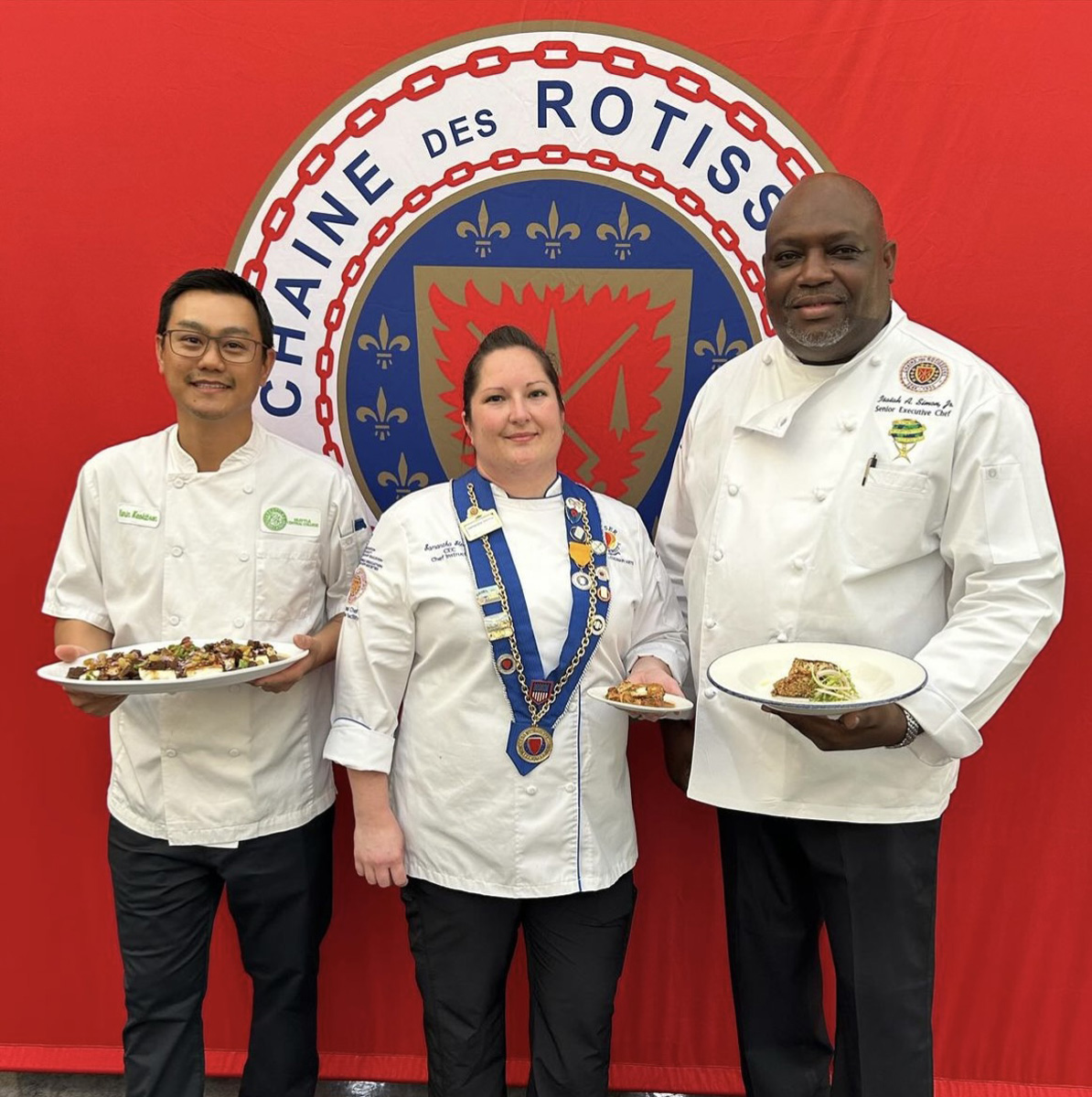
From left, Chef Varin Keokitvon, Chef Samantha Slechta, and Chef Isaiah Simon at the 2024 JCR Competition in Seattle (Photo: Chaîne)

Samantha advises Chaîne members to warmly welcome student chefs to their events as they naturally feel a bit intimidated and out of place because of their age. She recommends: “Be easy to approach and be very inquisitive of the young chefs. Just because they are younger doesn’t mean they don’t belong.” The Sarasota Bailliage is planning one dinner that will raise funds to pay for more student chefs to attend Chaîne dinners.

Samantha’s dedication to her students, the culinary profession through her work with the ACF and the Chaîne, and her family keeps her busier than ever. Thank goodness there are now electric bicycles if she ever needs to carry a cake across campus!

*Chef Slechta welcomes those looking to mentor chef students or hire graduate chefs to reach out to her at the following email address: sslechta@keiseruniversity.edu

Links
Keiser University (Culinary Arts Program)

Bettina Sichel Has Filled Some Mighty Big Shoes

Oct. 25, 2024 – Bettina Sichel, co-owner of Laurel Glen Vineyard, located on the eastern slopes of Sonoma Mountain in Glen Ellen, California, has a family legacy in the wine industry that is as intriguing as her vineyard’s unique Cabernet Sauvignon clone first planted in 1968. Peter Sichel, Bettina’s father who turned 102 in September, was born in Germany, attended middle school in England, fled to France, and moved to New York City before he was 20 years old. World War II set his first career as a spy with the Central Intelligence Agency (CIA) in motion. In 1960, he resigned from the CIA to operate the family’s winery and wine export business, founded in 1857 in Mainz, Germany, which the family reclaimed after the war. Bettina, the eldest of Peter’s three daughters, always knew she would have big shoes to fill with the family known worldwide for their popular Blue Nun wine. “I was earmarked from an early age to take over the family business,” Bettina said to Chaîne during a Sept. 26 telephone interview.

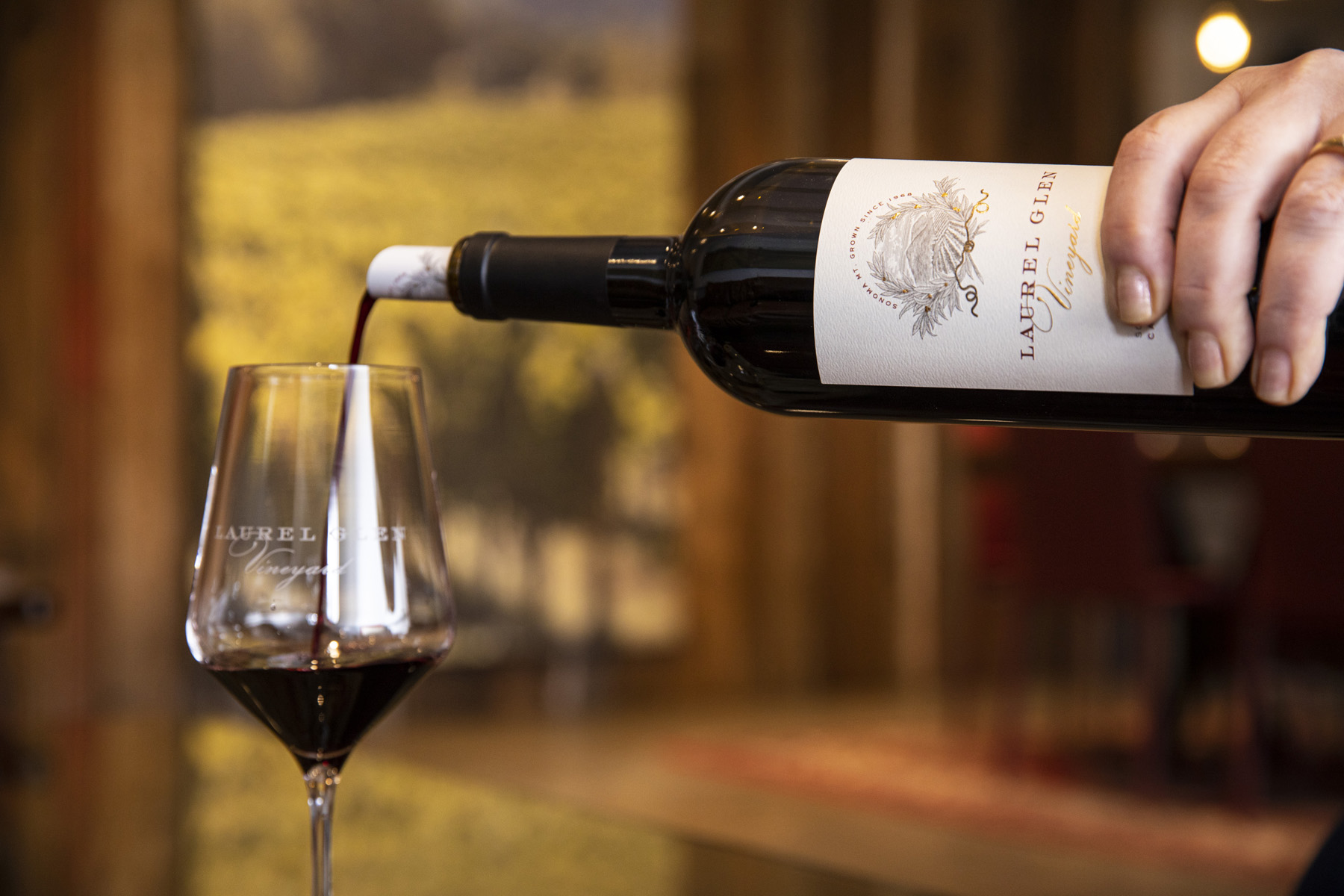
Laurel Glen Cabernet Sauvignon (Photo: Courtesy of Laurel Glen)
A bottle of Blue Nun Wine
A bottle of Blue Nun (Photo: The Little Museum of Dublin, via Wikimedia Commons CC BY-SA 4.0)

Blue Nun

The iconic Blue Nun label depicting blue nuns in a vineyard had its origin in 1929 when the Sichel family released a Liebfraumilch from their 1921 vintage with the newly designed label. Sales immediately skyrocketed. It helped that the 1921 vintage in Germany was a stellar one. By 1932, customers were asking specifically for bottles with the blue nuns on the label so the family decided to reserve their top Liebfraumilch for Blue Nun, adding the words on the label to firmly establish and market the brand.

With robust sales and offices in London, Bordeaux and Mainz, the family’s business future was bright, just over a decade removed from the devastation caused by World War I that resulted in members of the Sichel family fighting on opposite sides. The family, who were Jewish, was looking forward to growing their business. But then in 1933 Hitler rose to power in Germany. Peter was 11 years old. Family leaders channeled the strength of their ancestors to survive.

Sichel Family History

In 1857 in Mainz, Germany, located about 120 miles southwest of Frankfurt, three Sichel brothers and their father moved from Sprendlingen to build three apartment houses near an office building where they founded their wine business. Under the courtyard between their homes and office, they dug deep cellars to store and age wine, establishing the firm foundation, both literally and figuratively, upon which future generations of Sichels, proud German citizens, would thrive and prosper. Born in 1922, Peter Sichel remembers playing in the courtyard amid the maze of barrels and equipment. The business had been so successful, branches of the Sichel family opened additional companies with offices in Bordeaux, London and New York City, a prescient decision for reasons the family could not have known at the time. One by one, the Sichel families in Mainz fled as the German government seized their business. Peter’s family settled in Bordeaux but were again forced to flee their home in 1941 when Germany occupied France. After a harrowing journey out of France, via Spain and Portugal with Peter traveling alone, the family reunited in Lisbon, finally securing their freedom when they arrived in New York City. Peter enlisted in the U.S. Army the week after Pearl Harbor and in early 1943, was recruited for the Office of Strategic Services (OSS), the precursor agency to the Central Intelligence Agency (CIA). He was willing to do anything to defeat Hitler, Peter recalls in his 2016 autobiography, The Secrets of My Life: Vintner, Prisoner, Soldier, Spy.

Peter Sichel’s U.S. Army photo as shown on p. 177 of his autobiography. (Photo: J. Miller)

Following OSS training, Peter was assigned to Algiers, arriving in the bustling city on the Mediterranean Sea in North Africa in fall 1943. In August 1944, two months after the D-Day invasion on the beaches of Normandy, France, Peter was assigned to an OSS unit attached to the Seventh Army that landed in southern France to liberate France. Fluent in his native German language, Peter had a key role in recruiting German Prisoners of War (POW) to spy for the Allies. In his book, Peter said German agents he recruited wanted to end the war to stop the killing and further destruction of their beloved country. Many young German soldiers were fiercely opposed to Hitler’s Nazi regime. In total, Peter worked with more than 30 German agents. “Not one turned out to be a bad egg,” Peter stated in his book.(1)

End of World War II and Postwar Germany

In the waning days of the war in 1945, Peter was promoted to Chief of the OSS Seventh Army Detachment. Thousands of Allied soldiers were marching toward Germany from all directions in January and February to liberate Western Europe.

As French and American officers planned their march north, the French military made sure French soldiers were responsible for land west of the Rhône River where the best vineyards were located so they could save the vineyards. Now called the Champagne Campaign, many of France’s best vineyards were indeed spared.(2)

Peter M. F. Sichel’s autobiography – The Secrets of My Life: Vintner, Prisoner, Soldier, Spy, published in 2016. (Photo: J. Miller)

When the U.S. Army Seventh Detachment reached Mainz, Peter was with them with special permission to secure what remained of his family’s property and possessions. The family’s apartment buildings had been bombed to rubble. But because wine was a valuable commodity and currency during the war, a local manager operated the business after the family fled. When Mainz was liberated, the Sichel cellars were intact and held a lot of wine, some likely hid from the Nazis and some likely normal inventory from ongoing business, Bettina explained. Each German soldier serving on the front lines was allocated one liter of wine per day so German wine production continued unabated during the war.(3) And Peter explained in his book that Blue Nun was exported to both England and the United States throughout the war.

Peter’s uncle returned to Germany after the war to reclaim their business, connecting with local vintners and growers to make and export wine again. Bettina marvels at their resilience. “Can you imagine in the midst of all that devastation trying to make wine? 1945 is considered one of the greatest vintages ever,” she said.

Her father was transferred from the U.S. Army/OSS to the CIA after the war. As chief of an undercover OSS unit in late 1945 in Berlin, Peter was tasked with gathering intelligence on the actions of the Soviet Union in East Berlin and East Germany, the area assigned to the Soviets as part of Allied negotiations upon Germany’s surrender. In 1948 the Soviets turned into foes when they blockaded food and fuel deliveries to starve people living in West Berlin and Western Germany. Their goal was to control all of Germany to force the Allies out. But they had no authority in the skies above so the Allies began the Berlin Airlift, delivering food and fuel to airports for distribution to citizens. Peter regularly reported to Washington what he was learning about the Soviets from his clandestine intelligence gathering operation. The blockade ended in 1949. For the next decade, Peter, promoted to head of operations in Eastern Europe, had a front row seat to the Cold War that evolved between the Soviet Union and the United States.

Return to the Family Wine Business

Peter was contemplating his future with the CIA at the end of the 1950s when Peter’s uncle passed away. In 1959, Peter resigned from the CIA to take the reins of the Sichel family wine business, which included growing grapes, making wine, selling wine in Germany and exporting wine around the world. He returned to Mainz, this time as a civilian who was about to become a wine merchant, a wine grower, and wine personality, the title of Part 3 in his book.

A new office building stood on the spot where his ancestors had built their apartment buildings. He spent two months in Mainz to learn every aspect of operations. Thereafter, Bettina said, because her father did not want to live in Germany again, he commuted one week each month from New York City to Germany. As a child, Bettina said the family spent every summer in Europe.

After learning the ropes in Mainz, Peter returned to New York City to study the wine business in his adopted hometown. It turned out to be a rough and tumble environment, one that he felt was not aligned to the family ethos so he guided the company to partner with Schieffelin and Company, a major wine importer, in lieu of direct sales to restaurants. The family had lost their thriving wine business in Germany twice in the first half of the 20th century because of world wars. He was not about to let that happen again in the second half of the century.

Post WWII

After the war, sales expanded worldwide. Marketing Blue Nun with the slogan, “Blue Nun Goes Everywhere,” it had a price point and a taste that enjoyed broad appeal. Its heyday in England was in 1980 when the company sold about 300,000 nine-liter cases. It reached its peak in the United States in 1985 with about 1.3 million cases sold.(4)

“Blue Nun put me through college,” Bettina said.

Bettina Joins the Family Business

True to her and her family’s expectation to one day take over the business, Bettina went to work for her father at H. Sichel Söhne for six years after graduating from college to help him market Blue Nun. However, in the late 1980s and early 1990s, sales in the United States began declining because of increased competition and changing tastes. Peter points out in his book that they never intended Blue Nun to appeal to the high end of the market, a Sunday wine as Peter refers to it. Blue Nun had always been produced as a daily wine.

With his skills at expert analysis and information assessment that only a select few have developed as he had, he came to the conclusion that the downward trajectory of sales would soon lead to a catastrophic financial situation for the company. So in 1995, he sold the business to a large German company.

Her job eliminated, Bettina said she began knocking on doors in Napa Valley, the center of the American wine universe then and now.

Career in Napa Valley

Agustin and Valeria Huneeus founded the Quintessa estate winery in the Rutherford District of Napa Valley in 1990. As they were planning the launch of their first Quintessa release, they hired Bettina to be their director of sales and marketing, a position she held for 10 years. From Quintessa, Bettina went to the Napa Valley Vintners Trade Association. As she was contemplating her next move in the industry, one of her husband’s friends, with whom she regularly discussed wine and the industry, called for a regular chat. As the call ended, he made a joke that they should purchase a winery together. “I thought that was a pretty great idea,” Bettina said. “I took him up on it and here we are!”

The Laurel Glen Vineyard (Photo: Courtesy of Laurel Glen)

The Laurel Glen Vineyard on the eastern slopes of Sonoma Mountain caught their attention. At an elevation of 1,000 feet, the vineyard is above the fog line and about 1,400 feet below the summit. Morning sun warms the cabernet sauvignon grapes and the mountain shields the fruit from wind and intense afternoon heat to support slower ripening.

During their due diligence process, in June 2010 Bettina asked Phil Coturri, a highly respected organic viticulturist who operates a vineyard management company, to assess the quality of the vineyard for her. Patrick Campbell, Laurel Glen’s founder, owned the vineyard at the time.  Bettina describes Patrick as a “thrifty Scotsman” who did not like to buy expensive treatments for his vineyard. Because of his frugal nature, he farmed sustainably. “The soils were in great condition,” she said.

Bettina and her partners were not only buying a healthy vineyard but also a most unusual cabernet sauvignon grape, a clone that Patrick attempted to genetically trace but to no avail. Patrick purchased the vineyard, with three acres of mature cabernet vines, in the late 1970s from someone who worked at the University of California (UC) Davis. He took cuttings to the UC Davis genetics lab to identify the vines but they did not have a record of that exact clone. The lab was at the forefront in the United States identifying grape varietals through DNA testing. UC Davis declared Patrick’s vines a unique clone.

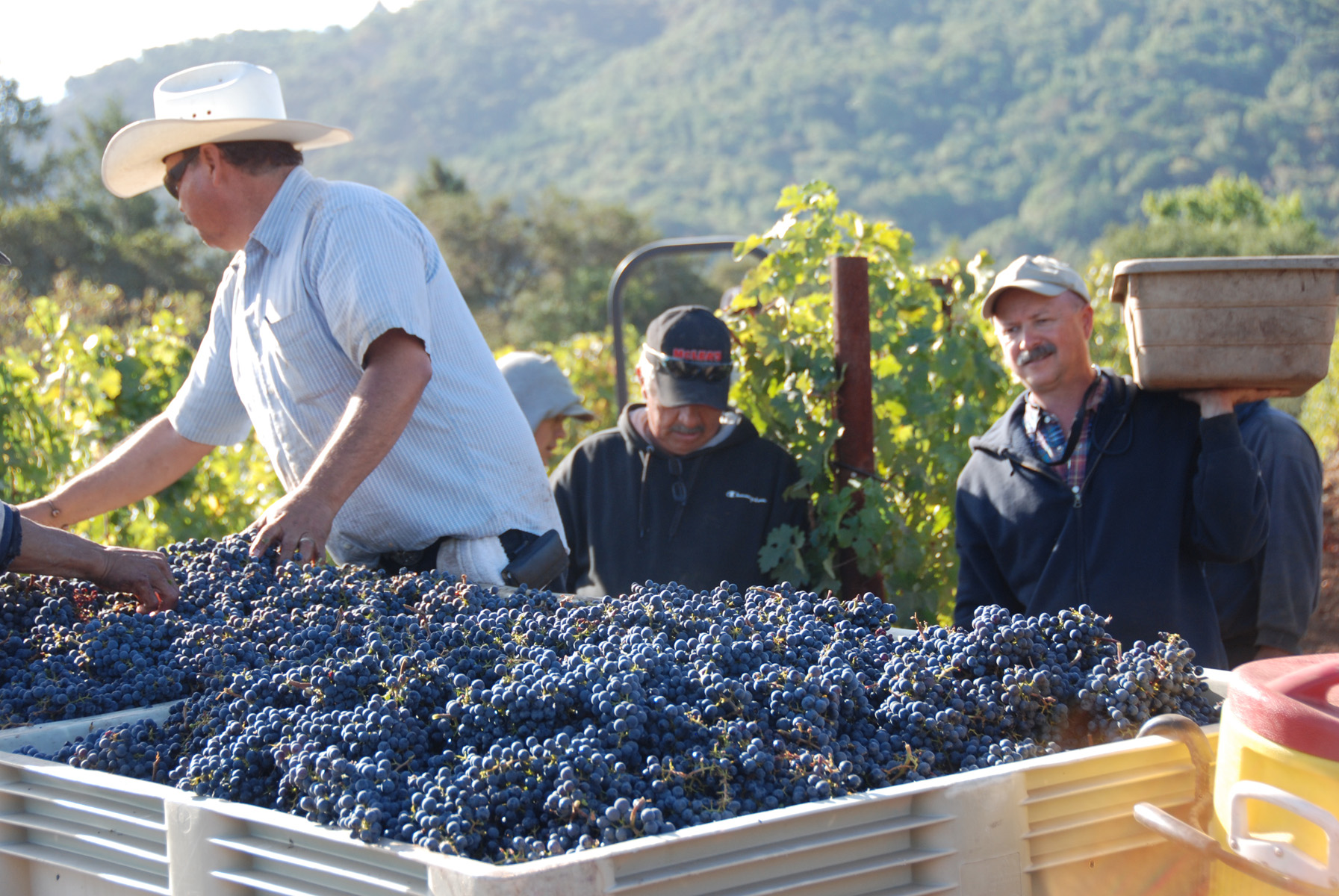
Miguel and Mike at harvest in the Laurel Glen vineyards. (Photo: Courtesy of Laurel Glen)

“Where that unique clone came from, I don’t exactly know,” Bettina said. First planted in 1968, it is the only clone of Cabernet ever planted at Laurel Glen Vineyard. Today they annually produce about 2,200 cases of cabernet sauvignon and another 600 cases of sauvignon blanc, riesling, and rosé varietals.

After the sale was completed in March 2011, Bettina outsourced vineyard management to Phil’s company choosing to reshape the vineyard by cane pruning the vines. “The timing could not have been more perfect because 2011 was such a cool, wet year, it was hard to get grapes to ripen,” Bettina said. Because of the cane pruning and the desire to make high quality wine, each vine carried less fruit than in the past. They harvested a little over two tons per acre whereas in 2010, the yield was 3.5 tons per acre.

Laurel Glen vineyard  (Photo: Courtesy of Laurel Glen)

“We started farming organically from the first day,” Bettina said. About as quickly as any vineyard could, in 2014 the California Certified Organic Farmers (CCOF) certified Laurel Glen as an organic farm. “The paperwork was mind numbing,” she said. Very proud of that achievement, she is still shocked at the low number of California vineyards with that certification, about 4 percent of all acreage farmed for wine grapes in California, according to CCOF statistics.(5) Laurel Glen custom crushes their grapes at a winery in Santa Rosa.

As a small, ultra premium winery, Laurel Glen’s primary sales channel is through their wine club. “Our Tasting Room is the most effective way of gaining new customers,” Bettina said. Similar to the thousands of wineries in California, Laurel Glen faced challenges in 2017 because of wildfires and then in 2020 with both wildfires and the pandemic.

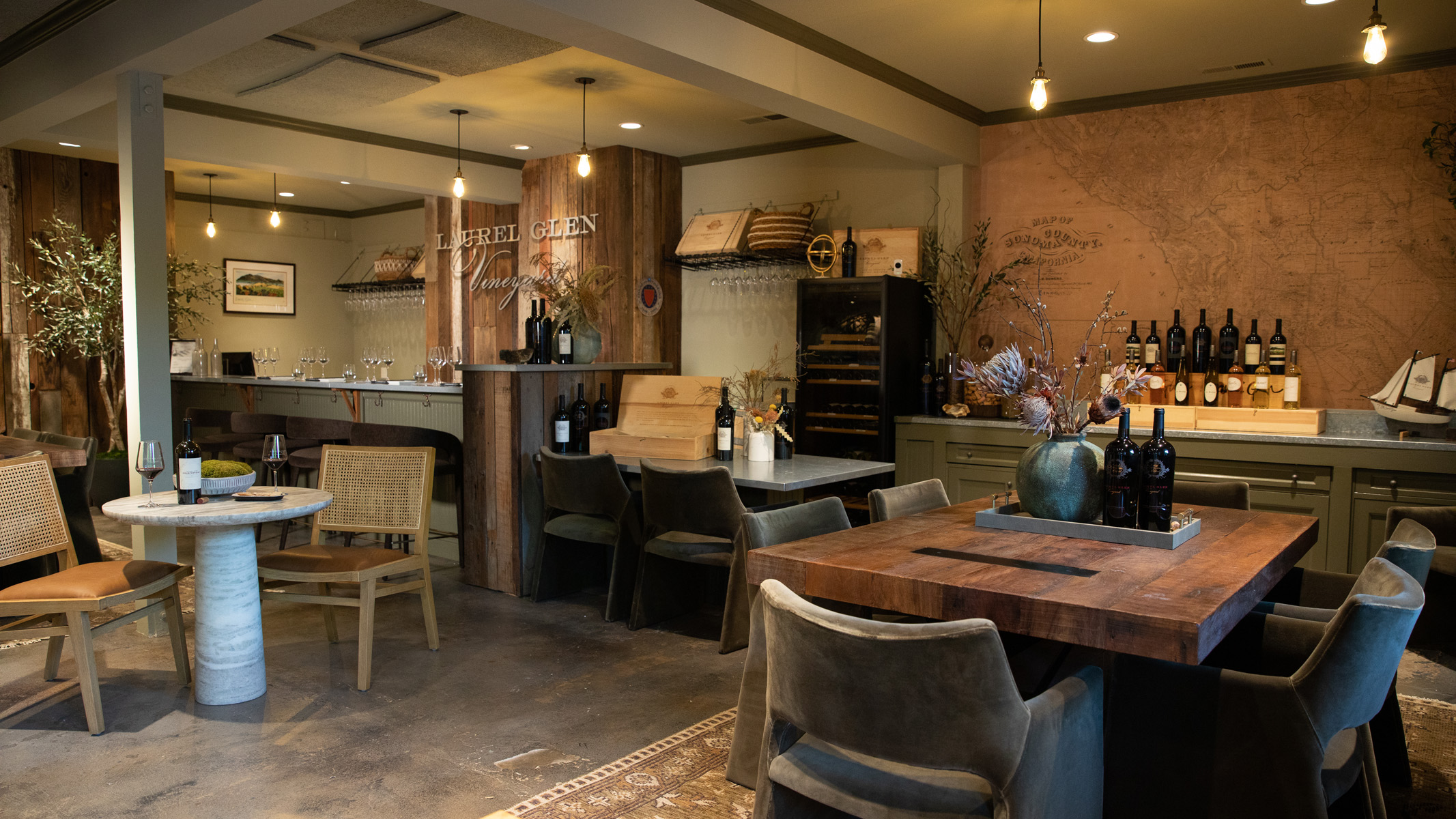
The Laurel Glen Vineyard Tasting Room (Photo: Courtesy of Laurel Glen)

Bettina explained that in fall 2017, wildfires destroyed 1.5 acres of their grapes but it was in October after harvest so they went ahead with production. The only effect was they produced fewer cases of wine.

“2020 was a very different story. We didn’t lose anything physically. However, smoke hung over our vineyard and Sonoma Valley for, I want to say, two months. Because we are a small winery, our reputation is everything and we did not feel comfortable making wine from those grapes. Instead of 2,200 cases of Cabernet Sauvignon, in 2020, we made 350 cases. 2020 had a much more devastating effect on our business than 2017 did.”

There is always a silver lining to every cloud. “Those 350 cases – the wine is delicious. It’s a little lighter bodied than our typical vintage, thus wonderful drinking right now,” she added.

Laurel Glen maintains a significant library to educate their customers who visit their Tasting Room about the high quality of their wine. “We pride ourselves on how well our Estate Cabernet ages. The wine starts to really come into its own in about eight years and then continues to get better from 12 to 15 years. After that, it’s a matter of personal preference,” Bettina said.

With such a rich family legacy in wine, Bettina brings years of experience to Laurel Glen as she has been expertly guided by her father. “He has always been a mentor and resource to me and has helped me enormously in my career in the California wine business,” she said.

The Laurel Glen Tasting Room (Photo: Courtesy of Laurel Glen)

Future of the Wine Industry

Laurel Glen Cabernet Sauvignon (Photo: Courtesy of Laurel Glen)

There is a new challenge that Laurel Glen and all wineries worldwide are facing. People are drinking less wine.

Bettina is passionate about understanding the reality and reversing the trend.

Of great concern is what she describes as an international anti-alcohol movement that is gaining traction after the World Health Organization (WHO) recently stated that no amount of alcohol is healthy. However, the WHO report does acknowledge some health benefits for low levels of alcohol consumption.(6)

As the United States Department of Agriculture (USDA) and the Department of Health and Human Services (HHS) are currently updating the Dietary Guidelines to be released in 2025 for 2025 to 2030, vintners are on the edge of their barrels waiting to learn the final recommendations.

“We are all terrified that they are going to decide as part of that, that no amount of alcohol consumption is healthy, which by the way is not true,” she said. A natural product that has been produced and consumed for thousands of years, she is dismayed about factors that could have an integral role in determining the guidelines.

Bettina refers to the expertise of Dr. Laura Catena, a medical doctor who graduated from the Stanford University Medical School and is a fourth generation vintner from Argentina. Dr. Catena has developed a website (In Defense of Wine) where she has posted a 27-minute evidence-based presentation, a summary of the topic with succinct conclusions viewers can easily understand. And she has a clear recommendation for viewers to consult their personal physician for individual guidance.

As all wine drinkers know, a tremendous benefit of wine is societal, how it brings people together to share a meal, share life’s ups and downs, and deepen bonds of friendship. In an effort to highlight that intangible benefit, Karen MacNeil, author and wine journalist, launched “Come Over October,” an effort to “Toast to togetherness this October,” according to the website.

2021 will be the 40th vintage of Laurel Glen’s flagship Estate Cabernet Sauvignon, a milestone Bettina said they will definitely be celebrating all of next year. “That’s a big milestone for us. We’ve been making cabernet from Sonoma Mountain for a long time and I think we’re only getting better at it.”

Spoken from a Sichel who has successfully filled the big shoes of her amazing father who in turn, filled many pairs of big shoes worn by those three brothers who had a dream in 1857 in Mainz, Germany and made it happen.

The Sichel family established an office in Bordeaux, France more than 100 years ago. Today, visitors to Bordeaux can tour the Cité du Vin, a museum built recently that is dedicated to telling the history and culture of wine worldwide. (Photo: Public Domain via Wikipedia/Flckr)

Links
Laurel Glen Vineyard
Dr. Laura Catena – In Defense of Wine
Karen MacNeil – Come Over October campaign

Footnotes
1. The Secrets of My Life, Vintner, Prisoner, Soldier, Spy (2016) p. 151
2. Wine & War, The French, The Nazis & the Battle for France’s Greatest Treasure (2002) p. 184
3. Wine & War, p. 34
4. The Secrets of My Life, p. 334
5. CCOF stats: https://organicallynapa.substack.com/p/where-are-californias-organic-vines
6. p. 43 Global status report on alcohol and health and treatment of substance use disorders. Geneva: World Health Organization; 2024. License CC-BY-NC-SA 3.0 IGO. https://iris.who.int/bitstream/handle/10665/377960/9789240096745-eng.pdf?sequence=1

Chef Alan Romano Lives Classic – from Cuisine to Cars to Cycles

Oct. 4, 2024 – Whether it’s restoring a 1975 Corvette to its glory, logging more than 2,000 miles on his new Harley in the last few months, instructing and mentoring young culinary students at Guilford Technical Community College in Jamestown, North Carolina for the past 21 years, or transforming a block of ice into a beautiful work of art, Chef Alan Romano lives life to the fullest. But he definitely paid his dues along his journey to success. During high school, he worked as a dishwasher at a restaurant outside of New York City. Similar to many chefs who begin their careers at a sink, during downtime while washing dishes, Alan closely watched the chef create magic in the kitchen. Alan stayed with it. “I did every job in the place.” And then he concluded, “This might be something I want to do,” Chef Romano, CEC, CCE, AAC and Chaîne member, said to Chaîne during a Sept. 11, 2024 telephone interview.

Chef Alan Romano on his motorcycle on the Kancamagus Hwy, New Hampshire. (Photo: Courtesy of Chef Romano)

By the time Alan finished high school, he had a few years of restaurant experience. He continued working at the restaurant steadily gaining responsibilities there while also attending classes in hotel/restaurant management at a local community college. Ultimately, the restaurant’s owner placed his full trust in Alan to competently perform any task required in both the front and back of the house.

Upon graduation from community college, he applied to, was accepted by, and graduated from the Culinary Institute of America (CIA). With a CIA degree in hand, he had the golden ticket for his professional career. “I got a lot of opportunities right after that,” he said.

In 1984 when he was 23 years old, he accepted a position with Bear Mountain Resort, located about 50 miles north of New York City. Just three to four weeks on the job, ARA Services, the restaurant’s management company now known as Aramark, asked Alan if he would like to go to the Summer Olympics being held that summer in Los Angeles. A sous chef who was supposed to go could not because of an injury. Alan replied: “Hell yeah, why not?”

Alan and four other chefs crisscrossed the country to feed volunteers for the Olympic Torch Run. An 18-wheeler became a mobile kitchen and dining car. “I was gone for about two months. It was one of the coolest things. I had never been out of New York. I had never been on a plane,” he said.

Staff Major Dominick Irrera, 1st Marine Division, leads a platoon of Marines as he carries the Olympic flame across Camp Pendleton on its way to the 1984 Olympic Games in Los Angeles. (Photo: Public Domain/Wikipedia Commons)

He realized that although New York City was a melting pot, there was a huge country to discover outside of New York defined by different cuisines and dramatically different landscapes. The beauty of the South made quite an impression on him, an impression that he tucked away for a few years. “Boy, it’s really pretty down here. That’s how I ended up in North Carolina. I never thought I would want to leave the Tri-State area but it opened my eyes to a lot of things. It’s like I woke up,” he said.

By 1987, Alan was the Corporate Executive Chef for Citibank offices in White Plains, New York. Life was good with nothing but clear skies and clear sailing. However, the fast pace of the nation’s financial center does not discriminate in good times or bad times. Following the economic turmoil in 1987 when the stock market crashed, thousands of people working for Citibank were laid off in the blink of an eye. “We went from feeding 5,000 to 8,000 people per day and went down to nothing,” he said. He decided he needed to leave New York.

He moved to Danville, Virginia to work at a large hospital, a safe bet immune from Wall Street gyrations. Homes were more affordable and the terrain was beautiful. “I was living like a king,” he said.

A few years before his move to Virginia he had started carving ice when the chef for whom he was working asked him if he knew how to do it. Alan said yes because he had one day of training as part of his CIA coursework. Alan was told to carve something for Thanksgiving. So he went to the basement freezer and carved a cornucopia. Passing the test with flying colors, his supervisor then told him to carve a turkey. Looking back on that turkey, Alan said it wasn’t very good but since it did resemble a turkey, he was off and running as an ice carver, a skill he honed that eventually drew attention from Hollywood.

Chef Alan Romano is a well known professional ice carver. (Photo: Courtesy of Chef Romano)

Bermuda Run Country Club in North Carolina

While working in Virginia and competing in an ice carving competition in North Carolina, a representative from the Bermuda Run Country Club near Winston-Salem offered him a job. Alan said: “You don’t even know if I can cook!” After an interview with the club’s General Manager, they made him an offer he couldn’t refuse so in 1991, he moved to North Carolina.

A fascinating world was about to open up to Chef Romano as he met and cooked for a lot of celebrities while serving as the Executive Chef at Bermuda Run. In 1937, Bing Crosby (1903-1977) launched the Bing Crosby Clambake Golf Tournament at Pebble Beach in California that paired Hollywood stars with pro golfers to raise money for charity. In 1986, the tournament moved to Bermuda Run.

Bing Crosby passed away in 1977 before the move to Bermuda Run. But Bob Hope (1903-2003), Crosby’s good friend and avid golfer, celebrated his 90th birthday at Bermuda Run. Alan made a cake for him. “When I mention Bob Hope, a lot of people don’t know who he is. He was one of the greatest comedians.”

Yogi Berra, the famous catcher for the New York Yankees from 1946 to 1963, participated in the golf tournaments as well. Alan said Yogi was one of his idols. Famous for saying “it ain’t over till it’s over,” Alan said Yogi would say that often. “He was so cool. Yogi was the best,” Alan said.

Charity golf tournaments attract star power even if the star does not play golf. Alan humorously remembers when Oprah Winfrey came to a tournament. Alan asked her what she would like for dinner. Because Alan and his team were feeding thousands of volunteers and about 100 celebrities, he had hamburgers grilling outside. Oprah told Alan she would love a burger and fries. He thought she would want something a bit more elevated but he told his sous chef and line cooks to prepare the meal.

Without thinking, one of his cooks used oil in which 200 pounds of catfish had just been fried to fry Oprah’s french fries. When she ate them she told Alan the fries were the best she’s ever had and wanted to know his secret. Alan replied he could not tell her, a deeply guarded secret!

“I’ve been very lucky to meet a lot of celebrities,” he said.

Chef Instructor at Guilford Technical Community College

But the thrill of serving celebrities never went to his head. While attending a local American Culinary Federation (ACF) meeting soon after he began working at Bermuda Run, a professor asked him to teach a class at Guilford Technical Community College. “I can’t teach. I can’t do that,” he replied. Recognizing how students would bond with Alan, soon Alan was teaching one class per semester. “I really liked it,” he said. In 2001, he became a full time chef instructor.

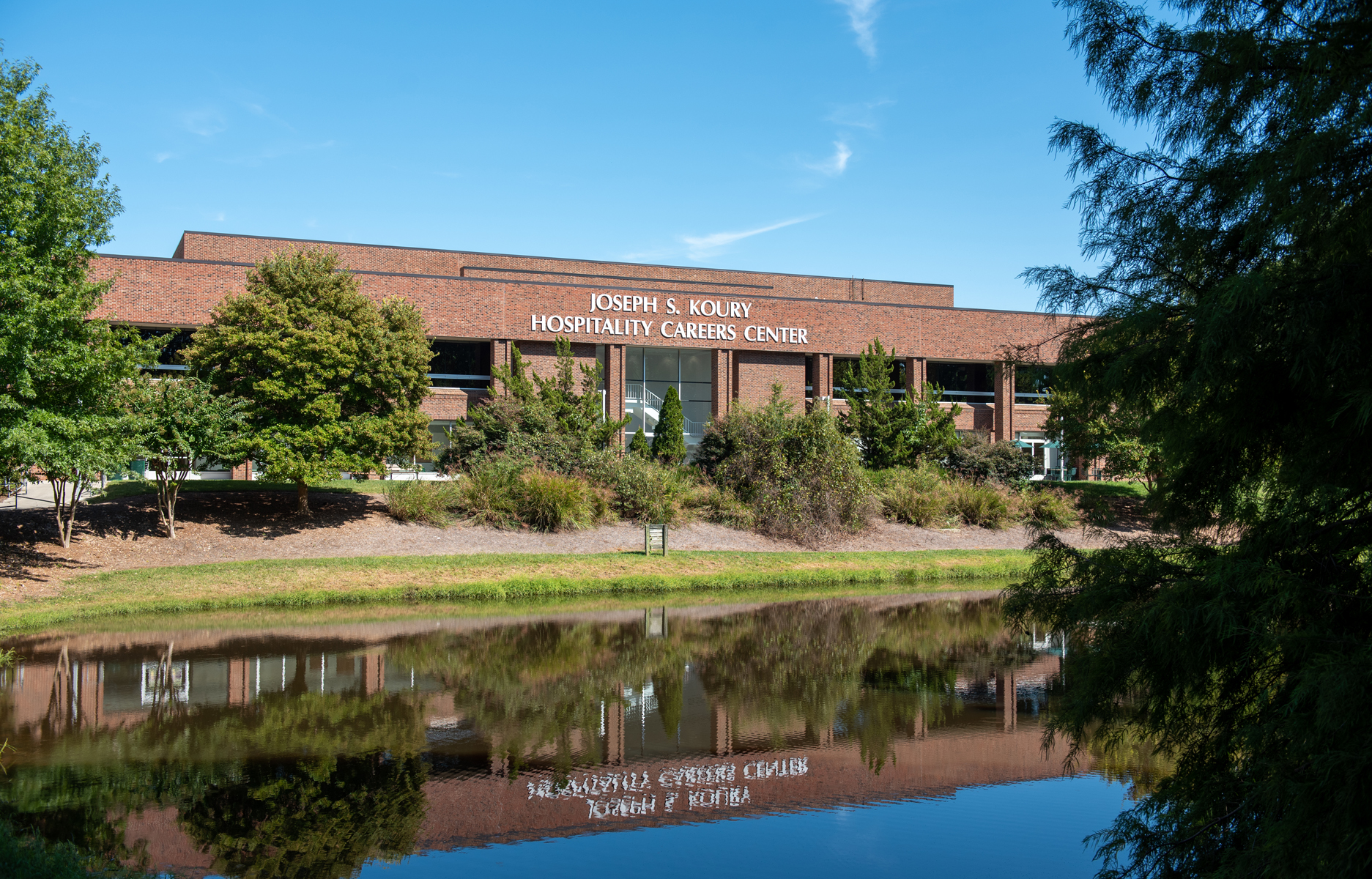
Joseph S. Koury Hospitality Careers Center at Guilford Technical Community College (GTCC) Jamestown Campus in Jamestown, North Carolina (Photo credit: Carrie Lilly/Guilford Technical Community College)
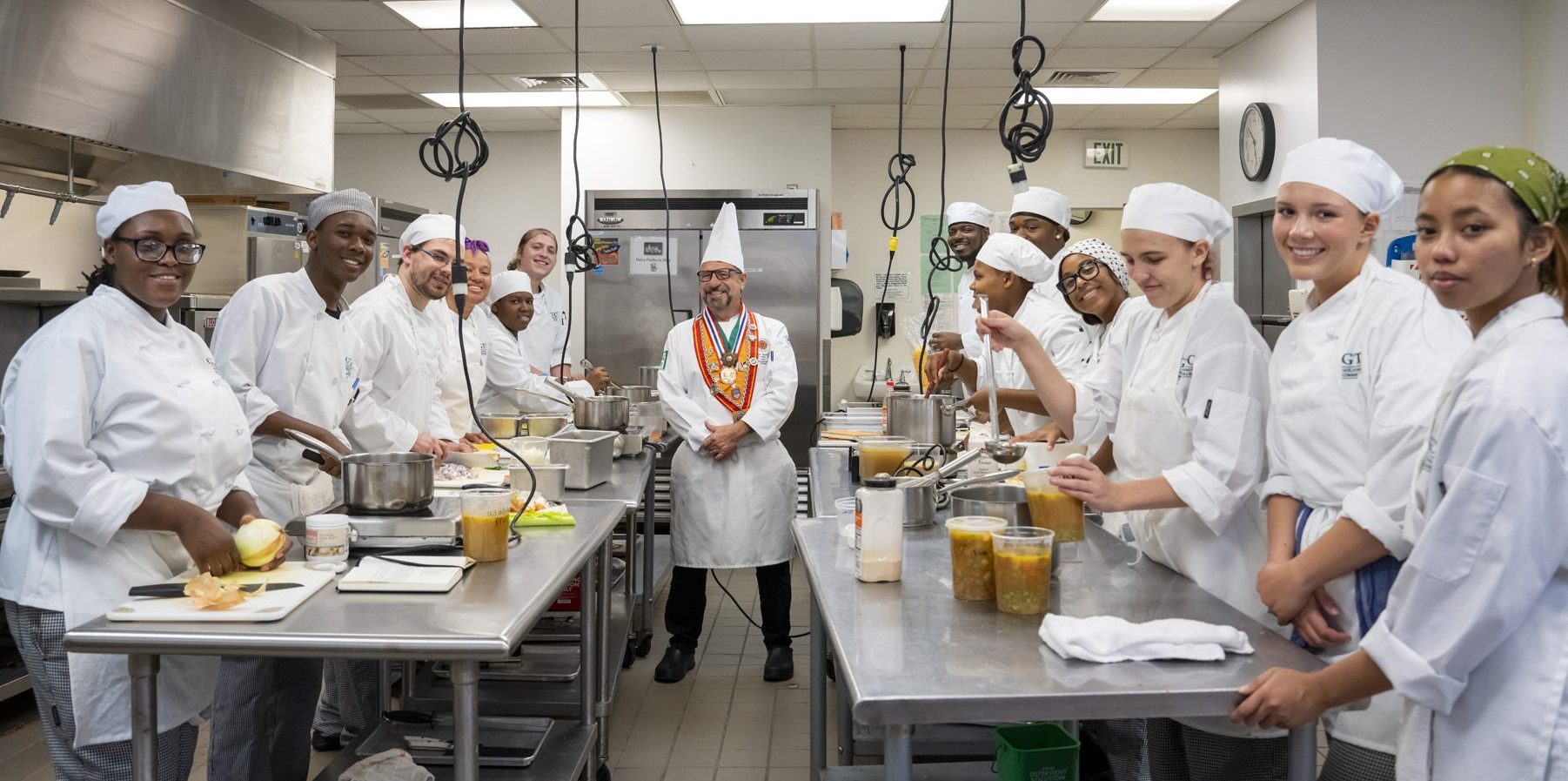
Chef Alan Romano with his students enrolled in the fall 2024 Culinary Skills I class at Guilford Technical Community College in Jamestown, North Carolina. (Photo credit: Carrie Lilly/Guilford Technical Community College)

Entrepreneur

Alan left Bermuda Run in 1999 to open his own catering and ice carving business. He accepted a job at a retirement home during this time to support his entrepreneurial quest. What surprised him was how fast his ice carving business took off and how profitable it was. His geographical location again served him well.

In the late 1990s, ice carving was just becoming popular in the South. With his location in North Carolina and years of experience as a carver, he was soon carving sculptures for NASCAR drivers, including Richard Petty and Richard Childress. “I did so many events for NASCAR. I didn’t know anything about NASCAR. I didn’t know anything about golf either. But I learned,” he said. Because of the demand and his talent, Alan said he made more money doing one ice carving than catering two to three events.

Ice carving by Chef Alan Romano (Photo: Courtesy of Chef Romano)

Hollywood even came calling. The production company for National Lampoon’s Pucked, a 2006 release starring John Bon Jovi, hired Alan as a technical advisor to create 30 ice sculptures for scenes in the movie. He also has a brief cameo in the film, definitely not something he dreamed possible when he was a high school student washing dishes.

Ice sculpture by Chef Alan Romano (Photo: Courtesy of Chef Romano)

With his high profile professional culinary career, Alan has been a local celebrity chef for years and still appears for cooking segments on local television stations two to three times per month. “It’s fun. I enjoy doing it.”

Even with his busy schedule past and present, he sets aside time to give back to students, veterans, and his community. “I have a deep respect for the military and the sacrifices they make for us. My father was a Korean War veteran, and while I never served myself, I’ve always felt compelled to give back in some meaningful way. To that end, I’ve had the privilege of helping certify over 100 military personnel from all branches through the American Culinary Federation. These certifications, at various levels, support their professional development and recognition. I frequently travel to Fort Greg Adams in Virginia, the Pentagon, and Homeland Security in D.C. to proctor certification exams and conduct training sessions for proctors, enabling them to certify others within their own ranks,” he said.

Reflecting on teaching and running a business at the same time, Alan said: “I did both forever, until last year.” He sold his ice carving equipment last summer and will soon have shoulder surgery because of the wear and tear he endured using power tools to carve blocks of ice for many years. “But I still love it. You get that WOW factor. It kind of blows people away,” he said.

One can easily wonder if Alan ever sleeps. In addition to his successful professional career, 13 years ago he bought a 1975 Corvette to rebuild and restore. Especially busy in the last five years, coincidentally one of his students worked at a machine shop. Alan became his student at the shop learning how to rebuild his engine, installing new pistons and many other tasks for the total engine overhaul. When completed, he experienced the thrill of starting the engine for the first time, similar to NASCAR drivers receiving a new car from the shop.

Chef Romano rebuilt and restored this 1975 Corvette, a process that took many years. (Photo: Courtesy of Chef Romano)

“I fired it up. It was like music to my ears being fired up. It was so cool,” he said. He often takes it to car shows and has more than a few trophies at home, including Best of Show. But that is not what motivates him. “I don’t go there to win trophies. I go there to have fun, meet people, feel the cars,” he said.

He has been a car and motorcycle enthusiast his entire life. In March, he bought a new Harley to add to his Harley he has been riding for the past 26 years and rode to Sturgis, South Dakota a few years ago. When he retires, he would like to take a cross-country trip with some of his motorcycle buddies.

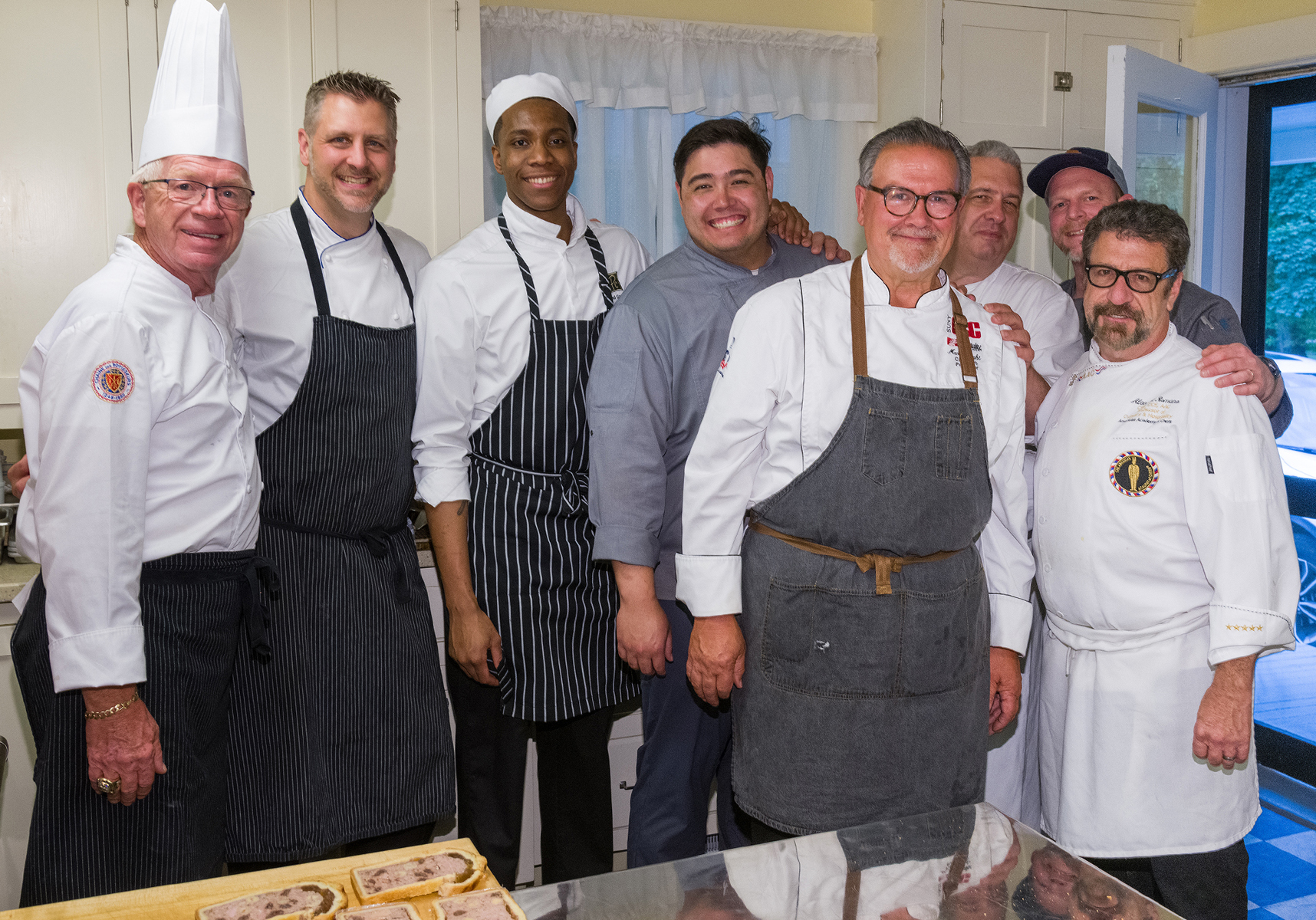
Chefs who participated in the 2023 Jeunes Chefs Rotisseurs competition in Madison, Wisconsin. From left, Reimund Pitz, Gerald Ford, Jedidiah Gaskin, Marc Ty, Mark Wright, John Coletta, Chef Sean from Jones Dairy Farm, and Alan Romano. (Photo: Chaîne)
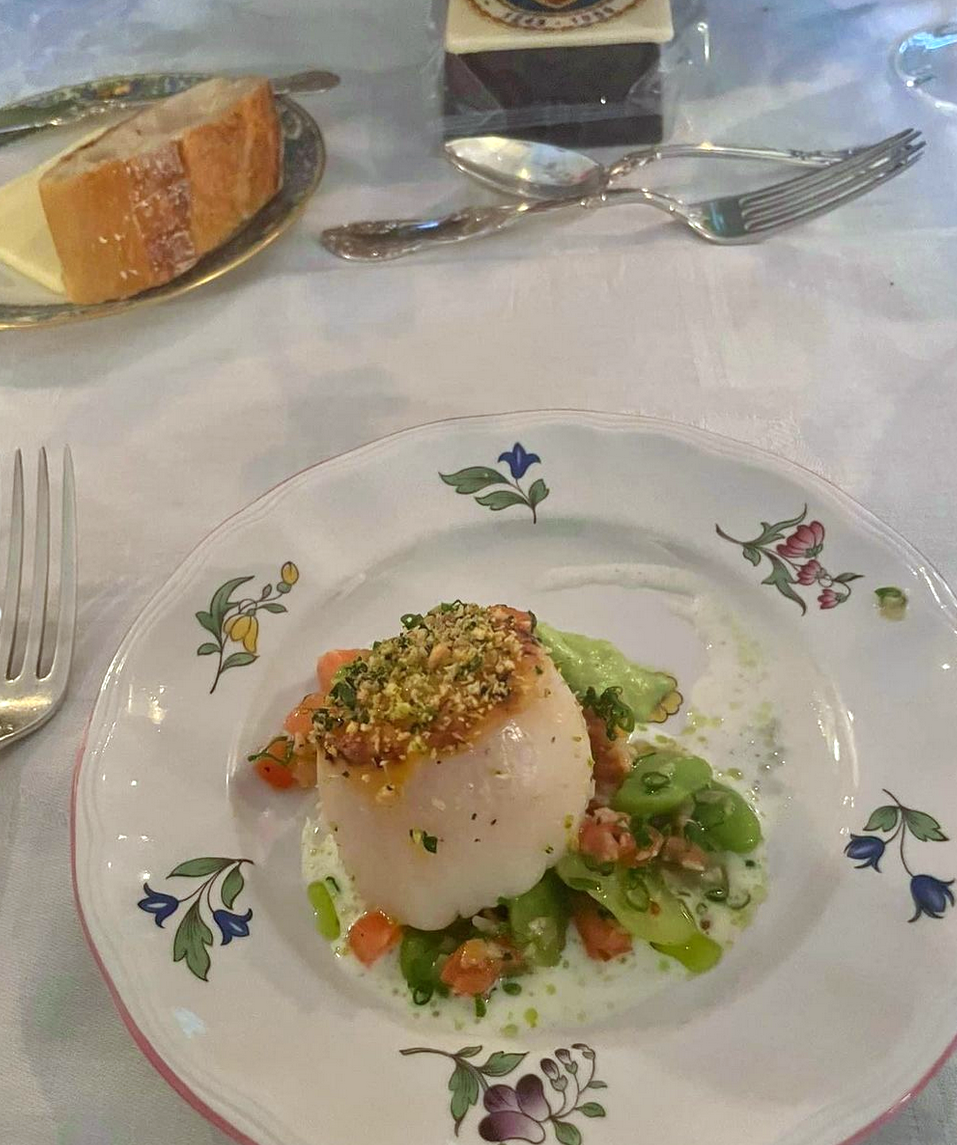
A dish prepared by Chef Romano and other professional chefs at the 2023 Jeunes Chef Rôtisseurs competition in Madison, Wisconsin. (Photo: Courtesy of Chef Romano)

Three years ago, Chef Reimund Pitz, Conseiller Culinaire des États-Unis, recruited Alan to join Chaîne’s Orlando Bailliage. “Reimund was one of my mentors when I was competing 20 years ago. We’ve been friends forever. I respect what he does. He’s all about giving back and helping students,” Alan said.

Alan was a kitchen judge at the 2024 National Jeunes Chefs Rôtisseurs competition in Seattle and the 2023 competition in Madison, Wisconsin.

Wherever and whenever Chef Romano is needed, he is there. In a follow up telephone call on Tuesday, Oct. 1, Alan described the devastation that Hurricane Helene caused, particularly in Asheville, North Carolina. He and other chefs, and public volunteers, are developing a plan to help get food to victims in and around Asheville. The effort is being coordinated with the VFW and the North Carolina Food Bank. Volunteers reacted quickly. “Right now it’s good ole boys with pick-up trucks delivering supplies,” Alan said.

He is torn because he has a commitment this week to teach an ACF certification course in Cleveland, Ohio. He knows those chefs are counting on him so he will honor that commitment. “It’s going to be a long process working on hurricane relief efforts,” Alan said.


Culinary Industry Future

As he looks into the future, he sees challenges in the culinary industry in a number of different areas, challenges that are echoed by chefs from coast to coast. Culinary students are seeking instant gratification and the idea of paying their dues is a bit foreign to them. “Everyone wants to be an influencer on TikTok and make money that way,” Alan said.

Chef Al Romano and class, Koury Hospitality Center, September 2024 (Photo credit: Carrie Lilly/Guilford Technical Community College)
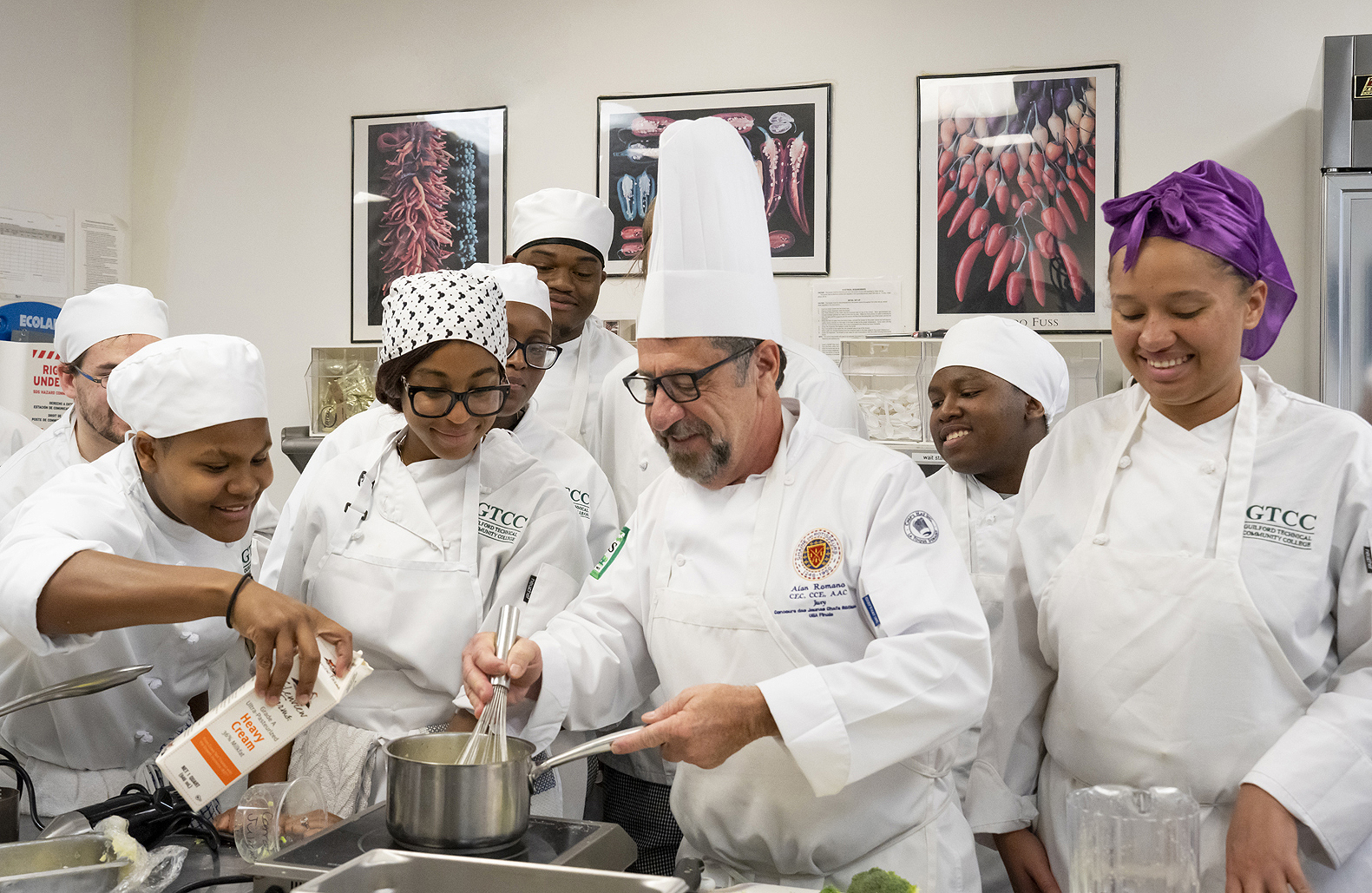
Chef Alan Romano and class, Koury Hospitality Center, September 2024 (Photo credit: Carrie Lilly/Guilford Technical Community College)

While he has watched culinary trends come and go for many years, he believes people want the basics. “It’s the simple things. You take your local ingredients, your fresh ingredients and work with those. Use the best of the best and cook it simple. It’s delicious. That’s what I think people want,” Alan said. If one word could define Alan it would be “classic.”

He offers advice to his students to expand their horizon beyond the digital world and immediate fame and fortune. “I tell students they have to find their niche in culinary whether it be baking, garde manger, wine, sales, marketing. There are so many different facets. Mine was ice at the time. A lot of chefs don’t do ice. It was something different, my niche,” Alan said.

“Classics never go away, whether it be classic cars, classic motorcycles, classic art, classic food. It’s not going anywhere,” Alan emphatically said.

Just imagine the fun to be had featuring a classic culinary feast at a classic car show!

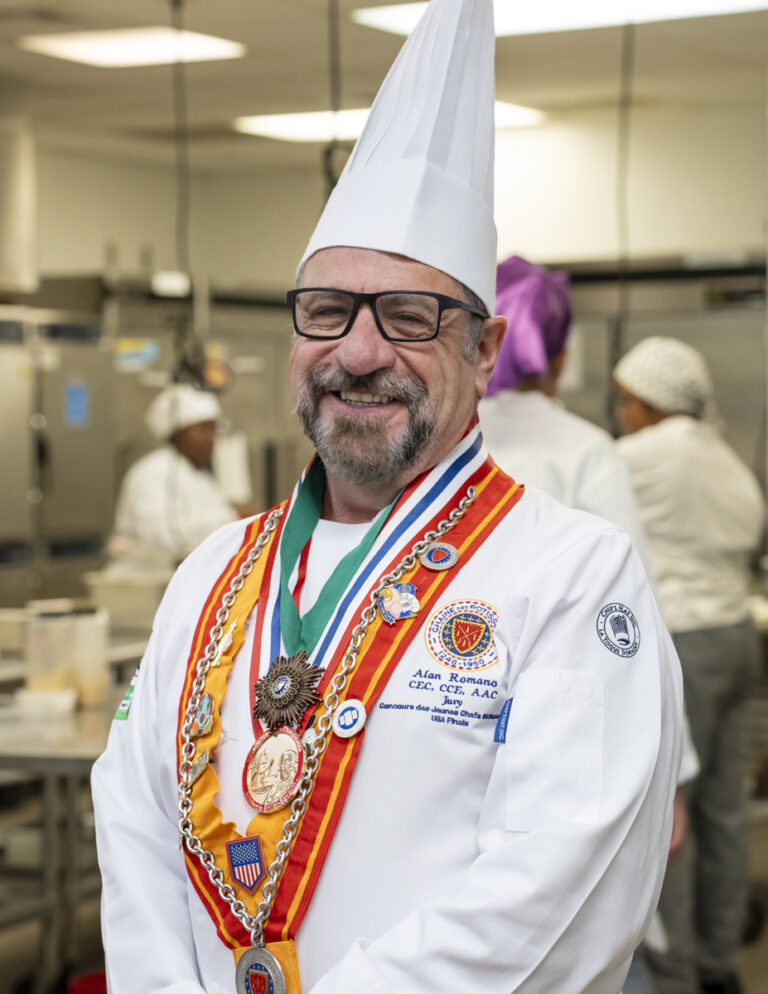
Featured image: Chef Alan Romano (Photo credit: Carrie Lilly/Guilford Technical Community College)

Links
Guilford Technical Community College


Chef Rene Marquis Leads the ACF with Passion to Support Chefs

Sept. 20, 2024 – Avid readers of biographies and autobiographies are naturally good conversationalists. They have mental repositories of authentic, fascinating stories, often how one individual inspired another to greatness. As a high school senior in Lewiston, Maine in 1990, Rene Marquis competed in a culinary competition in New Hampshire. Chef Fritz Sonnenschmidt, a master chef and one of the judges, told Rene he should come to his school, the CIA. “I didn’t know the CIA in Hyde Park. I only knew of the Central Intelligence Agency at that point in my life. I found out there was a school in Hyde Park and that’s where I went,” Chef Rene Marquis, CEC, CCE, CCA, AAC, National President of the American Culinary Federation (ACF), said to Chaîne during a Sept. 13 telephone interview.

Rene’s decision was not a difficult one to make. “First of all, the CIA in Hyde Park at the time had the largest concentration of master chefs in the United States. Ferdinand Metz was the President and Fritz Sonnenschmidt was the Culinary Dean. To be honest with you, walking into the front of that school was like walking into a Grateful Dead concert. You could smell different foods being cooked. You could hear pots and pans clinking and clanking. You could see big chef toques through the kitchens that had glass windows. Just the excitement in the air, the air of all of that going on was just tremendous,” Rene said.

Two years later Rene was wearing a chef’s toque as a CIA graduate with a degree in culinary arts. He made a cross country move to begin his career at The Broadmoor resort in Colorado Springs, Colorado, an iconic hotel/resort built by Spencer and Julie Penrose in 1918.

U.S. Army

Rene’s talents and personality are clearly magnetic because just three years after a master chef recruited him to the CIA and now a young chef working at The Broadmoor, a U.S. Army general asked Chef Rene to come and work for him. But there was one catch. Rene had to enlist in the Army.

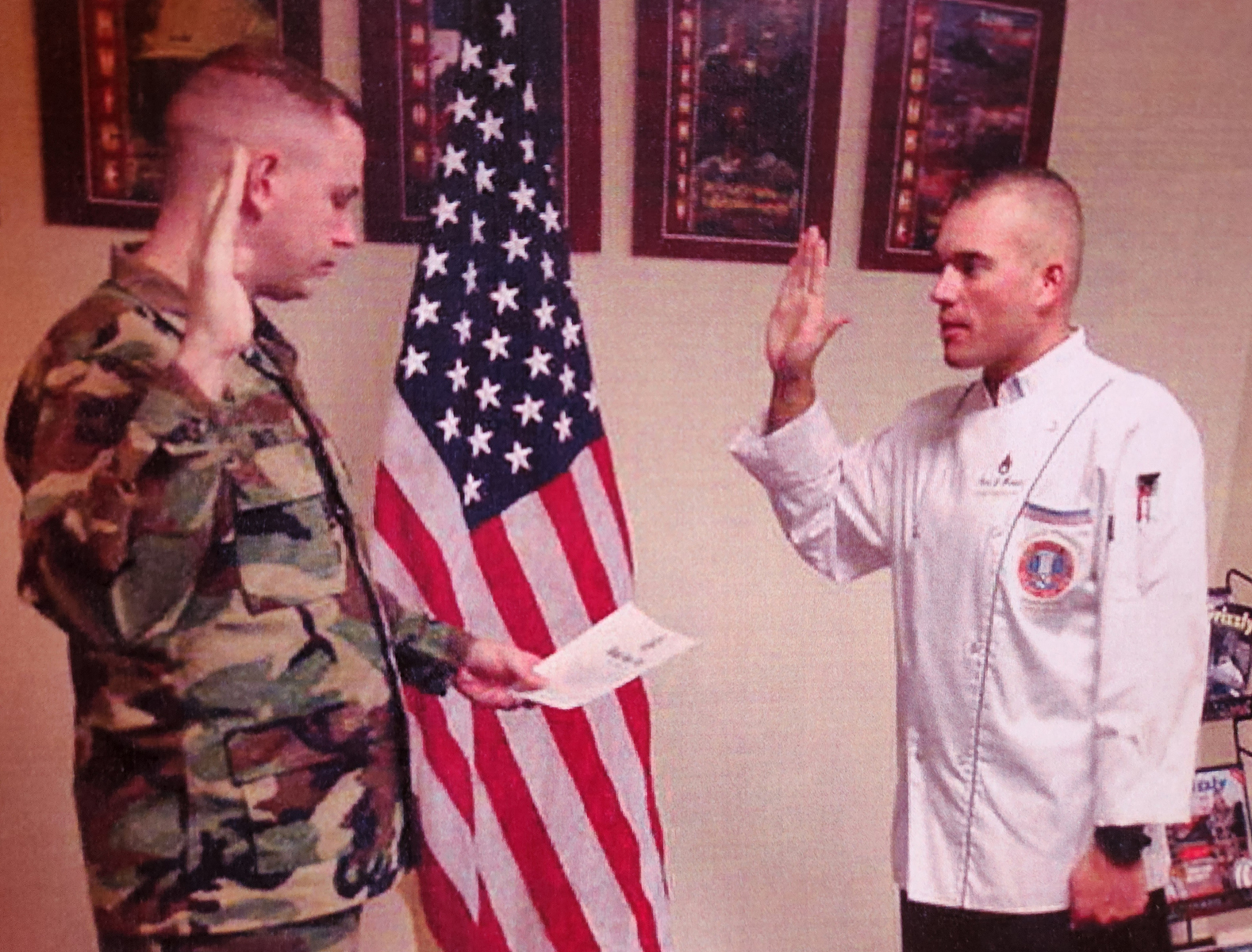
Travis Smith swears in Chef Rene Marquis on his second reenlistment. After a 21-year career, Chef Marquis retired as a Master Sergeant. (Photo: Courtesy of Chef Marquis)

“I joined the Army. They paid off my student loans. I got a cash bonus for joining the Army,” he said. He was in the Army now, first completing basic training at Fort Jackson in South Carolina and then advanced culinary training at Fort Lee in Virginia. With a college degree, he was on a fast track to becoming an Army Food Service Specialist for the general who had recruited him in Colorado. From Virginia, Rene packed his duffel bag for MacDill Air Force Base in Tampa, Florida where the general worked in U.S. Central Command, one of six generals on the base who had “Enlisted Aides” assigned to him. Aides included a chef responsible for daily meals for the general and his family in their home as well as entertaining the many guests who visited. “Every day was a new challenge,” Rene said. He might find out at 11 a.m. that the general was having eight guests for dinner so Rene had to create the menu, shop, prepare the food, and ensure the table was set properly for an excellent dining experience. He had some help around “game time” through the Army’s Protocol Office, which assigned military personnel with hospitality experience to assist but for these events, Rene was largely a one-man show from developing the menu to loading the dishwasher.

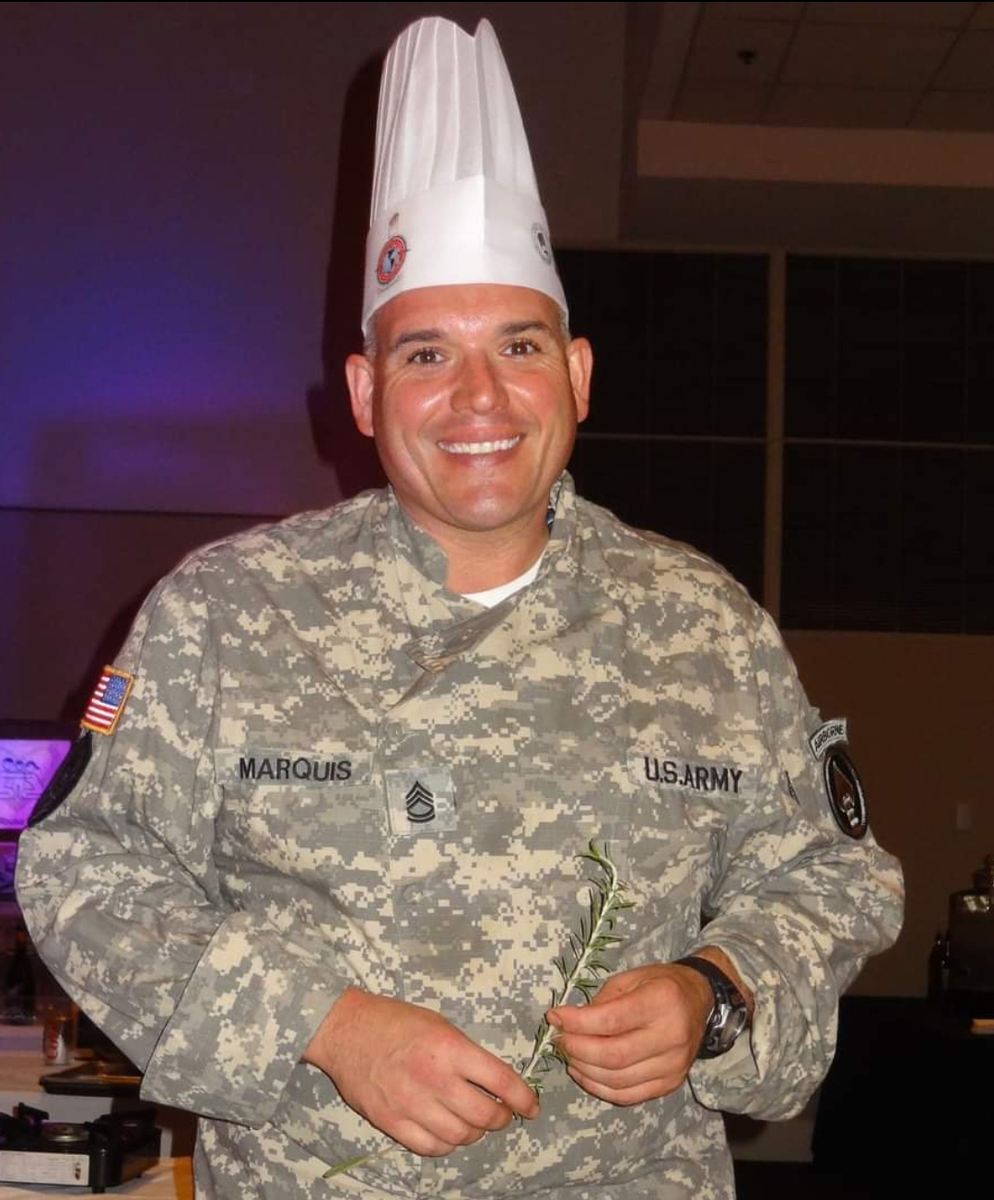
U.S. Army Chef Rene Marquis (Photo: Courtesy of Chef Marquis)

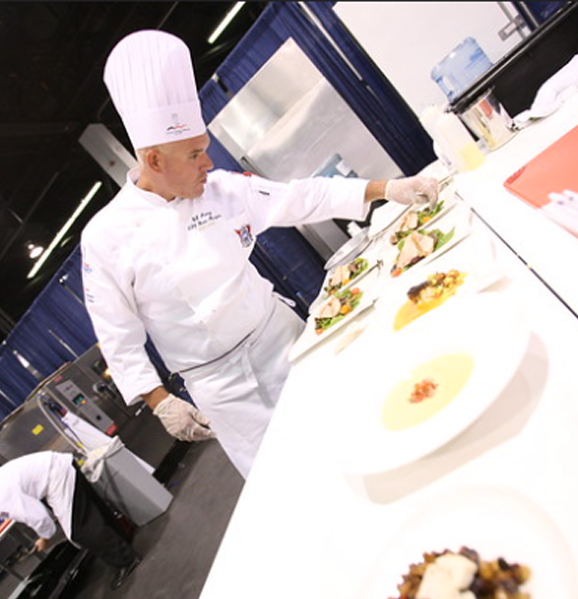
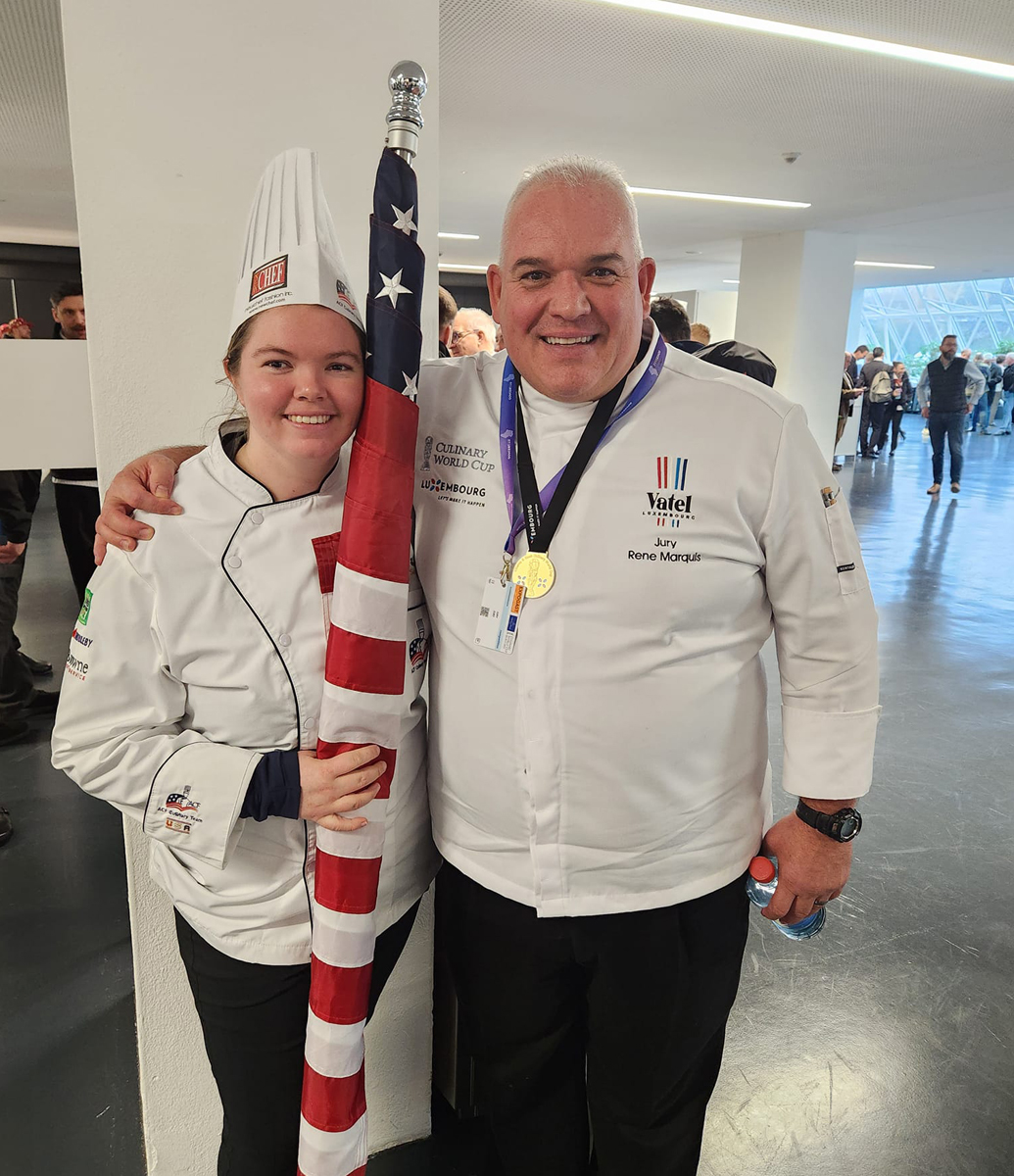
He worked for that general for two and a half years until the general retired. Rene enjoyed his Army career. Throughout his 21-year career as an Army chef, he worked for eight different generals. As a CIA student, Rene never dreamed he would one day compete in the Culinary Olympics and the Culinary World Cup. As an Army chef, Rene was a member of four culinary teams that competed in two Culinary Olympics and two Culinary World Cup competitions. Overall, they won 17 Gold Medals and 16 Silver Medals.

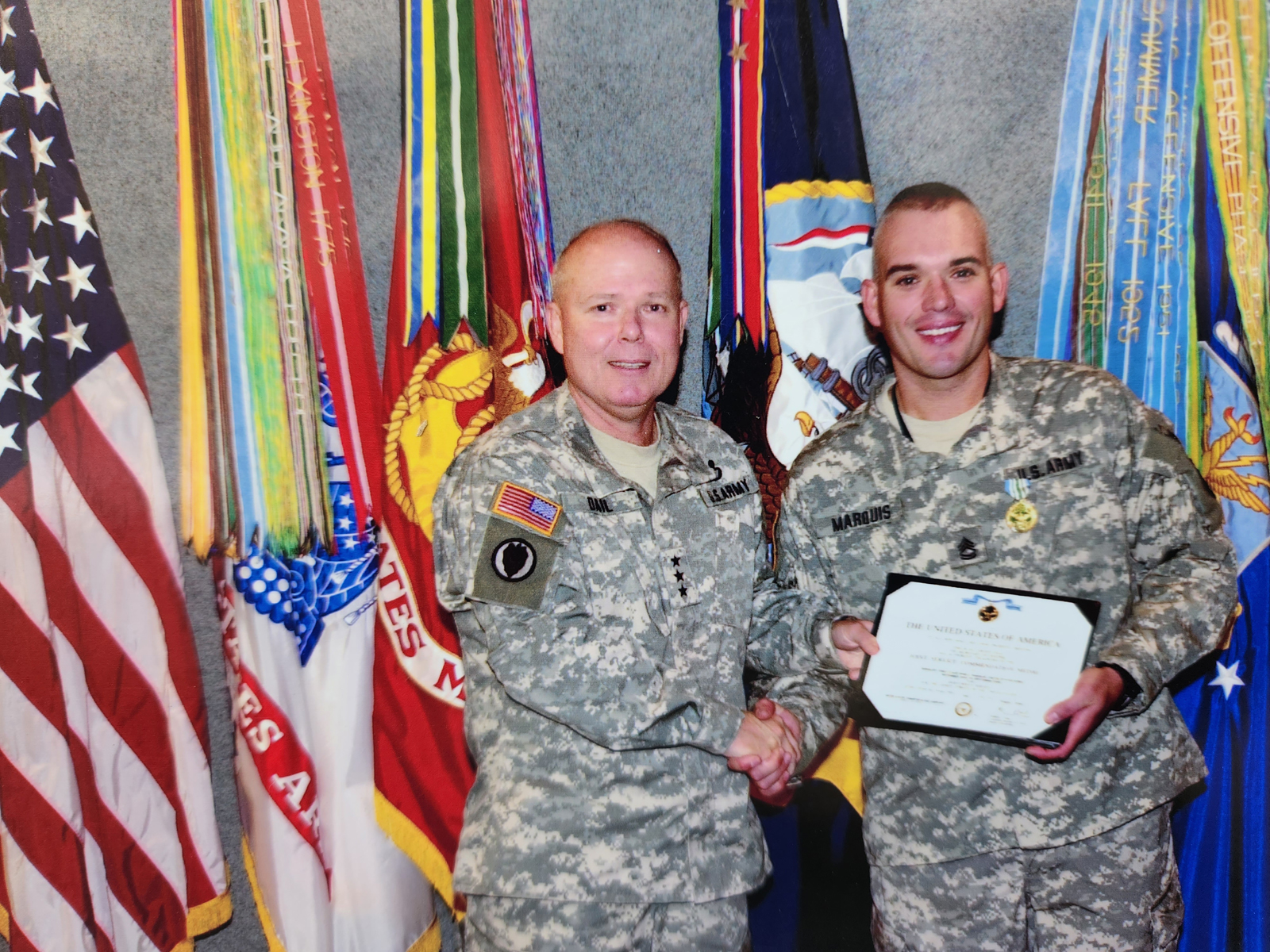
LTG Dale presents Chef Marquis with an award. (Photo: Courtesy of Chef Marquis)

“It was not only great representing my country as a soldier but I was also afforded the opportunity to represent my country as a soldier and a chef,” he said.

In the early 1990s when Rene was recruited, the Army was in the process of upgrading their food service for both officers and enlisted soldiers.

“When I first joined 32 years ago, dining halls were called Mess Halls. And they were a mess! It was like Beetle Bailey – using a metal tray and slopping food onto it. Through the years and historically through the Army especially, the Army changed all of its dining to be like restaurants you would be competing against in the civilian world,” Rene said. Army chefs were instructed to prepare food similar to fare being offered in restaurants such as Ruby Tuesday, Cracker Barrel and Applebees to name a few.

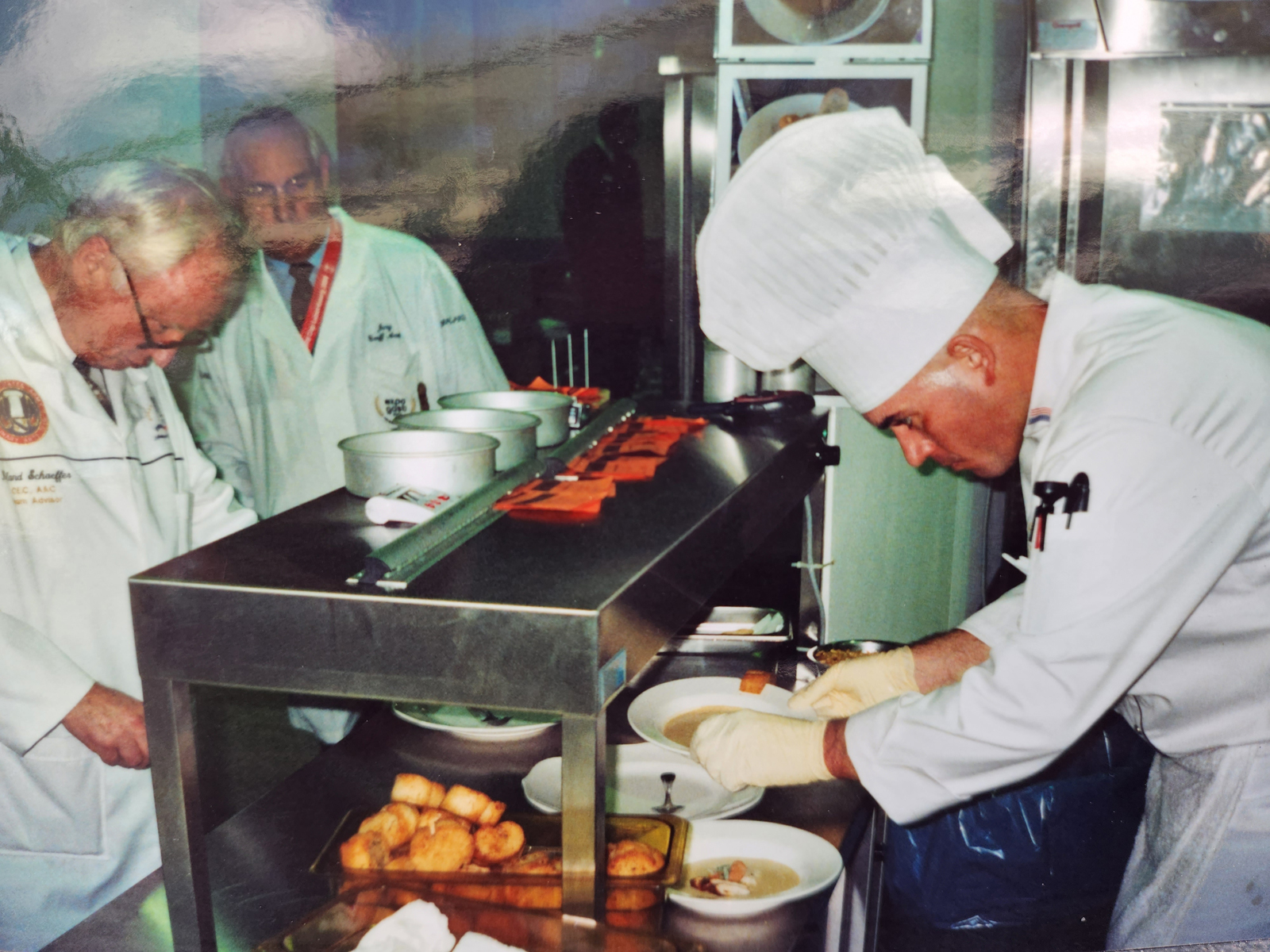
Chef Rene, right, at the Culinary Olympics with Chef Roland Schaeffer, left. (Photo: Courtesy of Chef Marquis)

The new rationale was mutually beneficial.

“The Army moves on its belly and food is the number one morale booster of any service member who is deployed. If you’re eating good food, you’re a happy force,” he added. And at bases in the United States, soldiers can save a lot of money by eating at the dining halls instead of restaurants off base.

Rene explained the U.S. Coast Guard is now upgrading their food service seeking civilian expertise by offering enlistees with a culinary degree or extensive culinary experience a $50,000 signing bonus. “It’s a lot of money for enlisting for three years.”

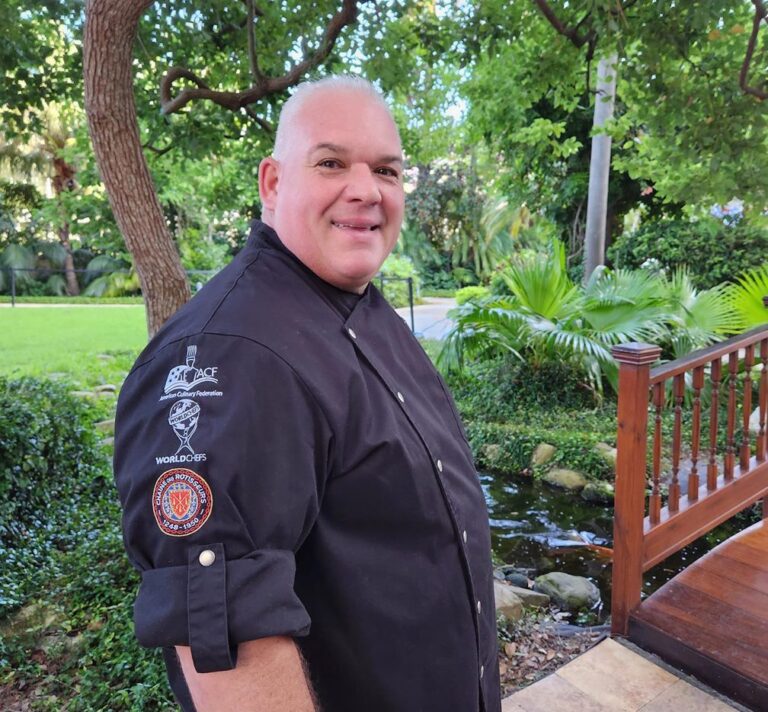
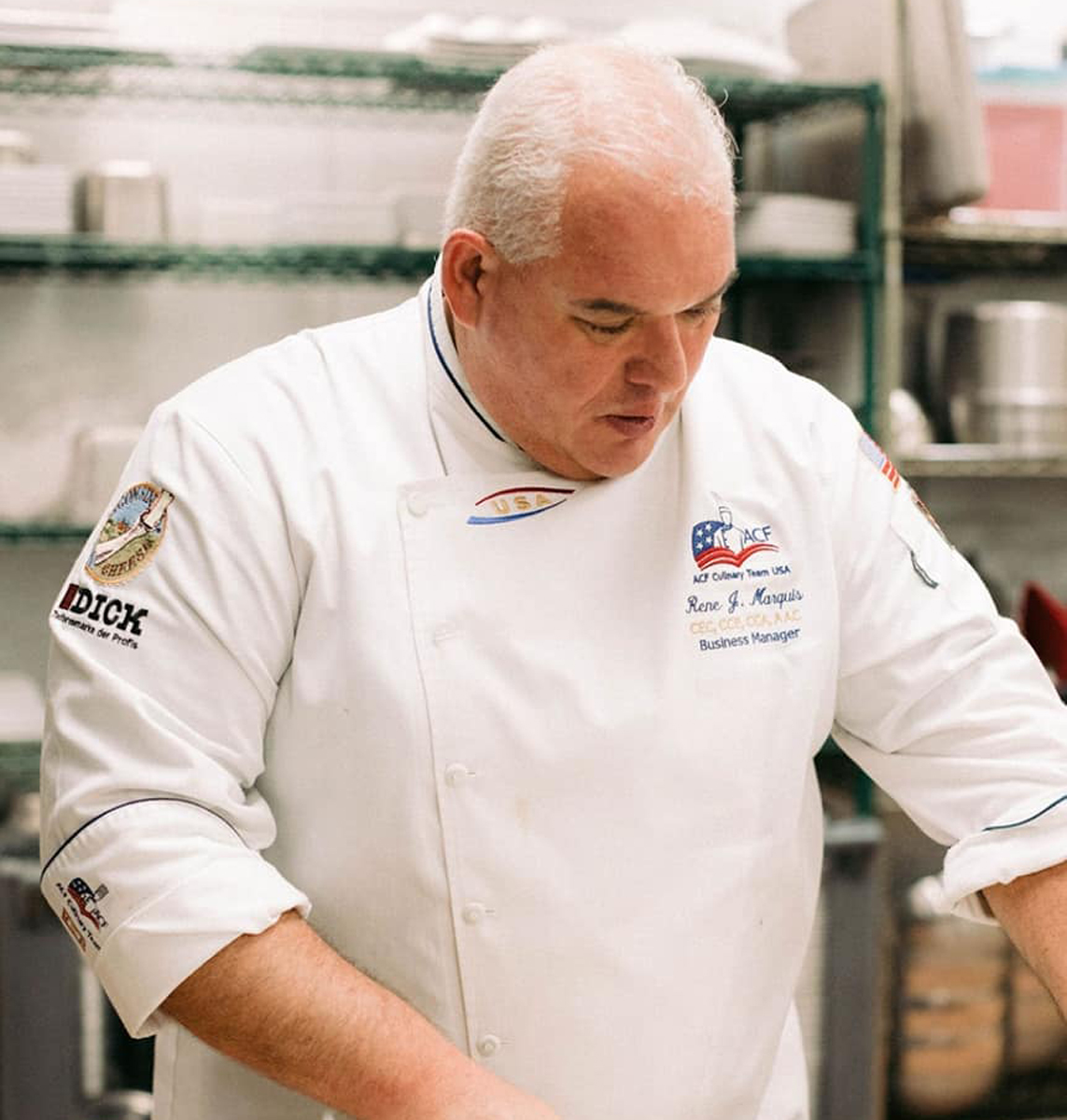
Chef Rene Marquis (Photo: Courtesy of Chef Marquis)


ACF and Land O’Lakes

In 2013, Chef Marquis retired from the U.S. Army with the rank of Master Sergeant. But he is busier than ever today basically holding down two full time jobs, one as Corporate Executive Chef for Land O’Lakes and since 2023, the National ACF President. Rene said he likes to tell people: “I am a corporate chef by day and an ACF volunteer by night.”

Founded in 1921 by 320 dairy farmers as the Minnesota Cooperative Creameries Association, Land O’Lakes was the first company to make butter from fresh, sweet cream and sell it in individually wrapped sticks as opposed to making it from sour cream and selling it in tubs, according to information on the Land O’Lakes website. Today more than 1,000 farmer-owners are part of the cooperative. Rene travels each week around the country for his job with Land O’Lakes. “I am responsible to show companies and restaurants how to use Land O’Lakes products to make their food better than it already is. The foods we produce are the best of the best. You start with the best ingredients, you end up with the best dishes,” Rene said.

National ACF President

The Land O’Lakes team was excited when ACF members elected Rene in 2023 as their new National President and they are very supportive.

An ACF member for more than 30 years, Rene took the national reins with deep knowledge of the organization from his experience as the Tampa Bay Chapter President. Under his tenure, he significantly grew membership and the number of volunteers. As National ACF President, he is looking to do the same and guide the organization of 14,000 members into the future.

“ACF is the authority of cooking in America and with the current leadership and current Board, we’re taking this organization back to what it used to be, a very successful organization run by the members for the members,” Rene said. He is the first ACF National President with military experience.

Members of ACF Tampa Bay making the Guinness World Record for Largest Cuban Sandwich. (Photo: Courtesy of Chef Marquis)

One of the first changes he implemented was to bring ACF culinary competitions and the national convention together under one roof. “It’s great to have a 3-ring circus but if the rings are in different tents, you don’t get to see what’s happening in the rings.” In addition, in Phoenix recently for the 2024 National Convention, all presenters were ACF members so attendees and presenters were on the same page, understanding in detail what was important to members.

In a post pandemic environment, it is more important than ever to be aware of the headwinds facing the industry. Every chef not only lives it daily but also works tirelessly to overcome challenges that remain. Rene sees signs the industry, even fine dining, is bouncing back. But if it was up to Rene, take out meals, delivered to homes in paper bags, would go away forever, a practice that gained traction during the pandemic, especially among young adults, and is still pervasive today. “This generation is fine eating out of a brown paper bag that is being delivered by a driver. I, myself – that’s not acceptable.”

Chef Rene Marquis with a student member of the ACF Tampa Bay Chapter. (Photo: Courtesy of Chef Marquis)
Chef Rene Marquis with a Team USA Youth Member at the Culinary World Cup in Luxembourg. (Photo: Courtesy of Chef Marquis)


He offers food for thought. Even though the driver is merely delivering the food, he or she is still handling it without any training. Is the driver’s car free of dog and cat hair? Has the driver sampled any of the french fries? How long has the food been in the car? “The only companies that have mastered delivering food, in my opinion, are pizza places and Chinese restaurants,” Rene said.

One of ACF’s core functions is chef certification and training, a service for customers and employers alike that speaks volumes about chefs’ qualifications. Rene offers a good analogy about why chef certification is so important. “I wouldn’t go to a doctor that didn’t have a M.D. after their name to get a heart transplant. So when you think about going to a restaurant that has an ACF certified chef, you assume they’ve met all the criteria that comes with that.” While many businesses dropped certification requirements during the pandemic, Rene said more and more employers are now making that a condition for employment. The Army cannot mandate ACF culinary certification but military chefs who earn certification on their own put themselves on an easier path to promotion.

Enrollment in culinary schools is also rebounding although Rene explained that so many schools closed during the pandemic, enrollment is up in schools still open but overall, the number of students entering culinary schools has decreased from pre-pandemic levels. And the nature of students’ culinary expectations has certainly changed, one of the challenges facing the industry. As many seasoned chefs comment, today’s culinary graduates want instant gratification, a large salary, and to be their own boss – or better yet, the next Food Network star straight out of the gate.

Students at Keiser University get ready for the Jeunes Chefs Rôtisseurs competition with instructions from Chef Marquis. (Photo: Courtesy of Chef Marquis)

Another of Rene’s pet peeves in the post pandemic world is the hesitancy of customers to order a $30 entrée while they think nothing of purchasing two, $15 items from a food truck. “And they are still hungry after their food truck meal,” he added.

Younger generations are looking for dining out to be an experience. They are interested in seeing their Caesar salad made tableside or their meal prepared in front of them as many Japanese steakhouses do. Rene said for an extra fee, some restaurants offer a mise en place feature, bringing out a cart of all of the ingredients in the dish the customer ordered. Young customers are also interested in learning about wine pairings. While serving in the Army, Rene selected all of the wines for the generals, a task with which he was comfortable because of his CIA education.

He advises people not to fall into traps of wine cliches. “I serve plenty of red wine with chicken,” he said. He selects wines based on the accompaniments, flavor profiles and sauces in the dish. One of his favorite chicken dishes is the French classic, Chicken Chasseur or Hunter’s chicken. He does not hesitate to serve a merlot or pinot noir with it for a delicious pairing.

ACF Task Forces

Guiding the ACF nationally with a new format for their convention while implementing a course correction for the organization has kept Rene very busy but he definitely must have burned a lot of midnight oil last year. He led an initiative to establish 13 new Task Forces to focus on specific areas. He is particularly proud of the new ACF Asian Chefs Alliance Task Force, chaired by Chef Kenny Tang. Chefs specializing in all types of Asian cuisine now have a hub for information on certification training and the certification process itself.

Liberty Manor, the Veterans home in Tampa Bay that the Tampa Bay ACF Chapter adopted and help feed each month. (Photo: Courtesy of Chef Marquis)

Rene also stood up a Military Task Force, a first for the ACF. Because of the nature of military service with frequent deployments and base changes, military chefs historically have not been a part of the organization but that will now change as ACF reaches out to them with a “boots on the ground” approach. Jeffrey Phillips, a retired two-star general, is the chair. More chefs in white toques, white jackets and camouflage pants will be a trendsetting look on bases worldwide no doubt!

The 11 other new ACF Task Forces Rene established are:

1. Baking & Pastry
2. Chapter Compliance
3. Chapters Supporting Chapters
4. Diversity & Inclusion
5. Finance & Investment
6. L. Edwin Brown Award
7. Strategic Relations
8. Chef & Child
9. ACFEF Knowledge Bowl
10. Women in Culinary Arts
11. Senior Living Chefs

Rene’s email inbox is likely a nonstop flow of requests and replies as he leads the charge for the ACF into the future with energy, enthusiasm and military precision. That will be his pace for the next few years, a pace he heartily embraces because he is helping ACF members advance their careers and his corporate clients serve great tasting food.

Upon his second and third professional retirements, he should think about writing his autobiography!

Links
American Culinary Federation (ACF)
Culinary Institute of America (CIA) Hyde Park, New York
Land O’Lakes

Kazim Gürel, Turkish Tastes Ambassador: Turkish Cuisine is Global Cuisine

Sept. 6, 2024 – Rewind history to the dawn of the 19th century and stop there. Imagine the lively discussions emanating from coffeehouses in Izmir, Türkiye, a city on the Aegean Sea that was one terminus of the Silk Road centuries before, and in London, England, the seat of the British government that recently lost their American colonies when colonists rebelled against taxes, including import taxes on tea. In 1803, the new American government sent Meriwether Lewis and William Clark on an westward expedition to explore a water route to the Pacific Ocean for commerce. The coffeehouse buzz in London, Izmir and Istanbul surely included anticipation of new trade opportunities with the nascent nation thousands of miles away across the Atlantic Ocean.

Visitors to Boston can tour the Boston Tea Party Museum that has a replica of an 18th century trade ship docked in Boston Harbor. (Photo: CMiller/Used with permission)

In western Türkiye, farmers have been growing olives and edible plants for thousands of years. As the capital of the Aegean Province, Izmir, located in the far west of Türkiye, was, and remains to this day, a center of the global spice trade. Pepper, cinnamon and cloves fueled the industry historically. Today Türkiye is the world’s largest producer of Oregano and bay leaves (Laurel).

Turkish products – olive oil, olives, figs and spices – promoted by Turkish Tastes. (Photo: Chaîne)

This economic juggernaut is as important to the country in the 21st century as it was more than 200 years ago. But those products only scratch the surface of Türkiye’s agricultural might. After studying the American culinary industry, in 2019, the Aegean Exporters’ Assembly launched Turkish Tastes, a public-private sector partnership, with a mission to educate both industry professionals and consumers about the rich history and diversity of Turkish food products that form the foundation of every global cuisine. “Many people when they think of Turkish food, they think of camels and kebabs. There’s a lot more to it than that,” Maître Rôtisseur Kazim Gürel, Turkish Tastes Ambassador, said to Chaîne during a July 24, 2024 interview via Zoom.

Türkiye

Map of Türkiye with Istanbul and Izmir circled in red. (CIA World Factbook/Public Domain/RET graphic addition)

A little larger in size than the state of Texas, Türkiye is located on two continents with much of its land in western Asia and a small percentage in southeastern Europe. Istanbul, Türkiye’s largest city, has land on both continents. The country’s unique geography provides a natural bridge for trade, commerce and agriculture between the two continents and the rest of the world. Abundant water resources, access to the Mediterranean Sea, the Aegean Sea and the Black Sea, fertile soil, and a temperate climate across seven geographic regions converge to set ideal conditions to grow olives, grapes, cherries, apricots, almonds, figs, hazelnuts, many other fruits and vegetables, and plants for spices. Olives have been grown and olive oil pressed from olives in Türkiye for thousands of years. Every Turkish meal includes olives in some form.

Many fruits and nuts favored by millions of Americans can trace their origin to Türkiye. Kazim explained that the Thompson seedless grape grown on thousands of acres in California today is a Turkish West Coast indigenous grape cultivar. Cherries and almonds originated in Türkiye and thankfully, found their way to farms and orchards in California and other states. Apricots and figs also originated in Türkiye. “We are by far the largest producer of figs, apricots and hazelnuts,” Kazim said. California and Türkiye share a similar climate with mild, wet winters and warm, dry summers, ideal conditions for growing bountiful fruits and vegetables.

Dried figs, apricots and nut mix (Photo: CMiller/Used with permission)

Turkish Tastes Ambassador

Kazim Gürel in a field of sage plants in Albania, which is the main supplier of sage around the world and the source for Turkiye’s supply to the U.S. breakfast sausage industry. (Photo: Courtesy of Turkish Tastes)

Kazim began his role as the Turkish Tastes Ambassador on a Wednesday afternoon in 2021 as the COVID pandemic was coming to an end. Taking a call in his Izmir office, Kazim was asked to speak at an upcoming meeting at the University of Nevada Las Vegas (UNLV) William F. Harrah College of Hospitality, a Turkish Tastes partner. He soon realized the request was to speak that Friday. “Are you nuts? That’s two days time,” Kazim said followed by an immediate commitment to be there. After quickly arranging a few other meetings, he was off to Los Angeles and Las Vegas, about 6,700 miles from Izmir. “It was fun. We met Dean Shoemaker who was very receptive.”

Kazim was surprised to learn that more money is spent on food and entertainment in Las Vegas than on gambling. “Well, that’s an interesting way to start,” he said.

The Turkish Tastes program with UNLV began a year earlier. “The whole program was basically to create awareness in the United States that for example, Türkiye is a very large producer of Sea Bass. We produce over $1.5 billion of Sea Bass. People don’t know that in America,” he added.

Through the Turkish Tastes collaboration, UNLV students take a course on Turkish cuisine, culture and history, which are inextricably linked to understand the irrevocable bonds Turkish farmers today have with their ancestors and the integral role Turkish agriculture has had for thousands of years in Turkish society. Small family farms still dominate the industry.

The gate of the sultan at the Dolmabahce Palace in Istanbul. Built between 1843 and 1856, the Palace served as the main administrative center of the Ottoman Empire. (Photo: CIA World Factbook/Public Domain)

Kazim explained the vast Ottoman Empire that governed Türkiye for hundreds of years extended from Vienna to Türkiye to eastern Europe, the Middle East, up to the border with India, and into North Africa. “So we have amazing interactions between those countries and Türkiye. Türkiye not only gave from our culture and cuisine but we took from their culture and cuisine. Hence, Türkiye has become a very, very important center and one of the three world cuisines, apart from China and France. A lot of the cultures you would know in Southern Europe, Greece, Lebanon, the Middle East actually have a lot of their roots in the original Turkish/Ottoman cuisine,” he said.

Iconic Turkish spices include saffron, sumac, basil, Oregano and bay leaves (Photo: CMiller/Used with permission)

That cuisine is known worldwide today as the Mediterranean diet, a healthy, delicious range of dishes prepared primarily with olive oil, spices such as Oregano, Laurel (bay leaves), and meat, fish, fruits and vegetables. For a splash of indulgence, classic Turkish meals end with a milk-based dessert or the iconic baklava pastry.

Turkish Tastes divides their educational efforts to raise awareness of Turkish cuisine beyond kebabs into six general categories. Those are:

    1. Seafood and Animal Products
    2. Cereals, Pulses and Oil Seeds
    3. Herbs and Spices
    4. Fresh and Processed Fruits and Vegetables
    5. Olives and Olive Oil
    6. Dried Fruits and Nuts

Outreach to High School Culinary Students Through ProStart

In addition to support at the college level, Turkish Tastes is a partner with the Nevada Restaurant Association, which sponsors the state’s ProStart program for high school culinary students. Kazim visits classes, always beginning by telling students he is from Turkey and asking if anyone knows where it is. “There is absolute silence,” he said. After finding Türkiye on a map, he shows them different types of apricots from a dark organic variety to the iconic yellow/orange fruit. Stories from history engage students. One of Kazim’s favorite tales he tells students is the story of a Turkish dish called, The Empress Loved It.

Istanbul, Türkiye (Photo: CIA World Factbook/Public Domain)

In the mid 1800s, the Ottoman sultan Abdulaziz visited Napoleon III and his wife, Eugenie, in Paris. The sultan reciprocated by inviting the couple to be his guests in Istanbul. When the Suez Canal opened in 1869, Eugenie represented the French government at the ceremony and then traveled to Istanbul to visit the sultan. To honor her visit, the sultan’s chef and Eugenie’s personal chef collaborated on a dish fusing their specialties of roasted eggplant with a French béchamel sauce for the base and then topping it with meat. The meal was such a success, the dish to this day is called, The Empress Loved It. “The kids love that story,” Kazim said.

After seeing students excited to learn about Turkish cuisine and culture, Kazim developed many other outreach programs for industry professionals and consumers in the United States. Turkish Tastes has produced two informational cookbooks to help professional chefs and home cooks explore and taste Turkish cuisine.

Informational cookbooks by Turkish Tastes (Photo: CMiller/Used with permission)

Kazim also invited three well known American chefs to each spend one week with him in Türkiye where he traveled with them to highlight a myriad of farms and factories growing, producing and exporting Turkish food products. “They were all blown away and now they’ve become Ambassadors of our food in the United States,” Kazim said.

From left: Kazim Gürel, Turkish Tastes Ambassador, and Conseiller Culinaire des États-Unis Reimund Pitz (Photo: Courtesy of Turkish Tastes)

Chef Reimund Pitz, CEC, CCE, AAC, WCMC, Conseiller Culinaire des États-Unis, was one of the three chefs Kazim invited to Türkiye.

About his visit and collaboration with Turkish Tastes, Chef Pitz said:

“It’s an absolute pleasure to come here and visit manufacturers from all industries of Turkish Tastes from poultry to herbs and spices to olive and olive oil to dried fruits and all others. We shouldn’t say that we are going to introduce Turkish products to the world market. Rather, we should say that we are going to ‘reintroduce’ to the world market. Now I have the privilege to serve as a Turkish Tastes’ International Ambassador. I am still in the process of sampling all of the great products I received while on my journey in Türkiye. We always think we have tasted the best, but I can honestly say the products I have received so far from Türkiye are absolutely incredible.” (Turkish Tastes, A Culinary Reference Book on Türkiye’s Amazing Ingredients, p. 20)

Turkish Tastes is one of two primary sponsors of Chaîne’s Jeunes Chefs Rôtisseurs annual competition, a program to which Chef Pitz has devoted many years to ensure its success.

From left: Chancelier des États Unis Rufus Cressend, Maître Rôtisseur Kazim Gürel and Bailli des États-Unis Bertrand de Boutray at the 2023 Grand Chapitre in Denver. (Photo: Chaîne)

One month ago, Kazim highlighted the chefs’ experiences in Türkiye at a dinner he hosted for 200 people, including 30 to 40 United Nations (UN) Ambassadors, at the Turkish House, part of the UN complex in New York City. The menu was a fusion of American and Turkish food inspired by two chefs who visited Turkiye – Chef Thomas J. Macrina, WCMC, CEC, CCA, AAC, DFS, and Chef Reimund Pitz. Dinner courses were named after places they visited in Türkiye. With the East River behind him and a big screen showing a video of the chefs’ time in Türkiye, Kazim said the event was amazing. “That was a lot of fun.”

From left: Chef Thomas J. Macrina, WCMC, CEC, CCA, AAC, DFS with Kazim Gürel, Turkish Tastes Ambassador. (Photo: Courtesy of Turkish Tastes)
Kazim Gürel and Conseiller Culinaire des États-Unis Reimund Pitz visit a beekeeping operation in Türkiye during Chef Pits’s visit. (Photo: Courtesy of Turkish Tastes)

For the past three years, Turkish Tastes has been a sponsor of the American Culinary Federation (ACF).
“I am delighted to extend my heartfelt appreciation for the invaluable partnership we have forged with Turkish Tastes. Our collaboration has not only enriched the culinary landscape but has also exemplified the spirit of international cooperation with the gastronomic community,” Chef Rene Marquis, CEC, CCE, CCA, AAC, ACE, National ACF President, and Chaîne member,” said. (Turkish Tastes, A Culinary Reference Book on Türkiye’s Amazing Ingredients, p. 18)

From left: Isabella Gürel on the day of her graduation from culinary school in New York and Kazim Gürel, her father. (Photo: Courtesy of Kazim Gürel)
Vice Conseiller Culinaire Honorarie Chef Rene Marquis, his wife Vanessa, Stefanie Gürel, Kazim’s wife, and Kazim Gürel. (Photo: Courtesy of Turkish Tastes)


Consumers

In parallel to their outreach to industry professionals, Turkish Tastes is reaching out to consumers through their work with a small number of independent restaurants on the East Coast, West Coast and Upper Midwest. For one to two months, restaurants will offer a separate Turkish Tastes menu to complement their main menu. That program is rolling out now and into 2025.

For the home cook, it’s educating them about the universality of Turkish ingredients and food. “We don’t care what cuisine you make, you can actually use Turkish food and Turkish ingredients to make any cuisine you want,” Kazim said.

To emphasize this point, Turkish Tastes invited four chefs to each create a course from a different country for a dinner Kazim hosted at Türkiye’s Consul General’s residence in Beverly Hills. “Every ingredient used to make all four courses and different cuisines came from Türkiye, which was amazing to the audience,” he said.

From left: Kazim Gürel, Ayhan Karabulut, Turkish Tastes project coordinator, and Conseiller Culinaire des États-Unis Reimund Pitz. (Photo: Courtesy of Turkish Tastes)
Türkiye is the second largest producer of olive oil in the world. (Photo: CMiller/Used with permission)


As Turkish Tastes begins commercializing Turkish products to American consumers, it will focus on olive oil and dried fruits and then move on to fish and other categories. Türkiye is the second largest producer of olive oil in the world and currently, many private label olive oil is bottled using Turkish olive oil, Kazim said.

Recently, Kazim’s father, who is 92 years old, asked him about his work with Turkish Tastes, wondering what it was he was doing and if he was getting paid. After filling him in on his global travels, he said, “No Dad, they don’t pay me,” to which his Dad then asked if it was a charity. “No Dad, it’s not a charity.” As all parents do, his father worried he had too much on his plate. “Well Dad, it’s good to give back,” Kazim answered.

Family, Gürel Group and Kütas Group

Kazim, 59, was born in Türkiye to a family of tobacco merchants, now in their fifth generation operating that business. “When it’s a multi-generational business, you don’t give it up just because it’s not politically correct,” Kazim said. According to a 2020 estimate published in the CIA World Factbook, about 31 percent of Türkiye’s total population (84 million) use tobacco products so a robust market for tobacco remains in Türkiye and in countries around the world.

Big Ben, the Great Clock of Westminster, in London (Photo: JMiller/Used with permission)

When Kazim was eight years old, he went to boarding school in England and then to a private prep school. Private schools in England are called public schools. “I’m a public schoolboy,” he said. The prep school he attended is steeped in British tradition, noted by Guilds opening schools. His school was founded by the Master of the Company of Grocers of London, a Guild established to maintain the purity of spices and set weights and measures, according to the British Museum. King Henry VI conferred a Royal Charter to the Guild in 1428.

One could say it was destiny for Kazim to pursue the career he did.

After completing his university education, he enrolled in an International MBA program that started in Switzerland at the University of Geneva. From there, he completed an internship in London at a bank and an insurance company followed by courses in the United States at Stanford and Berkeley. To gain experience in Asia, the final phase of the program took place in Japan and Hong Kong. Back in Geneva, he presented his thesis and graduated.

He decided to return to Türkiye to work in the family business. About one year later, his uncle launched a new business growing and selling bay leaves. He asked Kazim if he was interested in joining him. “I started working in that company with three to four people. Now we have 1,500 people and 14 different businesses,” Kazim said. That company is The Kütas Group, the food division of the family’s Gürel Group, the umbrella family company that includes its tobacco business as well as endeavors in automotive, finance, real estate and other investments.

With a motto of “Pure Integrity – From Field to Fork,” Kütas provides 50 percent of worldwide demand for pure Oregano; produces 16 varieties of organic spices; and processes 20 varieties of conventional spices. Impressively, 65 ovens are used to dry its Laurel, the world’s largest and most sustainable Laurel leaves drying operation, according to the company brochure. The leaves are also steam sterilized, as are many other spices the company processes, to ensure clean and ready-to-eat products.

Turkish spices – poppy seed, cumin, ISOT pepper, and rosemary (Photo: CMiller/Used with permission)


Kütas supplies Oregano and sage to major food and restaurant brands in the United States, a testament to the global reach of Kazim’s family spice business and the integral role Türkiye has in the global spice business.

Turkish Coffee being poured from a copper cezve
Turkish coffee being poured from a copper cezve (Photo by Müslüm Bayburs, via Wikipedia Commons, Eaeeae, CC BY-SA 3.0)

Kazim encourages Americans to visit Türkiye, particularly Izmir and the surrounding area. “We have an amazing wine trail of 18 to 20 vineyards that people can drive through and visit, a bit like the Napa Valley of the Aegean, shall we say,” he said. In that region, there are three Michelin-starred restaurants within a five-minute drive of one another. “These places are cooking incredibly innovative dishes. The lamb in Türkiye, for example, is to die for, the best lamb I’ve ever had is from Türkiye.” He attributes its taste to short-tailed lamb farmers raise in Türkiye as opposed to long-tailed lamb from New Zealand that is exported to many countries.

“I think people will be blown away if they come to Türkiye with the breadth of scenery and breadth of food, a gastronomic tour of great restaurants, different every night. You would be amazed,” he said.

And don’t forget to enjoy a cup of Turkish coffee. “The memory of a good cup of Turkish coffee lasts 40 years,” according to a centuries-old Ottoman saying. Following in the footsteps of their ancestors, Turkish business owners might just negotiate some terrific 21st century international trade deals over that cup of coffee!

References

A History of the World in 6 Glasses by Tom Standage (2005)
CIA World Factbook – Türkiye
British Museum – Company of Grocers
Turkish Tastes, A Culinary Reference Book on Türkiye’s Amazing Ingredients

Links

Turkish Tastes
UNLV Harrah College of Hospitality
Nevada Restaurant Association
American Culinary Federation (ACF)

Chef Yono Purnomo Built His American Dream

Aug. 16, 2024 – For six years in the 1970s, Widjiono “Yono” Purnomo began the new year by traveling around the world in 111 days on the SS Rotterdam. On the other 254 days, he was docking at piers in the Netherlands, New York City and port cities in the Caribbean. Born and raised in Indonesia, Yono graduated with an associate degree in hospitality from the Academy Perhotelan Negara in Bandung, the first hospitality/culinary school in Southeast Asia. With credentials, curiosity, and a gregarious personality, he set out on his life adventure when the Holland America Line hired him, one of 6,000 employees they were seeking then to serve the growing popularity of leisure cruises as international transportation took to the skies. That job charted Yono’s course in life that eventually led him to Albany, New York. “I came from far away to change my life in the United States,” Chef Yono, CEC, CFBE, said to Chaîne during an Aug. 9, 2024 telephone interview with Yono and his wife, Donna.

Northeast Conseiller Culinaire Provincial Honoraire Chef Yono Purnomo, CEC, CFBE (Photo: Courtesy of Donna Purnomo)

Holland America Line Hospitality Career

For those who believe in love at first sight, Yono and his wife, Donna, have a version that can aptly be described as “love at first sight and song.” In 1976 on her first night as a passenger on the SS Rotterdam, Donna, with a background in music, theater and elementary education, sang a song at the piano bar in the “Crow’s Nest,” the Ritz Carlton lounge. Working in the lounge, Yono was immediately smitten. Since servers are assigned to tables for the duration of the cruise to build rapport with passengers, Yono cleverly switched assignments to serve Donna’s table. The end of the cruise was the beginning of their courtship as Donna booked several weeklong cruises so they could see each other. She also saw Yono whenever his ship docked in New York City.

SS Rotterdam, Holland America Flagship in the 1970s (Photo: Bertknot from Scarborough, Australia, CC BY-SA 2.0 via via Wikimedia Commons.)

Born and raised in Amsterdam, New York, about 30 miles from Albany, Donna said it was a leap of faith that worked out. Donna and Yono eloped in January 1977 in Southampton, New York but Yono had to return to Jakarta the day after their wedding since his Holland America contract had ended. Thinking it would be about six weeks before he could return, it was six months before Yono was able to rejoin the ship with a 10-month contract. As his final contract was nearing its end in spring 1978, Donna shared the news of her marriage with her family and left Southampton to move back to Amsterdam to make peace. Yono left the ship in May 1978 and moved to Albany where he and Donna began their married life together. “In a bit of an O.Henry-esque twist, I looked into the process of becoming a member of the ship’s entertainment staff as Yono was working on finalizing his departure from the ship for good,” Donna said.

Donna and Yono Purnomo (Photo: Courtesy of Donna Purnomo)

With worldwide hospitality experience, Yono immediately secured a front-of-the-house job at an Albany hotel restaurant, starting on the bottom rung of a career ladder that turned out to be an exceptionally sturdy one with many extensions that over time, soared into the air.

While working at the hotel, he met Jim Rua who owned Casa Verde in Albany. Soon Yono was working for Jim in his dining room, multitasking as a sommelier, a maître’d, and member of the service staff. There he met Dr. Joel Spiro who, along with a group of local gourmands, established Chaine’s Albany Bailliage in 1977. Dr. Spiro served as its first Bailli for the next 18 years.

Dr. Spiro came into Casa Verde with longtime friend and Chaîne member, Michael O’Higgins, who noticed Yono and began speaking Indonesian with him, having learned the language when his father was stationed in Indonesia and Singapore while working for an oil company.

New to the United States, Yono made an immediate connection with Dr. Spiro and eventually the Chaîne des Rôtisseurs. “There’s a lot of almost impossible sounding things that have happened in our lifetime,” Donna said.

Northeast Conseiller Culinaire Provincial Honoraire Chef Yono Purnomo and Concelier des Bailliage des Etas-Unis Honoraire Dr. Joel Spiro. Dr. Spiro passed away on April 27, 2021. The Albany Bailliage held a tribute dinner in his honor at Yono’s on Aug. 8, 2021. (Photo: Chaîne)

From Casa Verde, Yono accepted a job at Albany’s 21 Club restaurant, located in a restored Victorian home. In 1983, Yono and Donna took another leap of faith when they had the opportunity to lease the restaurant and operate it themselves.

“We did it. The first six months were fine. And then one night, my chef tapped me on the shoulder and said if he didn’t get a raise, he was going to quit,” and Yono replied, “Let’s finish the shift and then we can talk.” But the chef said no and walked out the door.

Chef Yono and Donna with family. (Photo: Courtesy of Donna Purnomo)

“This was my expression – Holy S*@!,” Yono recalls. At this pivotal moment, Yono was about to take the first step to elevate his hospitality career into the rarefied air of top tier culinary professionals. Yono knew there was no looking back. Without a scintilla of self pity, his only option was to forge ahead with a confident, positive attitude. “I believe in America. If you dream big, you work hard, God willing, you make it. This is my thinking, my philosophy,” Yono said.

Yono helped his staff finish dinner service. Then he called everyone into the dining room for a meeting after the restaurant closed for the evening. He popped the cork on a bottle of Dom Perignon, thanked them for a job well done, told them his chef quit, and that he would be taking over the kitchen.

At 6 a.m. the next morning, Yono was at the market and by 9 a.m., was in the kitchen cooking. “I never knew how to even boil water. That’s the truth. But I had to do what I had to do,” he said.

Giving new meaning to “on-the-job training,” Yono immersed himself in learning how to excel in the kitchen by studying; seeking out mentors; joining many culinary associations, including the Chaîne des Rôtisseurs in 1984; and following his instinct to add Indonesian spices and ingredients to traditional American dishes. He recalls making an Indonesian rendang sauce for his filet mignon with foie gras, fusing cuisines before anyone was calling it fusion. His customers loved it.

As Yono honed his culinary skills, another crisis occurred in December 1985 when the restaurant went up in flames just before New Year’s Eve. Against all odds and because of an efficient contractor, they reopened six weeks later but the new beginning was short-lived. A New York City investment group bought the building and immediately raised rent to an unrealistic $8,000 per month. Donna and Yono wished them well.

1986 – Yono’s Opens

They had no choice but to start all over again at a new location, adding another extension to their career ladder. With help from a friend, they found an historic building at 289 Hamilton Street. They spent the summer of 1986 cleaning and getting ready to open their new culinary adventure. On Sept. 26, 1986, Yono’s, a fine dining restaurant with 20 tables in the tri-level space, opened for business with 80 percent of their employees from 21 following them.

On July 26, 2022, Chef Purnomo was inducted into the American Culinary Federation’s American Academy of Chefs. (Photo: Courtesy of Donna Purnomo)

In a few weeks, Yono’s will celebrate 38 years in business.

With two young children, Yono and Donna burned the midnight oil in those early years balancing family and business responsibilities. Yet Yono never stopped learning and advancing his skills. In 1989, he decided it was time to take another leap in the culinary industry to earn his chef credential through the American Culinary Federation (ACF) certification program. Yono describes the process of testing for his Certified Executive Chef (CEC) certification as “brutal.” But he made it. He then earned his Certified Food and Beverage Executive (CFBE) credential.

Recognition and awards followed rapidly. He was named the ACF Albany Chef of the Year in 1988. In 1991, he received the Medal of Honor from Les Amis D’Escoffier and an ACF Gold Medal. Yono was now standing on top of his career ladder but never lost sight of those starting as he did on the bottom rung and the importance of giving back to his local community.

In 2006, Yono, Donna, and Dominck, their son who is a sommelier, after having been courted by a developer, relocated Yono’s, and at the same time opened dp, an American Brasserie, in the Downtown Albany Hampton Inn and Suites at 25 Chapel Street.

Chef Yono and Dominick (far left) with their staff outside of Yono’s and dp, an American Brassiere, in downtown Albany, New York. (Photo: Courtesy of Donna Purnomo)

What an honor for Yono and Donna to have the City of Albany name Chapel Street the “Chef Yono & Donna Purnomo Way.”

Chef Yono (Photo: Courtesy of Donna Purnomo)

Mentoring Young Chefs

Mentoring young chefs has been integral to his life as a chef. “You can look like a chef in five minutes. But it takes a lifetime to become one. Being a mentor, a teacher, an advisor – that’s a chef to me,” Yono said.

For years, he has mentored young chefs in Chaîne’s Northeast Province for the Jeunes Chefs Rôtisseurs (JCR) Competition. Two of his students advanced to become JCR national champions and in 2021, Gabrielle O’Neil, who won both the Northeast Province and National Competitions, represented the USA in Paris. Realizing young chefs need financial support, he set up his own Foundation to help students at two schools in the United States – SUNY (State University of New York) Cobleskill and SUNY Schenectady – and at his alma mater in Bangdung, Indonesia. As a longtime Chaîne member, he is proud of Chaîne’s financial support for young chefs so they can afford to travel and compete on the national level.

In 2021, The State University of New York (SUNY) conferred upon Yono an Honorary Degree of Doctor of Humane Letters.

In 2020, The State University of New York awarded Chef Purnomo an Honorary Doctor of Humane Letters but due to the pandemic, it was conferred in 2021. (Photo: Courtesy of Donna Purnomo)

Yono recently returned from Seattle where he was a judge at Chaîne’s 2024 Jeunes Chefs Rôtisseurs Competition.

2024 Jeunes Chefs Rôtisseurs competitors and Chaîne officers –  From left: Conseiller Culinaire des États-Unis Reimund Pitz, Chef Jordan Foster, Chef Sumana Gavvala, Chef Carly Villanueva, Northeast Conseiller Culinaire Provincial Honoraire Chef Yono Purnomo, Chef Roman Nourse, Chef Ma’Chel Campbell, Chef Liam O’Brien, Chef Maribeth Ganiron, and Chancelier des États Unis Rufus Cressend (Photo: Chaîne)

His involvement this year was a testament to his unwavering dedication to his profession even when confronted with some physical limitations as a recent kidney transplant recipient. After one year on dialysis due to kidney failure in 2023, his family and the Albany community rallied to spread the word on social media that Yono, a beloved Albany chef, needed a kidney. The gift of life came in April 2024 when New York Presbyterian Hospital notified him a live donor from the Albany area, who had come forward on his behalf, was a perfect match. Yono had two weeks notice to prepare for transplant surgery.

“For me, I’m so honored and blessed,” Yono said. “I’m doing good. I flew to Seattle.” Still a little tired but always looking on the bright side of things, his daily dose of 43 pills has been reduced to 24 so he is thankful he is recovering well.

2024 JCR Competion Judges: From left, Chef Jay Marshall, Chef Purnomo, Vice Chargé de Missions Orlando William Paul, Chef Mark Wright, Chef Tom Macrina, and Maitre Restaurateur Chef Philip Jones (Photo: Chaîne)

Future of Fine Dining

As positive as Yono’s nature is, he is concerned about the future of fine dining. A perfect storm of fallout from the pandemic with people continuing to work from home, higher food costs, and higher labor costs is making it difficult for many restaurants to stay afloat let alone realize a profit. Finding employees is increasingly becoming difficult as well, Yono explained.

“To me, though education is important, it is not the only factor. If you come to me, I’m not looking at where you graduated from. I want a good attitude and common sense because I cannot change your attitude but I can teach you cooking. Show me, don’t tell me. If you can do what we do here, you’re hired,” he said, adding that some culinarians out of school today want to make $100,000 immediately. “That is unrealistic right out of the gate and must be earned,” Yono said.

He has sage advice for young chefs.

Northeast Conseiller Culinaire Provincial Honoraire Chef Yono Purnomo. (Photo: Courtesy of Donna Purnomo)

“We crawl first. And then we walk. And then we walk faster. And then we can run but it’s impossible to be born and run, right? Don’t think about money first. Think about your career first, your knowledge, your confidence, and then money will come. I did it. Be positive.”

Another storm cloud overhead is the 20 to 25 percent decline in enrollment nationwide in culinary schools. Yono said enrollment was high years ago when celebrity chefs inspired many young men and women to pursue a culinary career but that is not the case today. “Normally, we have the best of the best but now my standards are lower because you can’t get people. It’s a challenge getting qualified people; everybody, it’s not just me. It’s kind of sad,” he said.

Following the 2021 International Jeunes Chefs Rôtisseurs Competition in Paris, Chef Yono traveled through France, Switzerland, Holland and Rome to connect with students. (Photo: Courtesy of Donna Purnomo)

He fondly recalls the old days when men were required to wear a jacket to dine but today, nobody wants to dress up for dinner. Lack of formality is not on anyone’s radar though. Yono boils down success in operating a fine dining restaurant to two basic tenets: 1) Restaurants must be authentic and consistent because customers are very knowledgeable and travel the world, and 2) Service is tantamount because even if the food is not quite 100 percent, customers will come back if the service is excellent. If the food is great and the service inferior, they will often not return.

Even with modern day challenges, opportunity and innovation will always propel young and old alike to excellence and success.

“You have to be ready to take a chance because life is too short. You fail, you get up. You fail, you get up again – as long as you don’t make the same mistake over and over again. We learn from our mistakes. That is the best way to learn,” he said.

From the moment he boarded the SS Rotterdam in the 1970s, Yono’s life adventure has been defined by his internal compass always pointing in a positive direction no matter the adversity. He readily says he is living the American dream and wants others, especially young chefs, to experience it as well.

It may take a Jules Verne adventure for young chefs to break through today but life lessons from Yono will confidently launch them on their own culinary trip around the world – and to the top of their career ladders.

Related Articles from the Albany Bailliage
Here’s to the Best of Men
Joel Spiro – A Life Well Lived

Links

Yono’s
dp, an American Brassiere
SUNY Cobleskill
SUNY Schenectady


Chef Eric Leterc Dedicated to Culinarians and the Chaîne

June 14, 2024 – The phrase “on the job training” implies a skills-based approach to foster competency among novice employees in a wide array of industries, both service and commercial. To Chef Eric Leterc, Bailli of the Kauai/Oahu Bailliage since July 2023 and Executive Chef of The Pacific Club in Honolulu, helping his employees reach their potential at work inherently includes helping them identify their dreams and goals for life. “We have to inspire the younger generation,” Chef Leterc said to Chaîne during an April 24, 2024 telephone interview.

With 22 years as The Pacific Club’s Executive Chef managing a staff of 30 employees, Eric has read his fair share of resumes and interviewed hundreds of candidates seeking employment.

The Pacific Club in Honolulu (Photo: Courtey of Chef Leterc)

As a keen student of human behavior with formal training in a curriculum developed by Dr. John Demartini, Eric recalled a recent interview he conducted with a young woman. He begins his interviews with a simple question for the candidate: “What is your dream?” When he asked her that question, she began crying. She replied: “Oh, you’re the first one who ever asked me that question, who cared about me.” Eric hired her, giving her the opportunity to chart a fulfilling life.

Born and Raised in Annecy, France

Eric was born in Annecy, France, about 85 miles southeast of Lyon, the third largest city in France. About 60 miles east of Annecy is Mont Blanc, the tallest peak in the Alps near Italy and Switzerland. And just a few miles north of Annecy is Geneva, located at the western end of Lake Geneva. Eric explained that one side of Lake Geneva is in France (southern shore) and the other side in Switzerland (northern shore). Restaurants reflect their respective cuisines with classical French cooking in the French area and a more Americanized cuisine in Switzerland, he added.

Passage de l’Île, Annecy, France (Photo by Markus Trienke, CC BY-SA 2.0 via Wikipedia Commons)

When Eric was eight years old, he would bake cakes for his older sisters for their basketball and volleyball games. “For whatever reason, I was interested in cooking and baking,” he said.

In France at age 14, students must decide on a career path. His original goal was to be a cook in France’s Navy but when that did not work out, in 1978 at age 16, he secured a two-year apprenticeship to study Culinary Arts and Classical Cooking at Hôtel du Commerce in Thones, France, about 13 miles east of Annecy. “It was a very nice, small hotel/restaurant. I had a great chef who taught me the basics of cooking,” he said.

There Eric forged the firm foundation upon which he built his career. Following his apprenticeship, he had the opportunity to work at a 5-star hotel and other famous resorts such as Hotel du Cap-Eden-Roc on the French Riviera.

Move to Hawaii

Open to opportunities near and far, in 1990, Eric accepted a position as a chef in Hawaii, thousands of miles and oceans away. Throughout the 1990s he worked at restaurants on different Hawaiian islands establishing deeper roots each year. In 2002, the President and upper management at The Pacific Club, the oldest private social club in Hawaii that was founded in 1851 in Honolulu, recruited him aggressively.

The Pacific Club in Honolulu (Photo: Courtesy of Chef Leterc)

The Club was losing membership because of poor food quality at their restaurant so they chose Eric as the chef who could reverse the decline. He agreed to their offer and has been the Executive Chef there for 22 years and counting. He not only reversed the decline but also opened a new steakhouse in a previously underutilized back bar that has been very popular. “It’s packed almost every night,” Eric said. In addition to multiple restaurants, Eric oversees a large number of banquets, weddings, cocktail receptions and wine dinners held at the Club.

Bailli Executive Chef Eric Leterc at The Pacific Club (Photo: Courtesy of Chef Leterc)

Similar to many chefs trained in France who move to the United States, he came to Hawaii thinking French cuisine was the best in the world so what was popular in France would be popular in Hawaii. But once in Hawaii, he experienced many different types of food from chefs trained around the world in Japan, Vietnam and the Philippines to name a few. “Their food is very good,” Eric said. So he adapted his French cuisine to what customers wanted, seamlessly becoming part of the fusion cuisine trend that is no longer trendy but standard fare at many restaurants in all 50 states.

Asked why he made Hawaii his home after a few years living in the Aloha State, he said, “It was so comfortable, the culture, the food, the people, the opportunities. Everything was great so I stayed.”

In 2003, Eric joined the Chaîne as Chef Rôtisseur in the Kauai-Oahu Bailliage and in 2006, was named Vice Conseiller Culinaire. In 2019, Eric was elevated to Conseiller Culinaire Provincial and in July 2023, took the helm as Bailli of the Kauai-Oahu Bailliage.

Fourteen years ago, Eric became a Signature Chef for Sterling Silver Meat after working with them to ensure high quality meat at The Club. He and other Signature Chefs attend summits to exchange ideas and learn from each other. “It’s good camaraderie, good quality food,” Eric said. In addition, Eric is a member of Les Amis d’Escoffier Society of Hawaii, the Navy League, and the Elks Club Waikiki.

It seems obvious but Eric points out that for food to taste good, whether it’s a steak or tomato soup, core ingredients have to be good. “It’s the quality of the products. It makes a difference,” he added. He can look at the color of produce to evaluate its freshness and determine whether it has been “manipulated.” Produce grown and sold locally is ideal, he advises. And for meat he recommends never cooking a steak well done because its nutrients will be destroyed. “If you have good quality of meat, you don’t need much seasoning.” Eric’s favorite meat seasoning is pepper. “I love pepper flavor.”

Challenges in the Present and Future

Eric is not alone in facing the many challenges wreaking havoc in the culinary industry today. For example, a fellow chef in Honolulu just had to close his restaurant two additional days each week because he could not find staff to operate it.

Conseiller Culinaire et des Professionnels des Etats-Unis Chef Raymond Pitz, Bailli Chef Eric Leterc and contestant Maribeth Ganiron at the 2024 National Jeunes Chefs Rôtisseurs Competition in Seattle.(Photo: Chaine)

Reading resumes is a window into the problem. Eric recently received an application from a chef who stated on his resume his conditions for employment that included every Saturday and Sunday off as well as specific vacation parameters. “That doesn’t work in this business,” Eric said.

Even enrollment in culinary programs in Hawaii is declining, a surprising fact because Hawaii is one of the top tourist destinations in the world. Without large culinary schools in Hawaii, students interested in pursuing a culinary career have programs at two community colleges in which to enroll. And quite bewildering, Eric said last year one college reported just one new student.

It’s a scary situation, he lamented. But that presents an opportunity for the Chaîne to have an influential impact on the future of the industry.

Restaurants are struggling trying to make sure the bottom line on financial statements is in black ink, not just week-to-week, but month-to-month and year-to-year. Restaurants must establish a loyal customer base to flourish but recruiting top chefs and nurturing top talent to become exquisite chefs are difficult tasks in the post pandemic world.

Eric would like to see the Chaîne grow its membership in the United States in the next few years. It’s not just words to him. In addition to his full time job, last year he accepted the Bailli position of the Kauai-Oahu Bailliage so he could do his part to expand membership. He is reaching out to his chef cohort in Honolulu to spread the message that Chaîne is here to support them while also asking them to spread the word within their network about the Chaîne with its mission to foster camaraderie through the pleasures of the table and to support culinary students. It’s a two-way street already paved to last well into the future. “For me, love what you do and do what you love. I’m trying to do my best to bring Chaîne to a different level,” Eric said.

Mentor

Eric has formed a close relationship with faculty and staff at Leeward Community College, part of the University of Hawaii system, where he recruits their culinary students. A couple of years ago he hired Maribeth Ganiron, a 2019 graduate who earned an associate of science degree in culinary arts. She had competed in Chaîne’s 2023 Jeunes Chefs Rôtisseurs competition in Hawaii, finishing second after making a mistake on one of her dishes.

Maribeth Ganiron (Photo: Courtesy of Chef Leterc)

Eric mentored her and urged her to enter the 2024 Hawaii Provincial competition. Five students competed in the spring. Well known Chef Jonathan Misukami, Executive Chef at The Kahala Hotel on Oahu who was born and raised in Maui, was one of the judges. Maribeth earned first place.

After winning the Provincial competition, Eric and Maribeth appeared on Good Morning Hawaii, a local television show.

Chef Leterc recently appeared on Good Morning Hawaii with Maribeth Ganiron who earned first place at the Hawaii Provincial Jeunes Chefs RotisseursC ompetition. (Photo: Courtesy of Chef Leterc)

As a Provincial winner this spring, Maribeth recently represented the Hawaii Province in Seattle where she competed for the national title. “Going to Seattle to compete in the nationals will hopefully allow me to work with ingredients that I am probably not familiar with and really push me to my limits,” Maribeth said in an April 15, 2024 University of Hawaii press release. “Not only can I showcase my talents in places other than Hawaiʻi, but I can use this experience to gain more knowledge that I can use in my career in the future.”

According to the press release, Maribeth credits the Contemporary Cuisine course she took at Leeward, taught by Chef and Assistant Professor Matt Egami, for helping prepare her for the competition.

In Seattle, although Maribeth did not finish in the top two, she won the Best Appetizer award highlighting her culinary talents – and her bright future.

“She is a great worker with a great attitude and a great student. I’m very proud of her,” Eric said before they left for Seattle. Maribeth continues to work for Eric as a Cook III at The Pacific Club.

Whether it’s at The Pacific Club where he motivates his staff to perform at their highest level and helps them identify their dream, or through the Chaîne where he is now leading the charge to guide the Kauai-Oahu Bailliage to a bright future, Chef Eric has earned his accolades through his actions, actions that definitely inspire young culinarians.

“You need to have passion. You need to empower people. That’s what I love to do,” he said.

Links
Good Morning Hawaii segment with Chef Leterc and Maribeth Ganiron
The Pacific Club (Honolulu)

Leeward Community College Culinary Arts

Chef Varin Keokitvon Knows His Way Up and Down a Mountain

May 17, 2024 – To his students at the Seattle Culinary Academy, he is “Chef V.” The V stands for Varin, his first name. But the letter V could just as easily stand for Victory, a victory he engineered himself when his dream of becoming a professional snowboarder hit a snowbank after sustaining an injury on the slopes. Instead of flying down a mountain for a living, he decided to become a chef, methodically climbing the culinary mountain replete with long hours of attending class, studying, practicing, and working to remain in school. In 2009, one of his chef instructors suggested he enter Chaîne’s Jeunes Chefs Rôtisseurs Competition (JCR). “Let me just try it and see. So I did it and somehow I won the local version then the regional version and nationals was in Scottsdale. And I think I was pretty much the underdog,” Maître Rôtisseur Chef Varin Keokitvon, chef instructor at the Seattle Culinary Academy at Seattle Central College, said to Chaîne during an April 30, 2024 telephone interview.

One of his competitors at the 2009 JCR had recently returned from participating in the Culinary Olympics in Germany so Varin had reason to be considered an underdog. But he approached the competition with confidence in his preparation and experience. Coached by Chef John Fischer, CEC, CCE, AAC, HGT, WCMC, who at the time was a chef instructor at Renton Technical College, Chef Varin and Chef John created their formula for success.

Already well known for his expertise in pastry, which is one-third of the cooking competition, Varin worked on not losing any points in the kitchen score in which points are deducted for being messy, not being organized, and/or violating Department of Health guidelines for food safety.

2021 Seattle Induction: From left, Melissa Goodale (Dame de la Chaîne), John Harrison (Chevalier), Queena Cheung (Vice Chargée des Medias Sociaux), Varin Keokitvon (Maître des Rôtisseurs), Debbie Inthapandith, Grant Goodale (Chevalier).

Chef Fisher coached him to hold his own against the other competitors in cooking the first and second courses but then outright win the dessert course because of his pastry ability. Most young chefs struggle with pastry because they are not trained extensively in that area, Varin explained. Chef Fisher also helped Varin understand what the judges would be looking for as they evaluated him. His underdog status did not last long as the competition commenced. Reflecting on his success, Varin said, “I think it was partly from my work ethic and partly from coaching.”

No doubt his work ethic came from his upbringing in a loving family who instilled that value in him at a young age.

Family

Born in 1984 in Vientiane, Laos, Varin and his family – his parents, grandparents and older brother – emigrated to the United States in 1986 from Thailand. They had fled to Thailand from Laos shortly after his father escaped from a Laotian POW camp in 1984 where he has been a prisoner of war for eight years.

Pha That Luang, the Great Stupa in Vientiane, considered a national symbol of Laos includes many references to Lao culture and identity in its architecture. It was built in the 16th century. (Photo: CIA World Factbook)
Laos Map (CIA World Factbook)

Varin’s father was a bomber pilot for the Royal Lao Air Force during the Vietnam War, fighting as an ally of the United States. In 1976 as the war was coming to an end, he was captured and sent to a “re-education” camp. Fluent in five languages, eventually he earned privileges that gave him the opportunity to escape. Once free, he found his family in Laos and because he was certain the government would be looking for him, he moved his family to Thailand where he applied to emigrate to the United States to live in Seattle.
While many chefs report being inspired as a young child by cooking with their parents or grandparents, Varin said he wasn’t really interested in cooking as a young boy. Rather, “it was something I had to do to help out.” His mom and dad were always working so his grandmother raised him. He recalls entire weekend days being set aside to prepare egg rolls or make Vietnamese crepes (Banh Xeo). “I did not like it because all of my friends would be playing outside.”

But upon reflection, especially after entering the culinary profession, Varin is glad for the time he spent in the kitchen with his grandmother. “Now looking back, I think about that rich experience and how it helped me understand food a little more. And how wonderful it was to have those times to connect and to have those memories.”

He has vivid memories of being introduced to new foods, foods that he thought were very strange. Blue cheese leads that category for him as dairy is not a part of Laotian and Southeast Asian cuisine. “To find out blue cheese is milk from a cow that we decided to add this mold to, leave it out for three months, and now we’re going to eat it, was very odd to me,” he said. It’s a story he tells his students to this day as he asks them to tell him about the strangest food they have ever eaten.

Growing up in what he describes as a tough neighborhood, Varin said his father made certain that he and his brother attended good schools through a public school program that bused students to more affluent neighborhoods with better schools. Although the schools were better, Varin said there are always some bad influences regardless of the school. “Experiences in high school – some are bad, some are good but you always learn from them.”

In his senior year, he took a Home Economics class at Roosevelt High, which he failed. With his mind set on becoming a professional snowboarder, he would skip classes and admits to probably not putting in his best effort in the class. Ironically, he just hosted the 2023/2024 Roosevelt High Home Economics class at the Seattle Culinary Academy, immediately connecting with the students by telling them his story. What an inspiring and motivational role model Varin is for teenagers deciding on career paths today!

Snowboarding

After graduating, Varin announced to his father that he was moving to Stevens Pass (elevation: 4,061 feet) in the Cascade Mountains near the border of King County and Chelan County in Washington state to become a professional snowboarder. “I’m going to work there, live there, and get really good at this,” he told his father. Varin said he attributes his competitive nature to his father who still competes in badminton tournaments. “He’s pretty good,” Varin added.

Stevens Pass in Washington state – elevation 4,061 feet. (Photo: Delaney Adrian)

To support himself to practice his sport at Stevens Pass, he smartly deduced the best place to work would be at a restaurant where he would be fed. So he snowboarded all day and worked at restaurants in the evening.

Stevens Pass in Washington state (Photo: Delaney Adrian)

The first snowboarding season went smoothly. But then he hit a figurative snowbank his second year. “I got injured in the second season. Oh man, if I can’t ride and have to take off two weeks to heal, maybe I need a backup plan just in case,” he thought. Emphasis on pastry in the culinary arts was just starting to gain attention as a new area of expertise. “I had always remembered loving food and loved pastry. Maybe I’d like to do that one day.”

Culinary Career

Fortunately, one of his friends was studying culinary arts at North Seattle College. He told Varin, “You should come down here and do this because it’s pretty amazing.” So he did, leaving his snowboard dreams on a mountain pass.

Debbie Inthapandith and her husband, Varin Keokitvon (Maître des Rôtisseurs) US National Champion of Jeune Chef Rotisseurs Competition 2009. (Photo: Chaîne)

Back in Seattle, Varin’s instinct to try culinary school was spot on. “I ended up liking it and being really good at it.” After graduating from the two-year program he worked for a couple of years but his drive to push himself as far as he could go led him back to school to earn a degree in culinary arts and to specialize in pastry at Seattle Culinary Academy, part of Seattle Central College. Refining his skills working at restaurants while going to school made him the perfect candidate to enter the 2009 JCR competition.

On the heels of winning the 2009 JCR, Varin was awarded the 2010 Vilcek Prize for Creative Promise in Culinary Arts. Each year the Vilcek Foundation awards monetary prizes in two fields – the arts and biomedical engineering. In 2010, culinary arts was the focus for the arts category.

With two prestigious awards, Varin said a lot of doors opened, including the Spanish Embassy. The Ambassador of Spain to the United States invited Varin to participate in a trade commission program in Spain as one of 24 chefs from around the world learning Spanish culture, language, food products and cuisine. So it was off to Spain instead of France where he had planned to hone his skills in pastry. International success followed. “I was selected for El Celler de Can Roca, third best in the world that year,” Varin said.

Seattle Culinary Academy Logo (Courtesy SCA)

Living in Spain for about 10 months, when he returned to the United States, he took a job as Executive Chef at FareStart, a nonprofit founded in 1992 to feed homeless and disadvantaged adults. He worked there until 2014 when the E3 Restaurant Group recruited him to be the Executive Chef at Heartwood Provisions, a new restaurant concept.

There he developed his management skills setting high standards for his staff but being flexible, to a point, with schedules to give them a healthy work-life balance. He told his staff: “I’ll give you any day off you want but when the time comes – if it’s New Year’s Eve, I need everyone, all hands on deck. I don’t care what’s going on. No one gets that day off.” His style paid off. “Provide a lot of respect and support for people. You gain their respect and they pay it right back.”

Chef Instructor

In 2019, he left E3 to join the faculty at the Seattle Culinary Academy, returning to his alma mater to teach and mentor young culinarians. He could never have known it when he made this career decision but just a few months later, the pandemic hit and Heartwood Provisions was forced to close, never to reopen.

Chef Varin Keokitvon (Photo: Courtesy of Seattle Culinary Academy)

During the pandemic, the Academy only closed for the 2020 spring semester, returning to campus fully opened for summer 2020, albeit with many safety precautions in place. But that environment was still preferable to having students take lab classes virtually, Varin said.

Their culinary program is a lockstep one so that students progress along a defined trajectory first taking an introductory course in food service basics. Students who pass that course then take Varin’s course – Introduction to Cooking, a course that requires students to prepare eight to 12 plates daily that are served to staff and students for lunch. Varin does not believe that course could ever work virtually.

Chef Varin is a chef instructor at the Seattle Culinary Academy. (Photo: Courtesy of the Seattle Culinary Academy)

“I already have students nodding off in class because it starts at 7:30 a.m.. I can’t imagine them being on Zoom and doing that,” he said.

Seattle is no different than hundreds of other cities where restaurants are constantly looking to hire staff. Varin fields many requests from chefs but his focus is on preparing his students for long term success in the industry by career planning with them. He has noticed their student body is younger now with about 15 percent coming directly from high school. “That’s what I did too, besides the two-year hiatus trying to live on a mountain,” Varin said with a chuckle.

While snowboarding and culinary careers may seem light years apart, both provide immediate feedback and most important, joy. “The thing I love about our industry is it’s so rewarding and immediate. The moment you put the plate in front of someone, they can either hate it or love it but it’s immediate, nourishing, and something that is a connection,” he said.

Does Varin still snowboard in his spare time? “I put down the board and picked up a rod, mostly recreational fishing for salmon, trout and steelhead,” he said. Recently he was fishing on the Yakima River. He loves living in the beautiful Pacific Northwest. He and his wife are parents of a three-month-old daughter whom he is excited to take places to show her the beauty of the area.

Varin is now paying it forward by mentoring young chefs entering JCR competitions. He is thankful for the many opportunities that came his way because of it and believes competing not only develops great culinarians but also leaders for the world. For three years in a row, he has coached the student who won the Pacific Northwest Provincial JCR competition. At the upcoming 2024 JCR competition in Seattle, Varin’s student will again compete for the national title. The Seattle Culinary Academy will host the Welcome Reception and the Turkish Taste One Pot Competition on Friday, June 7 and on Saturday, June 8, Renton Technical College will host the JCR Competition and Gala Dinner.

Chef Varin instructs his students in the kitchen. (Photo: Courtesy of the Seattle Culinary Academy)

Laser focused on the real world, Varin views technology as both a blessing and a curse. On the positive side, his students can pull up videos on demand to watch master chefs flawlessly perform culinary techniques. But he said technology can also be a curse when it impedes students from experiencing the real world. Noting a personal story, he said his wife’s eight-year-old nephew would rather watch someone online playing a video game than playing the online game himself. “This is insane,” Varin said. “I just care about life skills – how to feed yourself, how to be on time. Those are giant in my book,” he said.

Chef Varin seasons a dish prepared by his students. (Photo: Courtesy of the Seattle Culinary Academy)

And for his students, he can easily tell if they have been practicing in the real world as opposed to merely watching videos. “If you don’t put the time in, you don’t get good at it. It’s one of the cool things about cooking. It’s immediate. We can tell if you’re not good,” he said.

Given the pervasive force of technology in all aspects of life today, nurturing young students to live – and work – in the real world is another mountain to climb but having climbed and conquered that mountain himself, Varin is uniquely qualified to guide the next generation. What a ride he is offering them!

Links
Seattle Culinary Academy
Vilcek Foundation